
Qualcomm is betting big on spatial AI with its recently announced Snapdragon Reality Elite platform, aiming to fuse high-performance on-device AI with premium optics and power efficiency [1]. The move is the next step in the arms race for spatial computing dominance, presumably pitting Qualcomm against Apple, Meta, and NVIDIA in a contest that will be won not just by hardware, but by who owns the developer mindshare and AI ecosystem.
What is Covered in this Article
- Snapdragon Reality Elite’s technical leap and its implications for mixed reality devices
- The strategic contest for spatial AI platform leadership
- Why on-device AI is emerging as the new battleground
- Critical execution risks and ecosystem questions facing Qualcomm and its rivals
The News: Qualcomm recently unveiled the Snapdragon Reality Elite platform, designed to push spatial computing into the AI era by enabling immersive mixed-reality experiences. With its reported 48 TOPS of on-device AI processing, Reality Elite can run both large vision models and large language models directly on-device, promising longer battery life, sleeker form factors, and more accurate hand and head tracking [1].
The platform will debut in XREAL’s Project Aura, with a focus on high-performance video-see-through and improved optical fidelity. Qualcomm positions Reality Elite as the engine for the next generation of Android XR devices, targeting premium AR and MR segments. With this launch, Qualcomm is not just iterating on hardware; it is aiming to redefine the spatial computing stack by making AI-native capabilities foundational rather than optional.
Qualcomm’s Snapdragon Reality Elite Ups the Stakes for Spatial AI
Analyst Take: Qualcomm’s Snapdragon Reality Elite is a strategic gambit to seize control of spatial computing’s future by embedding AI at the silicon level. But in a market where Apple, Meta, and NVIDIA are all gunning for dominance, the real battle may actually be for developer allegiance and ecosystem gravity rather than just hardware wins.
“XR adoption continues to expand, with more than 60 million devices already in market and growing momentum across industries,” explained Ziad Asghar, Senior Vice President and General Manager of XR, Wearables, and Personal AI. “As more advanced and integrated XR platforms are developed, demand is increasing for XR technologies that deliver higher performance, greater intelligence, and improved power efficiency. Snapdragon Reality Elite is designed to meet those demands with powerful on‑device AI, enabling faster, longer‑lasting, and more immersive experiences, and reinforcing our leadership in VR and MR as we build purpose‑built XR chipsets from the ground up.”
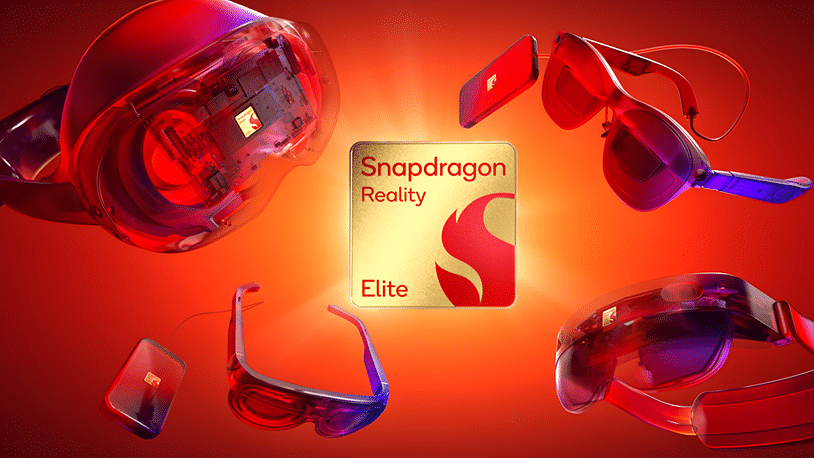
Highlights:
- Snapdragon Reality Elite is designed for immersive, premium mixed reality experiences and enables longer-lasting, sleeker, and cooler devices.
- It is engineered to drive the next wave of spatial GenAI, featuring 48 TOPS of AI processing and can run large vision models (LVMs) and large language models (LLMs) directly on‑device.
- It powers the latest Android XR devices, coming first to XREAL Project Aura, for better optical see-through, improved power efficiency, and better hand and head tracking.
On-Device AI As A Platform Differentiator
Snapdragon Reality Elite’s ability to run large vision and language models directly on-device signals that the spatial computing market is pivoting away from cloud overdependence, as it should. Privacy and latency improvements are core to this shift, with local inference being the key to unlocking new types of immersive, context-aware applications that cannot realistically remain dependent on cloud compute to deliver functional, let alone remarkable UX.
To be clear, the objective is not to run 100% of inference on-device, but rather to run inference workloads that will deliver better utility, value, and UX locally, while continuing to depend on cloud-based compute to handle workloads that must interface with databases and applications that run in the cloud. Two key components of this model are orchestration, which Qualcomm was early to inject into its AI discussions as far back as when live translations first entered the mobile market, and agent-tuned modems, which will increasingly be designed to handle the new complexities of efficient connectivity in usage scenarios requiring sustained, heavy AI orchestration.
The generative XR experiences that the Snapdragon Reality Elite platform is designed to deliver enable everything from photorealistic avatars with Gaussian Splatting and LLM‑based agents to real‑time large vision model (LVM), meaning that the platform drives the kind of object generation that will bring dynamic digital content into the user’s environment. These AI features also allow XR experiences to respond in real time, with greater contextual awareness and more natural interaction. Additionally, Snapdragon Reality Elite enhances head and hand tracking and supports see-through features, helping users engage more seamlessly with both digital content and the world around them.
How Apple Dropped The Ball
Apple has proven with Vision Pro that vertical integration can deliver polish, but mass adoption still depends on third-party innovation, developer enthusiasm, velocity, and, of course, price. And while Apple’s Vision Pro is a fantastic device, the product team seems to have misunderstood the assignment. This, in my view, was a head-scratching miss, particularly given how clear consumer were about their expectations: The ask from Apple’s core market was that Apple would release an XR product akin to the Apple Watch and iPhone – a stylish, Apple-coded everyday set of frames – capable of delivering a mix of familiar features in a novel UX package and a growing portfolio of new gen-over-gen features unlocked by this new form factor.
What the market got instead was a set of extremely expensive mixed reality goggles with limited utility. Not at all the form factor, price, UX, or utility the market was hoping for.
Qualcomm and Meta, meanwhile, realized that while VR and MR headsets had their place in the market – mainly in niche verticals like gaming, engineering and design, manufacturing, and entertainment – the real opportunity for scale was in smart glasses. Early focus on trying to bring some augmented reality to mainstream-adjacent form factors was a bit premature, but what the pivot to “smart glasses” confirmed was that the public was ready for $300 AR glasses “lite,” which prioritized audio, mics, cameras, and voice-enabled commands and AI assistant interactions over augmented reality features. This was the correct entry point and foundation for the category, with the pivot back to AR being predicated on a solid baseline of smart glasses adoption and the refresh cycle driving towards momentum of the all-important “what else can these do?” question from the established user base.
This may be a good time to note that about 3/4 of all smart glasses today are already powered by Qualcomm’s AR IP, and that the partnership between Qualcomm and Meta on this is currently one of the best case studies showing how the right partnerships and the ability to move fast can combine hardware, software, and ecosystem integration to establish leadership and scale early in the consumer market. It also speaks volumes about Qualcomm’s leadership in this domain that Meta, which made considerable investments in its VR and MR capabilities, and even rebranded itself to better align the company with what it called the “metaverse,” opted to power some of its most popular XR products with Snapdragon processors rather than its own hardware.
Back to the point: $300 smart glasses with no AR capabilities were the correct entry point for the category. $4000 MR/VR headsets with pass-through vision and live eye-renderings weren’t. Had Apple not invested so much of its resources in developing the wrong product, and instead developed Apple Glasses comparable to Meta’s, perhaps Meta and Qualcomm would have a bit more competition in this fast-growing, evolving category. Even at $499 or $599, Apple would have quickly eaten into Meta’s market share, likely without the need to split profits with Ray-Ban and Oakley, and would have put pressure on Qualcomm rather than the other way around.
Execution Risks: Power, Supply Chain, and the AI Software Stack
So long as Qualcomm and its partners focus on turning smart glasses into useful, remarkable, must-have agentic glasses, and don’t prematurely pivot to AR functionality, adoption rates should remain healthy. Qualcomm’s release of the Snapdragon Reality Elite now, however, paves the way for partners and developers to spend the next year building demand for AR glasses by addressing the gaps that continue to plague the category.
The danger for Qualcomm and for the AR category here is if eager partners like Meta don’t learn from the mistakes that have kept spatial computing from taking off for the past decade: The most important lesson here is that unless a new technology solves major problems for users, or creates remarkable new experiences for them that continue to create value beyond two weeks of use, mainstream consumers will simply not invest in it at scale. They will wait.
In other words, jumping the gun with AR when the real killer apps for the next year (at least) are 1) agentic functionality and 2) all-day wearability, would be a terrible error. (Remember the old saying: Just because you can doesn’t mean you should.) Even if the hardware is ready, unless the software and broader ecosystem are ready as well, you simply don’t have a complete product to take to market. This is the lesson that the XR category teaches us year after year after year, and one that the AI PC category also echoes, albeit not quite as loudly. My issue isn’t that Qualcomm released such a powerful platform this soon; it is that the ecosystem still needs time to adjust to the blistering velocity of Qualcomm’s IP refreshes.
The good news for Qualcomm is that right now, its low-power (performance per watt) advantage, impressive lead in XR IP, critical ecosystem partnerships (Meta, Samsung, Xiaomi and others), ability to easily tie XR into the Android and Mobile ecosystems, and extensive work in 6G connectivity arm it with a definitive head-start that competitors like NVIDIA, Apple, Google and MediaTek will have a tough time disrupting, This signals to me that 1) Snapdragon Reality Elite is currently the platform to beat in this space, and 2) competition for spatial computing, particularly in the agentic glasses and AR-capable agentic glasses categories, is at least a full calendar year from starting to heat up with credible challengers. The bad news is that I expect AR adoption to continue to disappoint before 6G technologies enable it to become mainstream. Agentic features, not AR, will remain the primary demand driver for the category in the foreseeable future.
What to Watch
- Developer Flywheel: Will Snapdragon Reality Elite attract a critical mass of XR developers by the end of 2027?
- Ecosystem Lock-In: Can Qualcomm prevent Android XR from fragmenting into incompatible forks?
- Supply Chain Strain: Will HBM and component shortages delay device launches or force compromises in 2027?
- AI Stack Interoperability: Will spatial AI apps built for Reality Elite run seamlessly across rival platforms, or will proprietary bottlenecks stall adoption?
- Assistant UX: How will competing AI assistant & agentic platforms like OpenAI, Google, Alexa, and others compete for dominance across the spatial computing ecosystem
Sources
1. Qualcomm Takes Spatial Computing into the AI Era with Snapdragon Reality Elite
Declaration of generative AI and AI-assisted technologies in the writing process: This content has been generated with the support of artificial intelligence technologies. Due to the fast pace of content creation and the continuous evolution of data and information, The Futurum Group and its analysts strive to ensure the accuracy and factual integrity of the information presented. However, the opinions and interpretations expressed in this content reflect those of the individual author/analyst. The Futurum Group makes no guarantees regarding the completeness, accuracy, or reliability of any information contained herein. Readers are encouraged to verify facts independently and consult relevant sources for further clarification.
Disclosure: Futurum is a research and advisory firm that engages or has engaged in research, analysis, and advisory services with many technology companies, including those mentioned in this article. The author does not hold any equity positions with any company mentioned in this article.
Analysis and opinions expressed herein are specific to the analyst individually and data and other information that might have been provided for validation, not those of Futurum as a whole.
Read the full Futurum Group Disclosure.
Other Insights from Futurum:
How Desktop AI Hubs Could Deflect Over 56.23 TWh Of Industrial Data Center …
Qualcomm Q2 FY 2026 Earnings Show Data Center Entry And Auto Strength
Qualcomm’S Snapdragon Wear Elite Redefines The AI Wearable Stakes—But Who Win…
Author Information

Olivier Blanchard is Research Director, Intelligent Devices. He covers edge semiconductors and intelligent AI-capable devices for Futurum. In addition to having co-authored several books about digital transformation and AI with Futurum Group CEO Daniel Newman, Blanchard brings considerable experience demystifying new and emerging technologies, advising clients on how best to future-proof their organizations, and helping maximize the positive impacts of technology disruption while mitigating their potentially negative effects. Follow his extended analysis on X and LinkedIn.