Analyst(s): Mitch Ashley
Publication Date: May 22, 2026
Google I/O 2026 was the moment a hyperscaler shipped across every layer of the AI stack. Futurum examines Antigravity as the runtime, the Hassabis architectural rewrite that anchors it, and the governance reinvention the strategy now requires.
What is Covered in This Article:
- Google announced Antigravity 2.0 at I/O 2026 as a five-surface platform anchored by a single-agent harness, alongside Gemini 3.5 Flash, Managed Agents in the Gemini API, Gemini Spark, AI Studio updates, and agentic capabilities embedded across Search.
- Google and Alphabet CEO Sundar Pichai opened the keynote, framing Antigravity as the cross-product agent runtime, and Google DeepMind CEO Demis Hassabis closed the second day, describing the move as a ground-up rewrite of Google’s engineering stack to be agent-first.
- Read against the Futurum AI Stack framework, Google has shipped across all eight layers in a single event, including a governance layer split across the Antigravity IDE and Gemini Enterprise Agent Platform.
- The keynote held the developer lane, leaving the governance plane underrepresented in the announcement narrative, even where it has shipped.
- Google’s governance plane for the agent runtime is split across the Antigravity IDE and Gemini Enterprise Agent Platform, with new agent-specific primitives shipping, including Agent Identity, Agent Gateway, and Model Armor. The open question is whether these emerging primitives scale to match the runtime they govern.
The News: Google used Google I/O 2026 in Mountain View on May 19 and 20 to push announcements across every layer of the AI stack. Antigravity 2.0 ships as a desktop application, CLI, SDK, Managed Agents tier in the Gemini API, and an enterprise deployment path through Gemini Enterprise. The Antigravity CLI replaces the previous Gemini CLI. Gemini 3.5 Flash launches as the default model, with Gemini 3.5 Pro arriving next month. Gemini Spark moves into trusted tester rollout this week as a 24/7 personal agent, with US Google AI Ultra beta the following week.
The infrastructure layer received an upgrade through Google’s eighth-generation TPU family, with TPU 8p optimized for training and TPU 8i for inference. Google’s developer blog frames the underlying primitive as the “Antigravity agent harness,” delivered through managed agents that ship with a fully provisioned sandbox in a single API call. Google and Alphabet CEO Sundar Pichai opened the keynote, citing capital expenditure of approximately 180 to 190 billion dollars in 2026, roughly six times the 2022 spend. Google DeepMind CEO Demis Hassabis, speaking the following day, described Google’s last year as streamlining the tech stack and “almost rewriting it from the ground up to be AI first and now agent first.” Full developer keynote coverage is available on the Google Developers Blog.
Google I/O: Did Google Just Ship the Full AI Stack?
Analyst Take — The Question Google’s CEOs Bookended: Google and Alphabet CEO Sundar Pichai opened I/O 2026 by putting Antigravity on the main stage as the cross-product agent runtime powering Gemini Spark, agentic Search, and the developer toolchain. Google DeepMind CEO Demis Hassabis closed the second day by describing the underlying move as an engineering-stack rewrite to be AI-first and agent-first. Read together, the two framings ask the same question from opposite ends of the conference: did Google just ship the AI full stack?
The question matters because the answer reframes everything else Google announced. If Antigravity is a developer tool with marketing reach, the cross-product instantiation is a form of positioning. If the Hassabis framing holds and Google has rewritten its engineering substrate to be agent-first, then Antigravity is the visible surface of an architectural commitment that touches every product the company ships.
What the Futurum AI Stack Reveals
The Futurum AI Stack frames the question precisely. Eight layers, two substrates, one control plane. Silicon, Infrastructure, and Models form the compute substrate. The Software Substrate sits above it. Runtime and Governance form the Agent Control Plane. Builder Tools and Apps complete the stack.
Figure 1: Futurum AI Stack
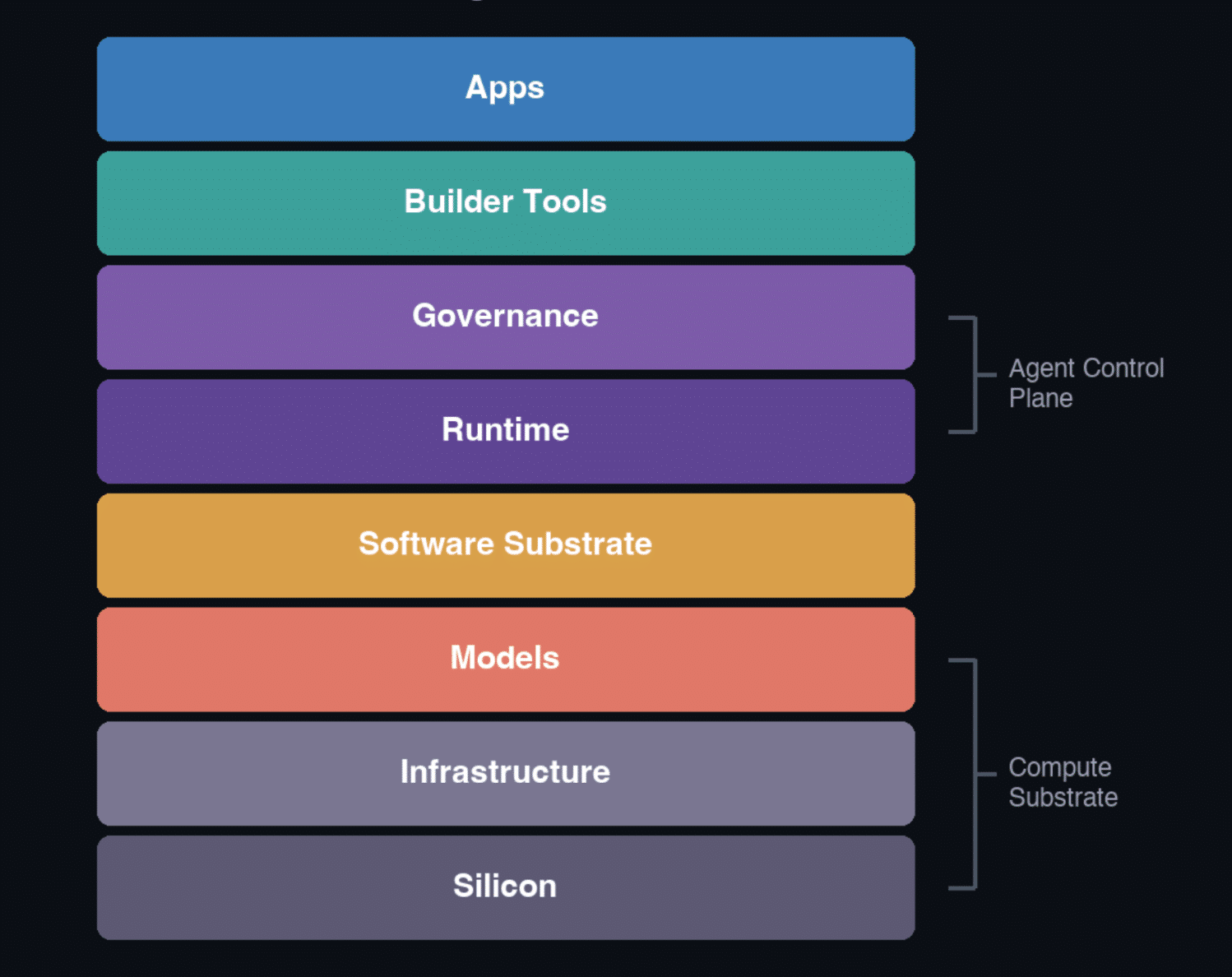
Map Google’s I/O 2026 announcements against the framework, and the pattern is clear. Silicon: TPU 8p and 8i, dual-chip generation. Infrastructure: JAX and pathways orchestrating training across more than one million TPUs globally. Models: Gemini 3.5 Flash, Pro to follow, Omni multimodal family, Gemma 4 open weights. Software Substrate: the Antigravity agent harness primitives, including dynamic subagents, hooks, async tasks, and cron-scheduled jobs. Runtime: Managed Agents in the Gemini API with provisioned sandboxes. Governance: Agent Identity with SPIFFE-based credentials, Agent Gateway, Model Armor, Agent Registry, and the Agent Platform evaluation framework, with credential masking and Git policy hardening at the Antigravity IDE surface. Builder Tools: Antigravity 2.0, CLI, SDK, AI Studio, Android CLI, Chrome DevTools for agents. Apps: Gemini Spark, AI Mode with generative UI, Workspace voice features, Pics, Flow, intelligent eyewear with Samsung and Warby Parker.
The Governance Layer – Split Across Two Surfaces
The governance layer is the part of the stack that the keynote narrative left unclear. Antigravity ships with credential masking, Git policy hardening, and cross-platform terminal sandboxing at the IDE surface. Gemini Enterprise Agent Platform extends the picture with Agent Identity, providing SPIFFE-based cryptographic identity and short-lived X.509 certificates for non-human actors.
Agent Gateway is enforcing access control and Model Armor inspection on agent-to-tool and agent-to-agent traffic, Model Armor providing runtime protection against prompt injection and tool poisoning, Agent Registry persisting agent definitions, and Cloud Trace, Cloud Logging, and OpenTelemetry surfacing immutable traces and evaluation.
These are real Agent Control Plane Layer 2 and Layer 3 primitives. The governance plane is not absent. It is split across the Antigravity IDE and Agent Platform, and the announcement narrative did not unify the picture.
The operational consequence still travels with the strategy. Every builder in an enterprise can now spin up dynamic subagents, schedule them via cron, and connect them through the Managed Agents API to production workloads. Operations, security, and compliance teams inherit that surface and need to know which controls apply where. Agent Identity partially answers identity and delegation across agent chains.
Agent Gateway and Model Armor partially answer policy enforcement that travels with the agent. Cloud Trace and the Agent Platform evaluation framework partially answer audit and evidence generation for asynchronous runs. What remains genuinely open: policy versioning and rollback as first-class lifecycle capabilities, behavior evaluation surfaced in the standalone Managed Agents API rather than only at the platform layer, change governance for cron-deployed agents acting in production, and a unified observability story that does not require enterprises to assemble the picture across documentation surfaces themselves.
The analytical question is not whether Google built a governance plane. It is whether an agent-first engineering rewrite of this magnitude forces an equally substantive reinvention of Google’s security and governance portfolio. Agent Identity with SPIFFE is not a retrofit of conventional identity. Model Armor is not a retrofit of conventional content filtering. These are agent-specific primitives, purpose-built for the new trust model. The open question is whether the reinvention extends coherently across identity, policy, audit, supply chain integrity, and operational control at the scale and velocity of the runtime Google just unified, or arrives piecemeal across product teams. That is the chapter enterprises should expect, and the one Futurum will be watching for.
What to Watch:
- Whether Agent Identity, Agent Gateway, Model Armor, and Agent Registry mature into a unified agent governance surface, or remain a collection of platform-specific primitives that enterprises must integrate themselves.
- Whether AWS, Microsoft, Salesforce, and IBM respond with comparable cross-stack consolidation, or continue operating multiple agent runtimes under distinct brands.
- Customer evidence beyond Google’s internal numbers, including identifiable enterprise references for Antigravity at scale with workload specifics.
- The MCP integration roadmap for Gemini Spark, which exposes the harness to third-party tools and will pressure-test the trust and delegation model in consumer agents first.
- Whether the agent-first engineering rewrite Hassabis described extends into Google’s identity, policy, audit, and supply chain integrity layers as a coherent re-architecture, or arrives piecemeal across product teams.
See the full developer keynote coverage on the Google Developers Blog.
Disclosure: Futurum is a research and advisory firm that engages or has engaged in research, analysis, and advisory services with many technology companies, including those mentioned in this article. The author does not hold any equity positions with any company mentioned in this article.
Analysis and opinions expressed herein are specific to the analyst individually and data and other information that might have been provided for validation, not those of Futurum as a whole.
Other Insights From Futurum:
Bedrock Advanced Prompt Optimization Cuts the Cost of Model Switching
Narrowing the AI Production Gap: Red Hat’s Focus on AI-Assisted Engineering
MuleSoft Omni Gateway: As Close to an Agent Control Plane as It Gets
Red Hat Brings Developers, Product, and Operations to the Center of Agentic AI
Author Information

Mitch Ashley is VP and Practice Lead for the CIO & Technology Buyers and Software Lifecycle Engineering practices at The Futurum Group. A multi-time CIO and CTO with 30+ years leading technical organizations, Mitch built and operated production systems spanning cybersecurity for the U.S. Department of Defense, PKI services for the broadband and 5G industries, SaaS platforms, large-scale telecom and banking systems, and a national broadband network. His work with AI began early, developing expert systems that diagnosed and repaired complex mainframe environments. That operator foundation grounds his analysis in operational consequence, covering the technology buyer's world of software engineering, cybersecurity, DevOps, cloud, and AI.