
Analyst(s): Mitch Ashley
Publication Date: April 29, 2026
Anysphere’s Cursor 3.2 introduces /multitask for async subagent parallelization, expanded worktrees, and multi-root workspaces. Futurum Research reads this as a control plane move that puts Cursor in direct competition with CI/CD vendors and cloud developer environments.
What is Covered in This Article:
- Anysphere released Cursor version 3.2 on April 24, 2026, introducing /multitask, an async subagent capability that parallelizes user requests and breaks larger tasks into smaller chunks for a fleet of subagents to execute simultaneously.
- The release also expands worktrees in the Agents Window for isolated background work across branches and adds multi-root workspaces that let a single agent session target a reusable workspace spanning multiple folders and repositories.
- Cursor’s positioning shifts toward an agent execution runtime, with the editor functioning as a single view within a broader agentic system rather than as the product center.
- The architecture creates direct competitive pressure on CI/CD vendors and cloud developer environment providers, not only on coding assistants.
- Governance and observability gaps widen as parallel subagents fan out across branches and repositories with a limited enterprise control surface.
The News: Anysphere released Cursor version 3.2 on April 24, 2026, introducing /multitask, a feature that lets Cursor’s agent execution runtime spawn async subagents in parallel rather than serializing requests in a queue. The Cursor 3.2 changelog states that with /multitask, Cursor breaks larger tasks into smaller chunks and assigns them to multiple subagents at the same time, and users can redirect already-queued messages to multitask execution instead of waiting for the current run to finish.
The same release expands the worktrees experience in the Agents Window. Users can run isolated background tasks across different branches and promote any branch into the local foreground with one click. Cursor 3.2 also adds multi-root workspaces, which allow a single agent session to target a reusable workspace composed of multiple folders for cross-repository changes spanning frontend, backend, and shared libraries.
These capabilities build on Cursor 2.5’s earlier introduction of async subagents that can spawn child subagents, and on the Cursor 3 Agents Window architecture..
Cursor 3.2 Reframes the IDE as an Agent Execution Runtime
Analyst Take: Cursor 3.2 completes a multi-quarter strategic repositioning. The editor recedes from the product center, and the Agents Window takes its place. /multitask makes that explicit by treating user requests as work to be parallelized across a fleet of subagents rather than typed into a buffer.
Combined with worktrees for branch isolation and multi-root workspaces for cross-repo coordination, Cursor now holds the agent execution runtime claim. This is where agent work executes, gets isolated across branches, and gets reconciled.
Figure 1: Cursor 3.2 Multitask in Agents Window
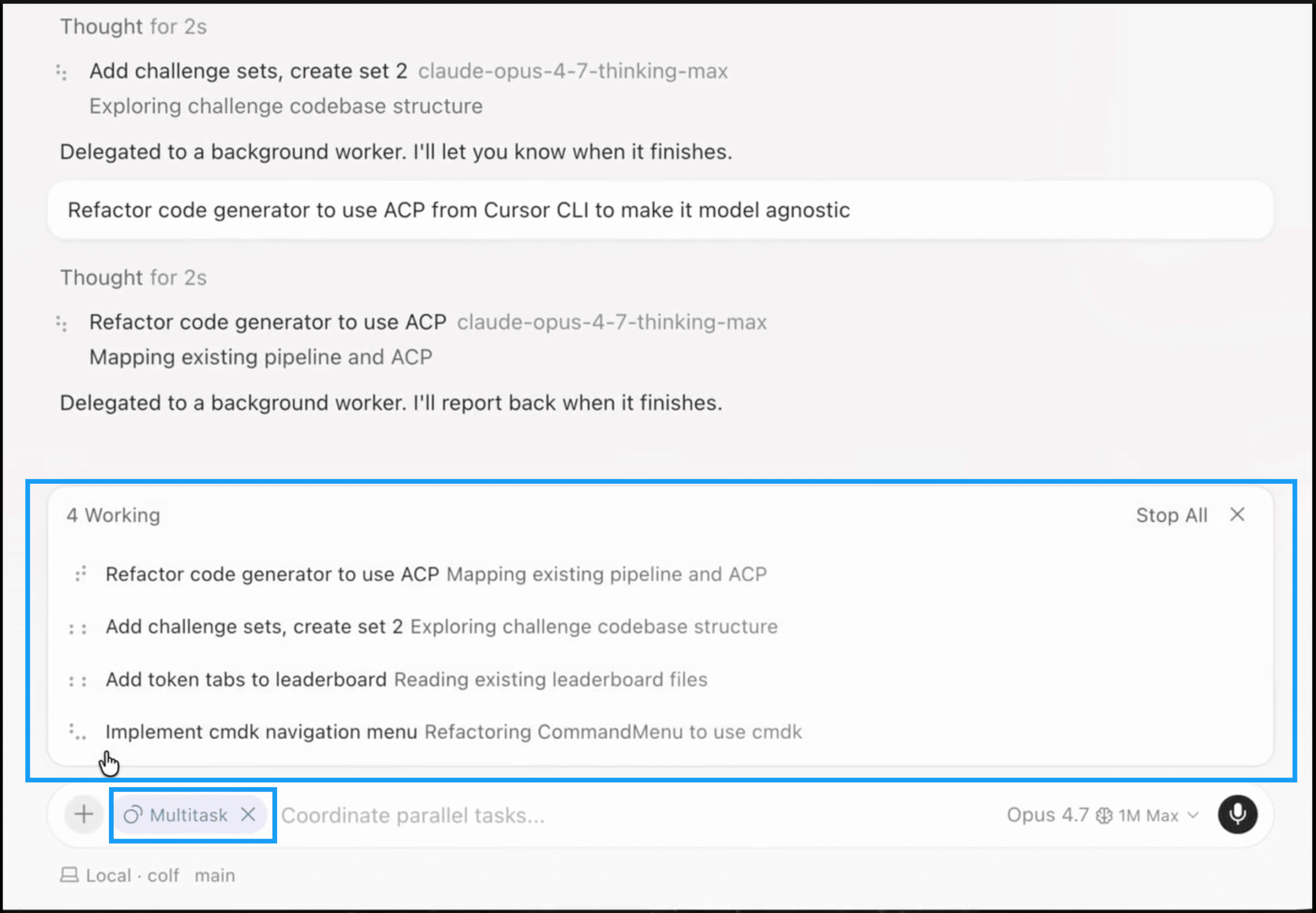
The reframing has practical consequences for how vendors must compete. Cursor is an agent execution runtime with a built-in code surface, and vendors competing on IDE capability alone are mispositioned against it. The IDE category no longer captures what the product does or where its strategic gravity sits.
Direct Pressure on CI/CD and Cloud Dev Environment Vendors
CI/CD vendors built their business on the assumption that automated work runs in the pipeline after human commits arrive. Cursor’s async subagent model relocates large refactors, multi-file features, and complex bug reproductions into the dev runtime, before any pipeline trigger fires. The pipeline still runs build and test, but the cognitive heavy lift moves left into Cursor’s agent execution runtime.
Figure 2: Reframing Cursor as the Agent Execution Runtime
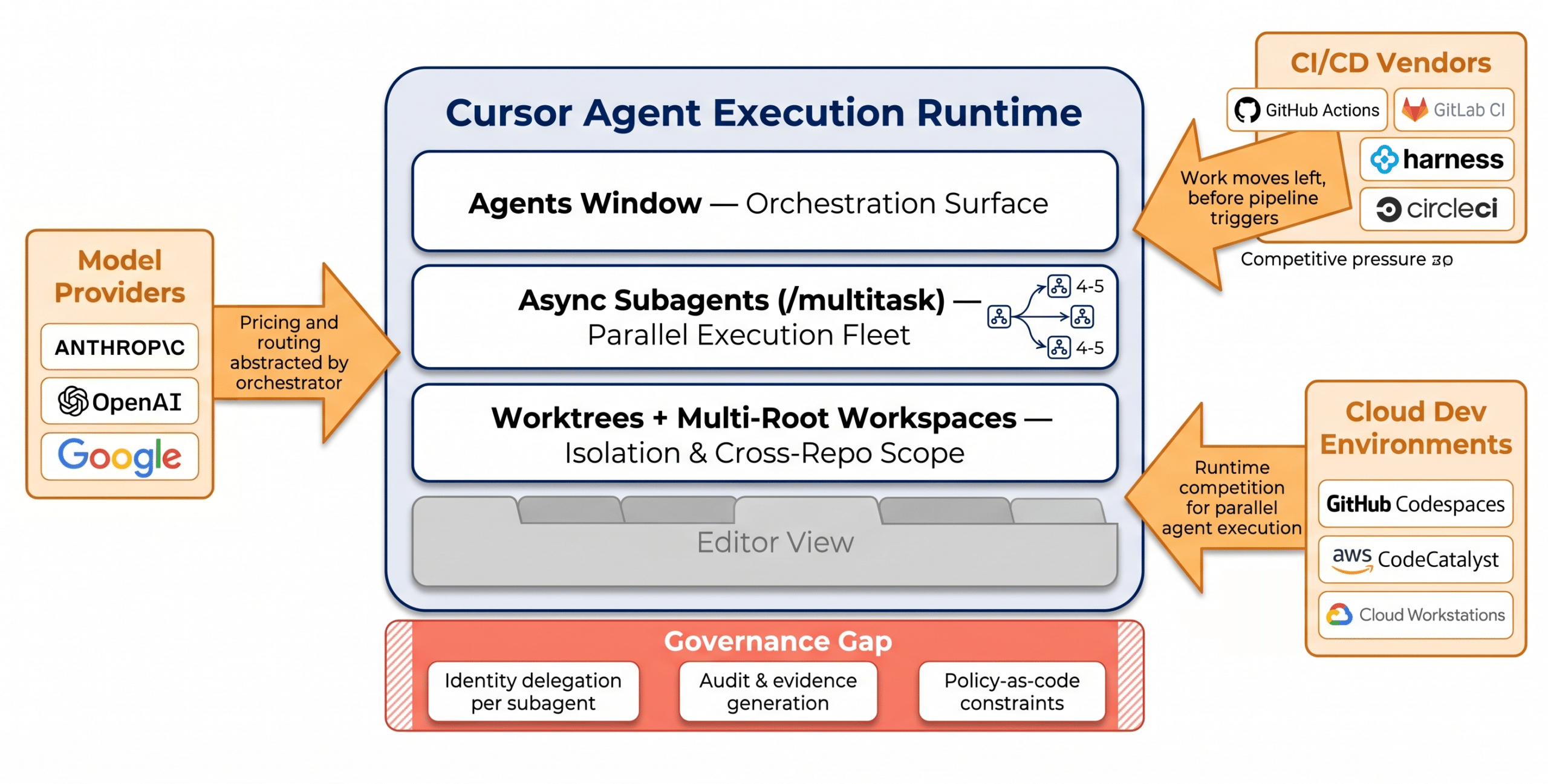
If Cursor’s approach here bears fruit, Harness, GitLab, CircleCI, and GitHub Actions now need a credible answer for what their offering contributes when a fleet of agents pre-resolves much of the work the pipeline used to mediate.
Cloud developer environment providers face a parallel problem. AWS CodeCatalyst, GitHub Codespaces, and Google Cloud Workstations sell the dev environment as a cloud service. Cursor’s self-hosted cloud agents and Agents Window architecture pitch the same value (parallel work across environments, branch isolation, remote execution) packaged inside the developer’s primary tool. The cloud dev environment vendors will need to articulate why their environment is the right place for agent work when Cursor is the orchestrator developers already use.
Model providers sit in a more ambiguous position. They benefit from Cursor’s volume but lose pricing leverage as Cursor’s billing model abstracts the underlying API. A current Cursor forum bug report describes /multitask routing through Cursor plan usage instead of users’ Anthropic API keys, which signals where pricing control is consolidating.
Governance Gaps Widen With Subagent Fan-Out
The strategic shift creates a control problem Cursor has not yet fully addressed. Each subagent is an actor with credentials, file system access, and (depending on configuration) network reach. Sandbox network controls landed in Cursor 2.5, which is a start. Enterprise governance demands more: identity delegation per subagent, audit trails of what each agent touched, evidence generation for change review, and policy-as-code constraints on subagent behavior.
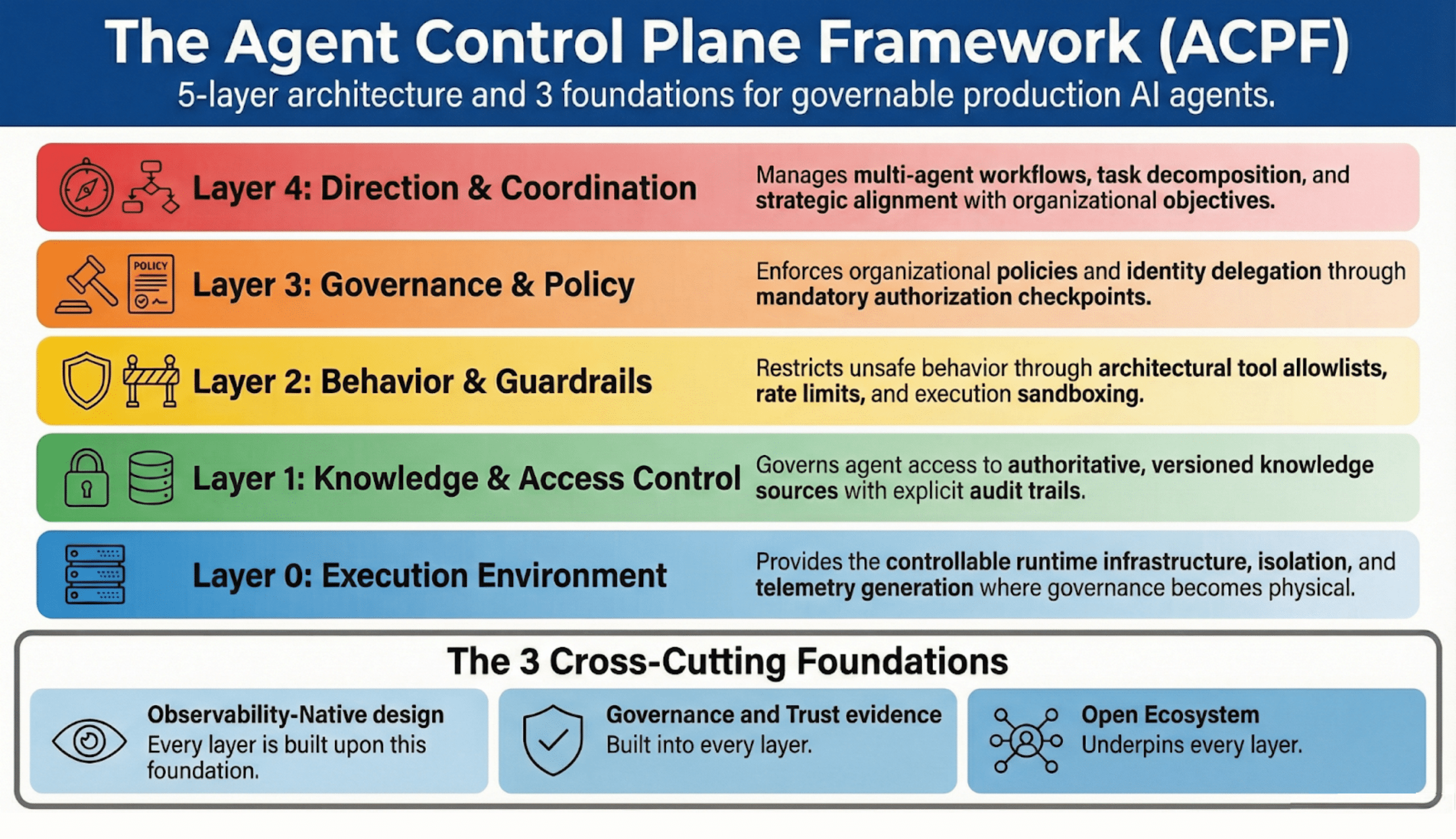
The Futurum Agent Control Plane Framework (Figure 1) treats those obligations as Layer 2 and Layer 3 responsibilities. Cursor’s current architecture concentrates them inside a single vertically integrated runtime rather than exposing them as a governable plane. Code review and pull request workflows built for human throughput also break under machine-speed output. Reviewers cannot meaningfully evaluate parallel changes from multiple subagents at the cadence Cursor’s runtime can produce them.
Figure 3: Agent Control Plan Framework
Strategic Implications – What Vendors Must Decide
Three vendor populations now face choices. CI/CD vendors must decide whether to extend upstream into the dev runtime or accept a narrower role downstream of agent fan-out. Cloud dev environment providers must decide whether to compete with Cursor’s agent execution runtime or integrate beneath it. Platform vendors building agent control planes must decide whether Cursor is a partner that surfaces governance hooks or a closed orchestrator that requires alternative entry points. Cursor 3.2 sharpens that question rather than settling it.
What to Watch:
- Whether GitHub Actions, GitLab, Harness, and CircleCI extend their offerings upstream into the dev runtime to recapture work that now executes inside Cursor before pipelines trigger. Expect responses positioned as “agent-aware CI” within two release cycles.
- How AWS, Google Cloud, and Microsoft respond with paired cloud dev environment and agent runtime offerings, particularly whether Codespaces and CodeCatalyst gain native parallel agent dispatch comparable to /multitask.
- Cursor’s enterprise governance roadmap: identity delegation per subagent, audit and evidence generation, and policy enforcement that maps to enterprise change governance and supply chain integrity requirements.
- Whether Anthropic and OpenAI build counter-leverage by partnering with rival orchestrators or surfacing subagent control planes that bypass Cursor’s billing abstraction.
- The reconciliation problem: which vendor builds the review-and-merge layer that lets human reviewers govern fleet output without becoming the bottleneck?
Read the full Cursor 3.2 announcement and Cursor 3.2 release notes for more information.
Disclosure: Futurum is a research and advisory firm that engages or has engaged in research, analysis, and advisory services with many technology companies, including those mentioned in this article. The author does not hold any equity positions with any company mentioned in this article.
Analysis and opinions expressed herein are specific to the analyst individually and data and other information that might have been provided for validation, not those of Futurum as a whole.
Other Insights From Futurum:
Salesforce Agent API Signals the Next Control Plane Battleground for AI Agents
Futurum Agent Control Plane Framework: A Reference Model for Production AI Agents
SUSECON 2026 – Big Bet On MCP and Partners for Infrastructure AI Operations
Author Information

Mitch Ashley is VP and Practice Lead for the CIO & Technology Buyers and Software Lifecycle Engineering practices at The Futurum Group. A multi-time CIO and CTO with 30+ years leading technical organizations, Mitch built and operated production systems spanning cybersecurity for the U.S. Department of Defense, PKI services for the broadband and 5G industries, SaaS platforms, large-scale telecom and banking systems, and a national broadband network. His work with AI began early, developing expert systems that diagnosed and repaired complex mainframe environments. That operator foundation grounds his analysis in operational consequence, covering the technology buyer's world of software engineering, cybersecurity, DevOps, cloud, and AI.