
Austin, Texas, USA, December 4, 2025
Futurum’s 1H25 Cybersecurity Decision Maker Study Reveals the Delicate Balance Between Operational Control and User Experience
Recent findings from Futurum’s 1H25 Cybersecurity Decision Maker study highlight the evolving complexity of endpoint security. As the network perimeter continues to dissolve, the endpoint remains a critical battleground. However, the data reveals that success is not solely dependent on threat detection; it relies heavily on navigating organizational ownership structures and minimizing friction for end-users.
IT Operations Leads Endpoint Ownership, Requiring Strong Security Oversight
The study uncovers a distinct trend regarding who actually “owns” endpoint security within the enterprise. While the Chief Information Security Officer (CISO) and their team may set the strategy, the operational reality is often different.
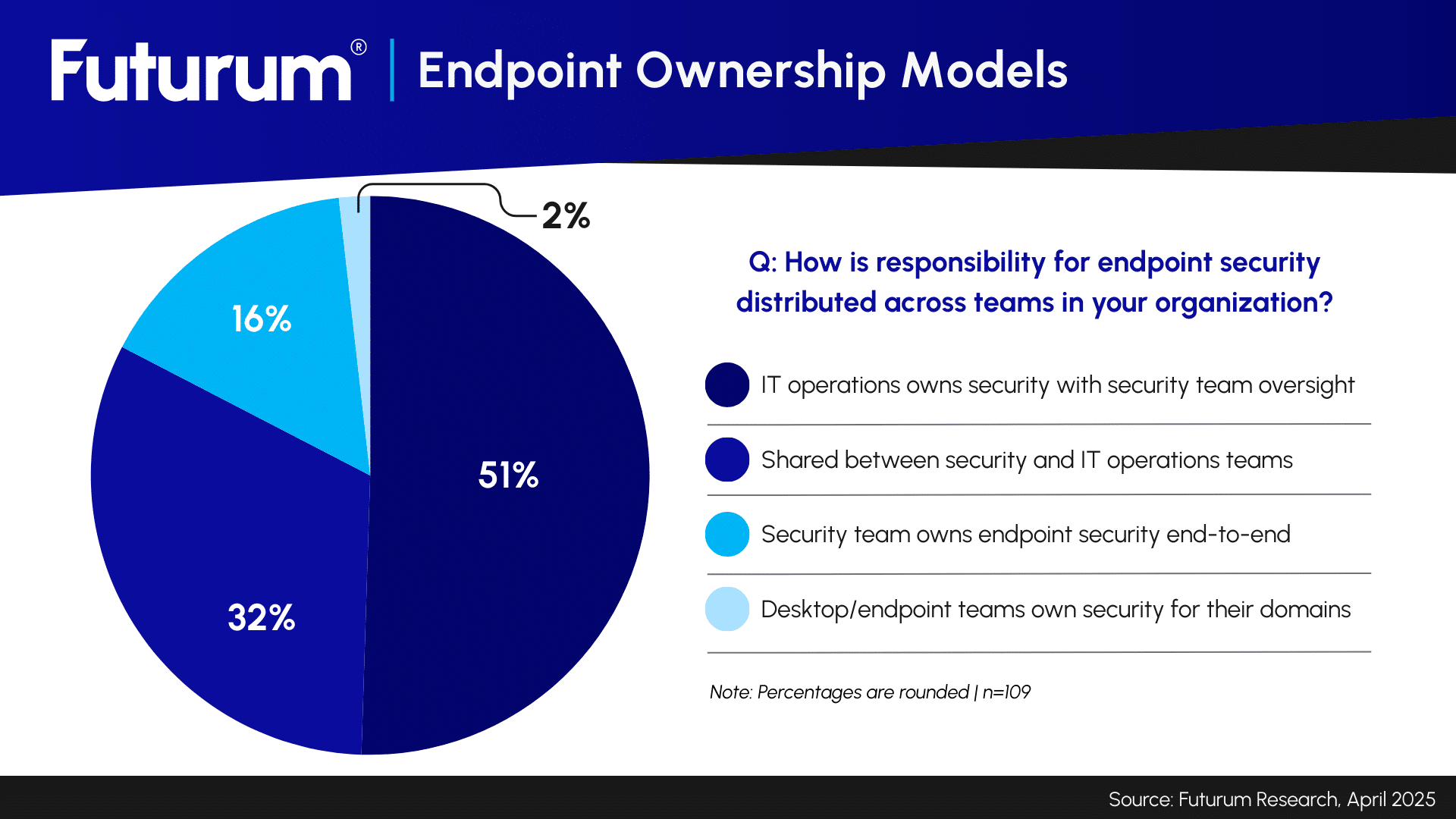
According to the data, 50.5% of organizations report that IT operations owns endpoint security with security team oversight. This indicates that for half of the market, the team responsible for keeping systems running is also responsible for locking them down, which is a dynamic that requires rigorous checks and balances.
Furthermore, 32.1% of respondents indicated that ownership is shared between security and IT operations teams, while only 15.6% reported that the security team owns endpoint security end-to-end. This operational structure emphasizes the need for security tools that are seamless for IT teams to deploy and manage, rather than specialized tools that sit in a silo.
Figure 1: Endpoint Ownership Models
Top 5 Endpoint Security Challenges: The User Experience Barrier
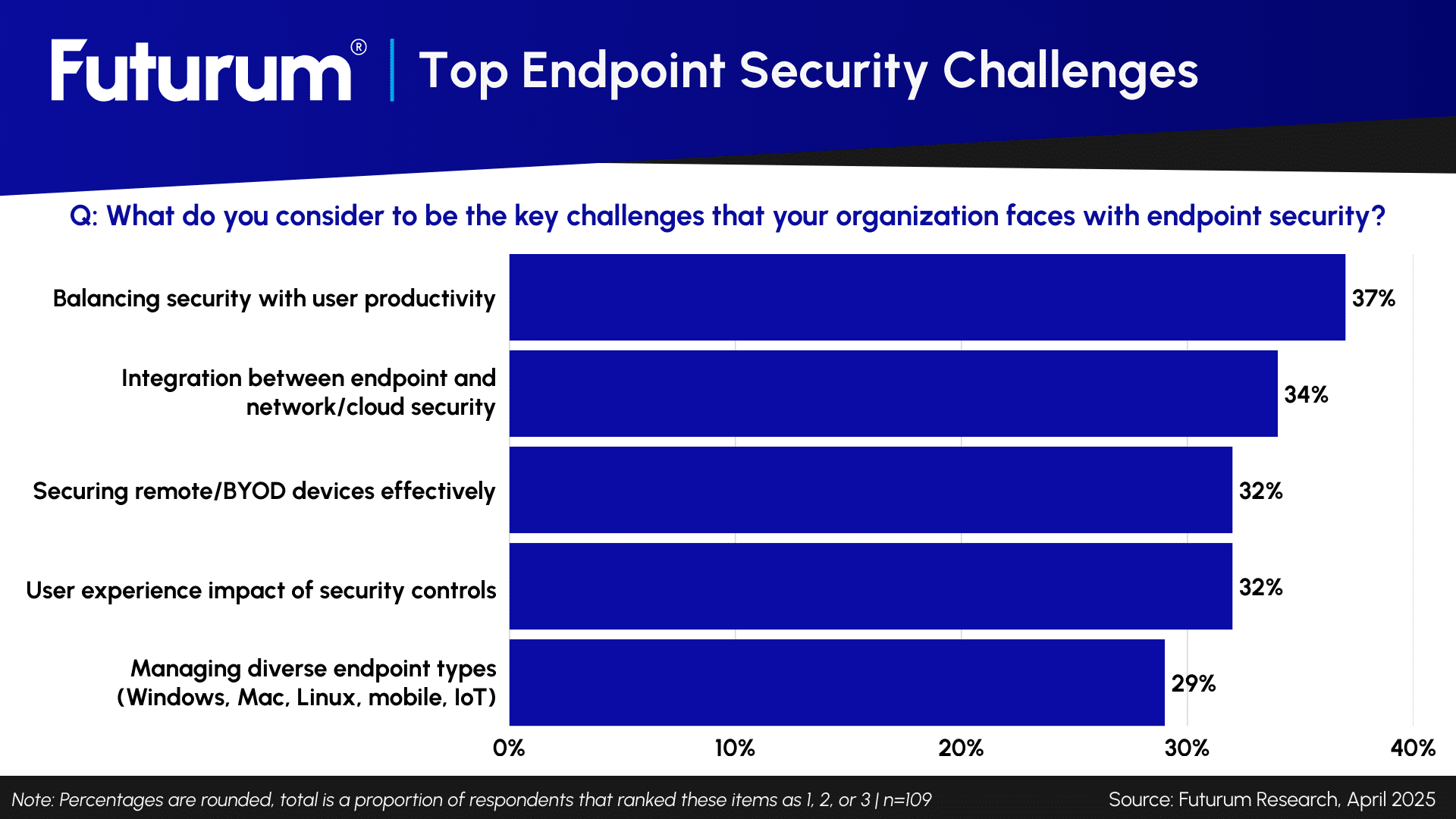
While technical threats are omnipresent, the study reveals that the key challenges on the topic of endpoint security are operational and user-centric. When asked to rank their top challenges, respondents pointed to the friction between protection and productivity.
The top 5 endpoint security challenges identified in the study are:
- Balancing security with user productivity: The number one challenge reflects the ongoing struggle to implement controls that do not impede employees’ ability to work efficiently.
- Integration between endpoint and network/cloud security: As environments become hybrid, isolated endpoint data is less valuable. Organizations are struggling to unify these signals.
- Securing remote/BYOD devices effectively: The permanence of hybrid work continues to complicate the security perimeter.
- User experience impact of security controls: Closely related to the top challenge, the tangible “feel” of security on the device remains a friction point.
- Detection and response speed for advanced threats: Organizations remain under pressure to reduce dwell time against increasingly sophisticated attacks.
Figure 2: Top Endpoint Security Challenges
The Rise of the Browser and AI
Beyond the traditional challenges of ownership and user friction, the study points to a renewed focus on the browser as a critical endpoint interface. With the rapid integration of Generative AI into daily workflows, the browser is transforming from a passive portal into an active, intelligent workspace.
“We are seeing a massive shift in how the endpoint is defined, driven largely by the emergence of and interest in AI-enabled browsers,” said Fernando Montenegro, VP and Practice Lead at Futurum. “As the browser becomes the de facto operating system for the enterprise, we see security practitioners rightly concerned about it becoming a key target. Security leaders are now forced to look beyond traditional Endpoint Detection and Response (EDR) to dedicated browser security controls that can manage these AI-driven risks without killing productivity.”
This trend aligns with the survey’s top challenges; securing the browser is essential, but doing so without degrading the performance of AI tools or the user experience is the new frontier for endpoint strategy.
Subscribers can read more in the “1H 2025 Cybersecurity Decision-Maker Survey Report” on the Futurum Intelligence Platform. Non-subscribers can click here for inquiry and access.
About Futurum Intelligence for Market Leaders
Futurum Intelligence’s Cybersecurity and Resilience IQ service provides actionable insight from analysts, reports, and interactive visualization datasets, helping leaders drive their organizations through transformation and business growth. Subscribers can log into the platform at https://app.futurumgroup.com/, and non-subscribers can find additional information at Futurum Intelligence.
Follow news and updates from Futurum on X and LinkedIn using #Futurum. Visit the Futurum Newsroom for more information and insights.
Declaration of generative AI and AI-assisted technologies in the writing process: This content has been generated with the support of artificial intelligence technologies. Due to the fast pace of content creation and the continuous evolution of data and information, The Futurum Group and its analysts strive to ensure the accuracy and factual integrity of the information presented. However, the opinions and interpretations expressed in this content reflect those of the individual author/analyst. The Futurum Group makes no guarantees regarding the completeness, accuracy, or reliability of any information contained herein. Readers are encouraged to verify facts independently and consult relevant sources for further clarification.
Disclosure: Futurum is a research and advisory firm that engages or has engaged in research, analysis, and advisory services with many technology companies, including those mentioned in this article. The author does not hold any equity positions with any company mentioned in this article.
Analysis and opinions expressed herein are specific to the analyst individually and data and other information that might have been provided for validation, not those of Futurum as a whole.
Read the full Futurum Group Disclosure.
Other Insights From Futurum:
Futurum Intelligence Cybersecurity & Resilience IQ
Futurum Research 2025 Key Issues & Predictions
Futurum Research: SOC Challenges
Author Information

Fernando Montenegro serves as the Vice President & Practice Lead for Cybersecurity & Resilience at The Futurum Group. In this role, he leads the development and execution of the Cybersecurity research agenda, working closely with the team to drive the practice's growth. His research focuses on addressing critical topics in modern cybersecurity. These include the multifaceted role of AI in cybersecurity, strategies for managing an ever-expanding attack surface, and the evolution of cybersecurity architectures toward more platform-oriented solutions.
Before joining The Futurum Group, Fernando held senior industry analyst roles at Omdia, S&P Global, and 451 Research. His career also includes diverse roles in customer support, security, IT operations, professional services, and sales engineering. He has worked with pioneering Internet Service Providers, established security vendors, and startups across North and South America.
Fernando holds a Bachelor’s degree in Computer Science from Universidade Federal do Rio Grande do Sul in Brazil and various industry certifications. Although he is originally from Brazil, he has been based in Toronto, Canada, for many years.

