
The News:
Communicating with brands on social media platforms has become a preferred strategy for many consumers, according to the results of a recent Khoros survey that included more than 1,300 respondents who indicated they had tweeted directly to or about a brand or company on Twitter, Facebook, or Instagram. Indeed, the survey found that 75% of Twitter users have used the platform to engage with brands, with 59% of Facebook users using that platform to reach out to brands. Just over a third (34%) of Instagram users engaged with brands on that platform.
The survey found that about 50% of consumers who engage with brands on social media are reaching out about customer care concerns, including questions about products and services, as well as airing complaints through that channel. The top care-related reason that consumers reach out to brands on social media, regardless of the platform, is to ask questions about products and services. About 33% of Twitter and Facebook users who communicate with brands reach out primarily for answers to questions, with 30% of Instagram users reaching out for that purpose.
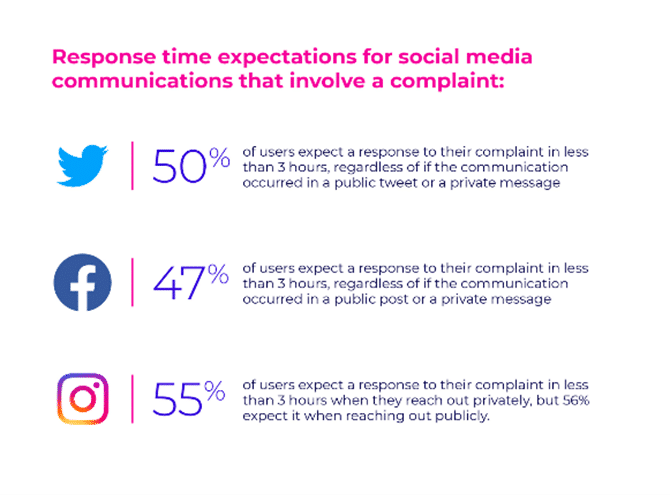
Behavior varies more broadly by platform when it comes to airing complaints, with 20% of Twitter users complaining to a brand on the platform, compared with 14% of Facebook users, and 8% of Instagram users. And across each platform, 65% of users expect a response from the brand, though roughly 50% of users only expect a response within 3 hours.
You can see the full survey results at this link.
Customer Care Questions Drive Significant Engagement with Social Media Platforms
Analyst Take:
A recent survey conducted by Khoros of social media users found significant customer engagement across social media platforms, with 50% of consumers who engage with brands on social media are reaching out about customer care concerns, including questions about products and services and airing complaints through that channel. Perhaps most importantly, 65% of users across each of the three major social platforms – Facebook, Twitter, and Instagram – expect a response from the brand.
Interestingly, the survey found that across the three social platforms, an average of roughly half of users expect a response within three hours. This illustrates that customers are far more tolerant of a delay in response time when they initiate an interaction through a preferred social channel, as compared to traditional voice communication channels, where a three-hour delay would be flatly unacceptable.
Response Time May Be a Point of Competitive Differentiation
Only about a quarter of consumers who communicate with brands on social media to resolve complaints expect a response in under an hour. While most customers may not expect companies to quickly respond to complaints within one hour, CX practitioners who hope to meet the support needs of customers who reach out via social media should consider making response time a priority. Creating a procedure to exceed expectations can be a key service differentiator that drives customer retention and CX.
Many of the analytics and insights packages used to collect feedback from social channels, such as Emplifi, Medallia, Concentrix, and Forsta, among others, make it easy to quickly respond to both questions and negative feedback, such as product or service complaints.
Best Practices for Responding Quickly to Complaints Made Through Social Media
Promptly responding to complaints demonstrates that the customer’s time – and by extension, the customer – is highly valued by the brand or company. While many customers may use social media to levy complaints because it is easier than picking up the phone and sitting in a queue, they may feel similar levels of frustration or anger about the situation.
Providing a quick response via social media can quickly turn a negative experience into a positive one, simply by displaying empathy. Even a quick, automated response that tells the customer that the brand is sorry they are having a problem can be instrumental in making sure the customer feels they have been heard.
As such, it is important to take the following steps:
- Establish a procedure for responding to all complaints quickly, by sending an acknowledgement message or post, letting the customer know that the company is sorry the issue is occurring, and that the problem is being reviewed.
- Ensure that any customer information can be linked to the person making the complaint, so that when a representative reaches out to address the problem, any relevant customer information or past interactions have been surfaced and can be referenced during the interaction.
- Ensure that agents have the tools they need to solve or resolve the issue, which can include making sure they either have the knowledge required or can connect the customer with the appropriate resources.
- Make sure that the reach back to the customer occurs through the same social media channel, but ensure the proper systems and procedures are in place to seamlessly switch channels if the customer requests to do so.
Author Information

Keith Kirkpatrick is VP & Research Director, Enterprise Software & Digital Workflows for The Futurum Group. Keith has over 25 years of experience in research, marketing, and consulting-based fields.
He has authored in-depth reports and market forecast studies covering artificial intelligence, biometrics, data analytics, robotics, high performance computing, and quantum computing, with a specific focus on the use of these technologies within large enterprise organizations and SMBs. He has also established strong working relationships with the international technology vendor community and is a frequent speaker at industry conferences and events.
In his career as a financial and technology journalist he has written for national and trade publications, including BusinessWeek, CNBC.com, Investment Dealers’ Digest, The Red Herring, The Communications of the ACM, and Mobile Computing & Communications, among others.
He is a member of the Association of Independent Information Professionals (AIIP).
Keith holds dual Bachelor of Arts degrees in Magazine Journalism and Sociology from Syracuse University.