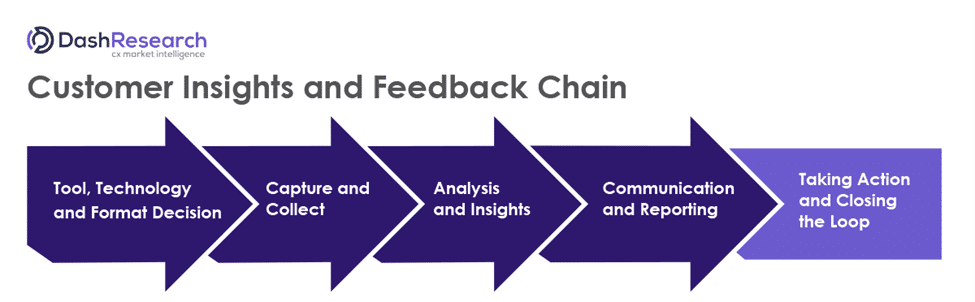
There is no shortage of technology solution providers in the customer insights and feedback space, ranging from those who offer end-to-end solutions to those who focus in on just one or two areas of the insights and feedback chain. One of the areas garnering particular focus is the analysis and insights piece, since this is the engine that drives action. During discussions for Dash Research’s upcoming report, Customer Insights & Feedback, I spoke with many providers in this segment, all offering their own takes on this key part of the CX ecosystem.
Gurol Kurt, co-founder and CEO of AlternaCX, an end-to-end CX provider that puts heavy focus on feedback analysis, driving down to find the root causes of satisfaction, spoke about determining the most critical pieces of feedback out of the vast amounts of incoming data. The company uses natural language processing (NLP) to uncover insights from open-ended feedback, and can also run simulations to see how changes in various aspects of satisfaction will affect the ultimate satisfaction outcome. An example Kurt provided is an in-person visit to a bank branch: A person had to wait for 30 minutes and finally was able to interact with a representative. They were very helpful, did their absolute best, but because of an issue with bank bureaucracy, the person walked away with the issue not solved. There are three factors here: (1) wait time, (2) employee helpfulness, and (3) problem resolution. Any of these can be the customer tipping point toward satisfaction or dissatisfaction. Technologies that allow the end user to determine which of the factors carry the most weight and will help companies provide the best targeted action.
Auryc, a provider of customer intelligence solutions, focuses on making sense of the deluge of customer feedback by combining voice of the customer (VoC) data with full behavior analytics, session replays, and predictive intelligence. Says Co-founder and CEO Jinlin Wang, “Your technology has to allow customers to determine not just the what, but the why, and the nirvana is the action piece. What are you doing to do with it, and how quickly?” Auryc can do this whether a person leaves intentional feedback or chooses not to. For instance, many frustrated customers still will not leave feedback on a website or app, but using customer behavior analytics, Auryc can tease out insights by looking at website behaviors and analyzing those same behaviors against all sessions to identify the “silent sufferers” of a bad experience.
During a conversation with Eric Head, Verint’s VP, Go to Market, Head shared that many companies are still struggling to connect data silos and drive enterprise-wide action. Often, CX programs have a hard time pushing through past the “listening” activities. Verint’s Experience Management solution helps move organizations along the CX maturity scale by making it easier to combine digital, workforce, and experience management. The platform can ingest data coming in from a variety of interaction modes and use cases (including contact center, employee, retail, marketing, etc.). Text analytics, speech analytics, and predictive modeling then help to provide a faster path from data to insights so that the right action can be taken by the right people.
Uncovering the “whys” behind positive and negative customer feedback (or receiving no feedback at all) and translating that to quick and targeted action is becoming the gold standard in CX programs. This last action piece of the feedback chain is a critical driver to current and ongoing investment in customer insights and feedback solutions. Investment in these technologies will continue to grow in importance, as companies seek to flip customers from being detractors to promoters, and try to deepen customer relationships.
Author Information

As a detail-oriented researcher, Sherril is expert at discovering, gathering and compiling industry and market data to create clear, actionable market and competitive intelligence. With deep experience in market analysis and segmentation she is a consummate collaborator with strong communication skills adept at supporting and forming relationships with cross-functional teams in all levels of organizations.
Sherril holds a Master of Business Administration in Marketing from University of Colorado, Boulder and a Bachelor of Arts in Psychology from Rutgers University.