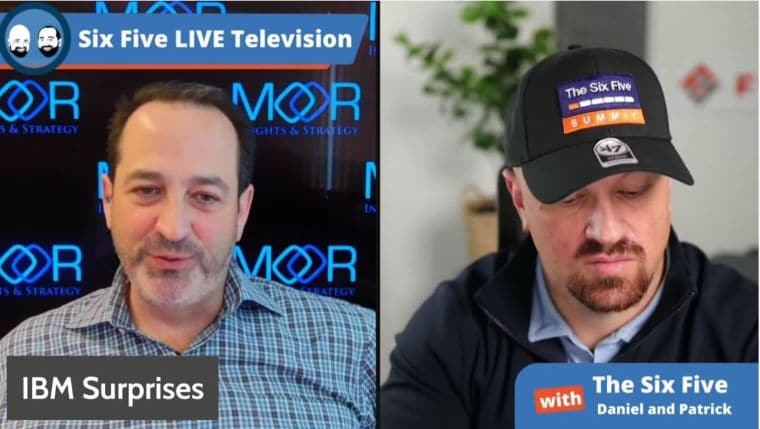
The Six Five team talks about the latest earnings report from IBM.
Watch the clip here:
If you are interested in watching the full episode you can check it out here.
Disclaimer: The Six Five Webcast is for information and entertainment purposes only. Over the course of this webcast, we may talk about companies that are publicly traded and we may even reference that fact and their equity share price, but please do not take anything that we say as a recommendation about what you should do with your investment dollars. We are not investment advisors and we do not ask that you treat us as such.
Transcript:
Patrick Moorhead: Yeah. Let’s cruise into IBM coming off of post-Kyndryl. And net IBM surprised on the top and the bottom. They had their highest revenue growth in six to seven years. And even though it’s 6% to 7%, and that may not wind everybody up, it’s a heck of a lot better than no growth, 1% growth. I think IBM overall had a really good showing. A couple hotspots for them, I felt, was cloud revenue at 19%, Red Hat revenue at 21%. Software at 8% may not sound interesting until you recognize that it’s 89% gross margin. And then it looks really good.
Consulting, 13% at 27% gross margin. Infrastructure was flat. Infrastructure at IBM is really driven by Z, and z15 really has an extended cycle. So being flat and Z being on its last quarters of being sold before I’m expecting the new version to come in soon I think is really good. And the great part about that is because most Zs are being used in cloud, being used with containers, or at least the new versions, it could get that cloud number up to 30%. Which I think really makes for an interesting type of investment.
And I had some people who were pinging me on quote-unquote “cloud,” what does it mean? But I’m kind of tired of this conversation with certain vendors. Because listen, if I look at AWS, Microsoft, GCP, cloud is IaaS, PaaS, and SaaS. So IBM’s hybrid cloud revenue is a combination of its software, consulting, and infrastructure. And their definition absolutely passes muster. I think we’re more mature. I’m hoping we’re more mature as, I don’t know, a tech analyst industry, and even an investor industry to understand that cloud doesn’t just mean IaaS. It’s a whole lot more. And we’re going to talk about more cloud when we get to the SAP.
Daniel Newman: Yeah. The definition of cloud is a moving target, Pat, and I think the market that long built its reputation on measuring IaaS is problematic. It’s not actually just IaaS, PaaS, and SaaS. It’s also all the services that encompass delivering cloud, and most companies have a combination of all those things. For a long time, we looked at AWS as just IaaS, but they have all the things. They have PaaS. They have a lot of services. Of course, software’s a smaller component of what they’re doing, but I’m watching slowly things like Connect and Chime and other services built out that could easily take them into that direction.
When you get to 16 billion a quarter, you’re going to need to start to find diversified revenue streams when you’re just selling primarily infrastructure. And so data services, there’s so many things. But IBM, look, this is a very simple assessment, Pat. And I know sometimes we like to make analysis tough, because it makes us look smart. But IBM made a big decision to spin off GTS, Kyndryl, and… Most of GTS. It wasn’t exactly GTS. But most parts of it. Managed infrastructure services. It was a boat anchor for the company. It had been losing money and a disproportionately large percentage of the overall revenue and cost centers.
So the company would have really good quarters like a Z cycle, like you mentioned, and could barely break above breakeven or 1% growth. We remember the Rometty declining revenue and earnings period when she was CEO. Krishna realizes that sometimes you have to break down the board before you can build it back up better. And so that decision’s been pivotal. We’ve been hearing for the last few years about his decisions to go hybrid cloud. IBM not trying to compete directly with AWS and Azure was a very good decision, because it’s a different business model.
But when it comes to comprehensive, highly regulated industries that have very specific needs, from mainframe to edge, software and automation, IBM has a pretty comprehensive set of offerings and services to meet that need. Pretty comprehensive set of offerings and services to meet that need. They can do it, as you suggested, at a very high margin, and they’ve made some really good decisions. That $34 billion acquisition of Red Hat looks better with each good quarter. It still was a big number. It’s still going to take a long time to get all that return, but we’re seeing what companies are going for right now.
And IBM didn’t have a choice. I’m going to say that. They did not have a choice but to accelerate their hybrid cloud portfolio in a meaningful way, and Red Hat was instant credibility. That was instant credibility with a large subset of the hybrid cloud community, and that’s starting to pay off with a 20-ish percent growth. Now that they have dropped the boat anchor, they’ve shown they can be more profitable to that mid-high single digits, that’s not going to be enough and the market’s not going to be satisfied. So I’m going to say that right now, the market’s going to want more. They’re going to want more. They’re going to want higher growth, faster growth. But this was a good sign that this quickly, upon the spinoff, IBM was able to deliver better than expected results.
Patrick Moorhead: I give them congrats.
Daniel Newman: Do we have like a little button that we can press like Kramer does that cheers?
Patrick Moorhead: Yeah, exactly.
Author Information

Daniel is the CEO of The Futurum Group. Living his life at the intersection of people and technology, Daniel works with the world’s largest technology brands exploring Digital Transformation and how it is influencing the enterprise.
From the leading edge of AI to global technology policy, Daniel makes the connections between business, people and tech that are required for companies to benefit most from their technology investments. Daniel is a top 5 globally ranked industry analyst and his ideas are regularly cited or shared in television appearances by CNBC, Bloomberg, Wall Street Journal and hundreds of other sites around the world.
A 7x Best-Selling Author including his most recent book “Human/Machine.” Daniel is also a Forbes and MarketWatch (Dow Jones) contributor.
An MBA and Former Graduate Adjunct Faculty, Daniel is an Austin Texas transplant after 40 years in Chicago. His speaking takes him around the world each year as he shares his vision of the role technology will play in our future.