Research

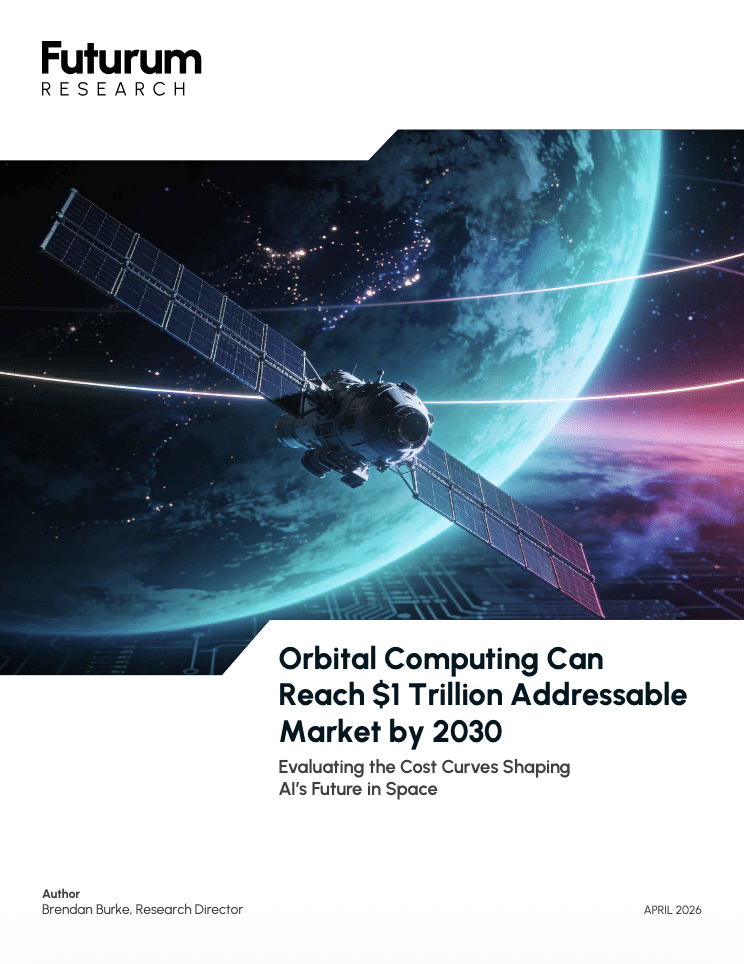
Orbital Computing Can Reach $1 Trillion Addressable Market by 2030

The burgeoning field of orbital computing is rapidly transitioning from a theoretical concept to a funded industrial race driven by the increasing constraints and escalating costs of terrestrial data centers. With AI workload demand potentially requiring 300 GW of compute by 2030, operators face a crisis: acquiring grid-connected power can take 3 to 7 years, stranding billions of dollars in finished silicon. This has led to two highly capital-intensive strategies: accelerating terrestrial off-grid AI factories with dedicated power plants, and aggressively pursuing orbital data centers, which promise limitless, unattenuated solar power and the infinite cooling sink of deep space, bypassing Earth’s regulatory gridlock.

Despite the structural advantages of space, deploying a gigawatt-scale AI factory in Low Earth Orbit (LEO) currently incurs a significant economic premium. However, the central thesis of our analysis is that the cost crossover point between orbital and terrestrial infrastructure will arrive first for off-grid deployments, rather than for all AI compute. This is largely dependent on SpaceX Starship achieving full reuse and high flight cadence, which is projected to push launch costs below $100/kg by the end of the decade, thereby collapsing the single largest cost input. For most grid-connected data centers, which benefit from existing electrical infrastructure, terrestrial deployment is likely to remain the lower-cost option in the long term.

The economically justified addressable market for orbital computing can reach approximately $1 trillion by 2030, pending cost declines and efficiency gains, representing about one-third of the $3 trillion in AI compute capital expenditure. This segment includes capacity facing multi-year grid queues, sovereign compute mandates, and incremental demand beyond terrestrial infrastructure’s capacity. The success of this transition relies on further technological progress, specifically steep declines in launch costs and increased efficiency in satellite hardware, such as radiators and solar panels. An emerging ecosystem is forming across the value chain, with specialized vendors in compute clusters, semiconductor hardening, and optical interconnects, though the market will remain supply-constrained by launch throughput and satellite manufacturing capacity well beyond 2030

In our latest Analyst Insight Report, Orbital Computing Can Reach $1 Trillion Addressable Market by 2030, Futurum Research covers:

  • The primary drivers pushing AI computing to orbit are severe delays in terrestrial grid interconnections and the rising costs of building off-grid data centers.
  • The crossover for cost parity between orbital and terrestrial computing will occur first for off-grid deployments, which are currently facing escalating costs, rather than for grid-connected facilities.
  • The key technical challenges and cost drivers for orbital data centers are launch costs and the mass of satellite hardware, particularly the radiators needed for heat rejection.
  • A growing ecosystem of vendors is emerging across the value chain, specializing in space-hardened silicon (e.g., AMD, NVIDIA), optical inter-satellite mesh networking (e.g., Starcloud, Kepler), and vertical integration (e.g., SpaceX, Amazon).

If you are interested in learning more, be sure to download your copy of Orbital Computing Can Reach $1 Trillion Addressable Market by 2030 today.

To learn more, download your copy of our latest report, Orbital Computing Can Reach $1 Trillion Addressable Market by 2030, now.

Author Information

Brendan Burke, Research Director

Brendan is Research Director, Semiconductors, Supply Chain, and Emerging Tech. He advises clients on strategic initiatives and leads the Futurum Semiconductors Practice. He is an experienced tech industry analyst who has guided tech leaders in identifying market opportunities spanning edge processors, generative AI applications, and hyperscale data centers. 

Before joining Futurum, Brendan consulted with global AI leaders and served as a Senior Analyst in Emerging Technology Research at PitchBook. At PitchBook, he developed market intelligence tools for AI, highlighted by one of the industry’s most comprehensive AI semiconductor market landscapes encompassing both public and private companies. He has advised Fortune 100 tech giants, growth-stage innovators, global investors, and leading market research firms. Before PitchBook, he led research teams in tech investment banking and market research.

Brendan is based in Seattle, Washington. He has a Bachelor of Arts Degree from Amherst College.

Book a Demo

Welcome

The vision behind everything in Futurum’s Custom Research practice is this: research should show you what is happening, what comes next, and what to do about it. It should be personal to each audience, easy for people to grasp, and structured so LLMs can reason over it accurately. And it should be fast and turnkey; you want answers now, not another project to carry for quarters.

Whether you are defining business, channel, or go-to-market strategy; evaluating vendors or justifying ROI; or commissioning research to fill an emerging market need, we have your back, with a program that answers your questions with the objectivity and credibility to drive real decisions.

To do it, we bring unmatched data to bear: Futurum research, surveys, and market projections; validated market feeds; ETR’s 15 years of insight from 10,000 technology decision-makers; G2’s buyer and user data; and what our analysts hear every day. Add leading primary collection, from AI-moderated voice interviews to surveys and analyst-led interviews, all turnkey, and every project comes out credible, nuanced, and actionable.

And we don’t just drop the results in your lap. For internal work, we provide analyst-led sessions, interactive dashboards, and a range of formats. For market-facing work, Futurum delivers turnkey activation and amplification that actually gets seen, by people and by LLMs, through our media and share of voice. This is research that moves decisions and markets.

We will meet you wherever you are, from a fast-turn brief to a multi-year program, and shape the work to your goals, timeline, and budget. The right program for your moment.

If any of this is useful, I would love to talk.

Benjamin Brown, VP Custom Research, Futurum Research

Benjamin Brown

VP, Custom Research · The Futurum Group

Newsletter Sign-up Form

Get important insights straight to your inbox, receive first looks at eBooks, exclusive event invitations, custom content, and more. We promise not to spam you or sell your name to anyone. You can always unsubscribe at any time.

All fields are required


Thank you, we received your request, a member of our team will be in contact with you.