
Analyst(s): Mitch Ashley
Publication Date: December 15, 2025
The AAIF arrives at a moment when agentic AI is advancing faster than the industry can align on shared protocols and operational safeguards. By creating a neutral home for open standards and collaborative governance, the foundation provides the structure needed to turn rapid innovation into scalable, reliable, and interoperable agentic systems.
Key Points:
- The Agentic AI Foundation (AAIF) establishes a neutral home where agentic systems evolve collaboratively and openly rather than in isolated vendor silos.
- MCP’s contribution as the anchor project signals a strategic shift toward shared stewardship across AWS, Anthropic, Google, Microsoft, OpenAI, and other vendors.
- The AAIF intends to fill a structural gap between fast-moving vendor innovation and the slower processes of traditional standards bodies.
Overview:
The formation of the AAIF signals that agentic AI has outgrown the phase where individual vendors define the ecosystem on their own. Agents now plan work, orchestrate tasks, and operate across the software lifecycle. Yet the underlying protocols and behavior models remain fragmented. The result is a widening gap between what teams want from agentic systems and what today’s proprietary implementations can reliably deliver.
The AAIF offers a path to close that gap. By placing MCP, AGENTS.md, goose, and future standards under neutral governance, the foundation provides a shared structure for the interoperability, security, and lifecycle controls enterprises expect. This builds on the momentum from our research on agentic AI open standards, where vendors rapidly converged on MCP, A2A, ANS, and AI-SBOM to find common ways to access tools, exchange context, track identity, and operate agents safely at scale.
Figure 1: Six Reasons Why the Industry Needs the AAIF
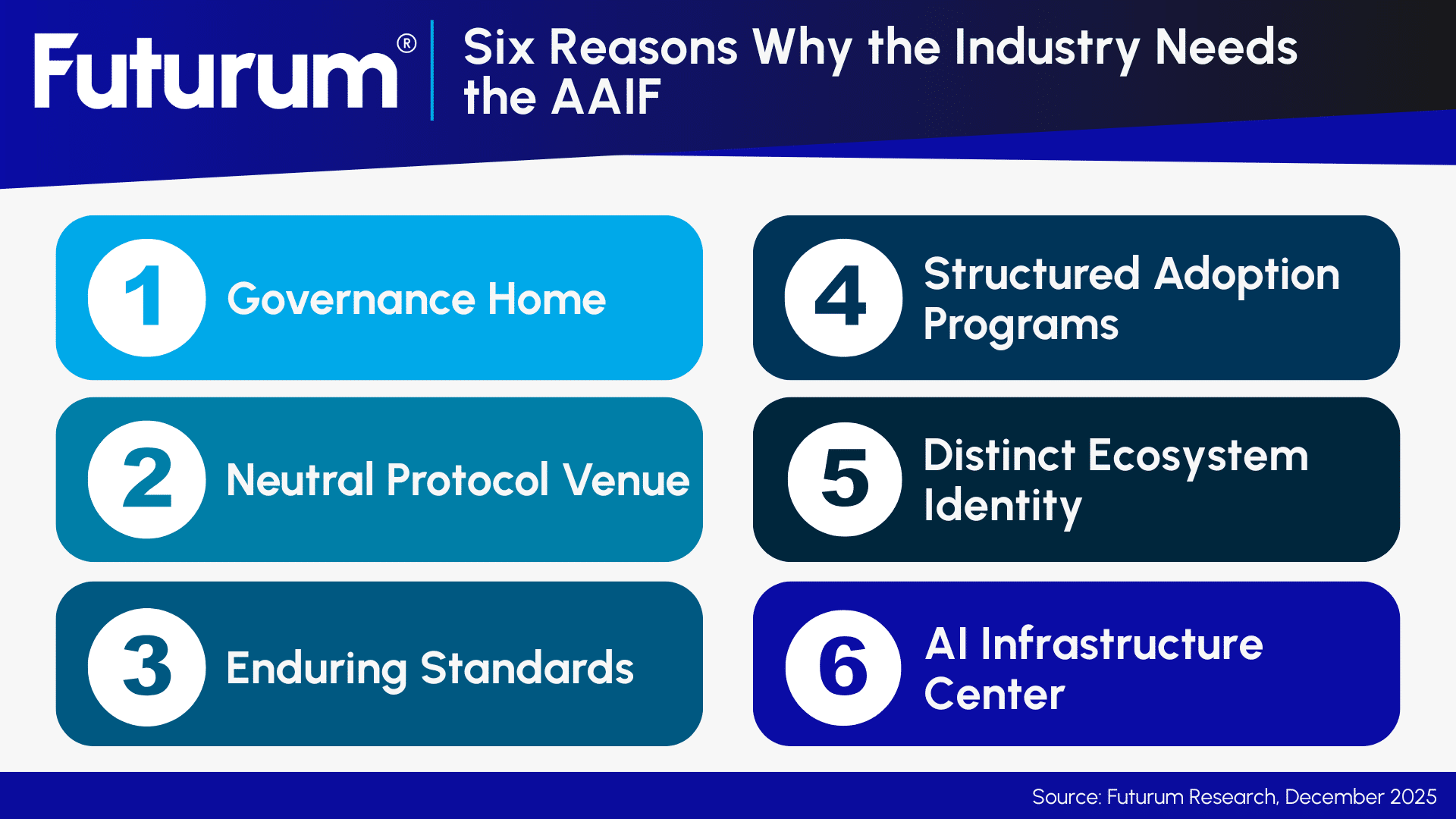
The six reasons captured in Figure 1 reflect the structural forces shaping the agentic AI ecosystem. Agentic systems are advancing faster than the industry’s ability to coordinate shared expectations for interoperability, identity, and operational safeguards. This aligns with the findings in FuturumWatch Top 10 Essential Agentic AI Open Standards, which highlighted the rapid emergence of shared protocols and the growing need for neutral governance as adoption accelerates. See the full report available with Futurum’s IQ Intelligence service for more information.
For vendors, the AAIF removes the pressure to invent isolated protocols that customers must later reconcile. A neutral venue allows innovation to shift from competing specifications to differentiated experiences, performance, and platform depth. It also creates a clearer route for conformance testing and reference implementations, which are essential for adoption across enterprise environments.
For practitioners, the value is immediate. Open standards reduce the friction of integrating agents into existing pipelines. Clear behavioral rules increase predictability. Shared schemas and protocols help teams avoid brittle extensions and reduce the operational overhead of managing multiple agent systems that behave differently under load. The AAIF’s role as a governance home establishes the long-term stability needed to build real workflows rather than short-lived experiments.
Conclusion
A foundational shift is underway. Agentic systems are moving toward an architecture defined by open protocols, portable identity models, consistent project guidance, and observable behavior. The AAIF accelerates this transition by providing the ecosystem with a dedicated home to align on interoperability, trust mechanisms, and infrastructure standards that will carry agentic AI into mainstream software development and operations.
For vendors and practitioners alike, the opportunity is clear. Engagement with the AAIF positions teams to build on shared foundations rather than reinventing them. This is how the industry creates scalable, secure, and sustainable agentic systems that perform reliably across the full AI development lifecycle.
The full report is available via subscription to Futurum Intelligence’s Software Lifecycle Engineering IQ service—click here for inquiry and access.
See the AAIF announcement on linuxfoundation.org for additional information.
Futurum clients can read more about it in the Futurum Intelligence Platform, and non-clients can learn more here: Software Lifecycle Engineering Practice.
About the Futurum Software Lifecycle Engineering Practice
The Futurum Software Lifecycle Engineering Practice provides actionable, objective insights for market leaders and their teams so they can respond to emerging opportunities and innovate. Public access to our coverage can be seen here. Follow news and updates from the Futurum Practice on LinkedIn and X. Visit the Futurum Newsroom for more information and insights.
Author Information

Mitch Ashley is VP and Practice Lead for the CIO & Technology Buyers and Software Lifecycle Engineering practices at The Futurum Group. A multi-time CIO and CTO with 30+ years leading technical organizations, Mitch built and operated production systems spanning cybersecurity for the U.S. Department of Defense, PKI services for the broadband and 5G industries, SaaS platforms, large-scale telecom and banking systems, and a national broadband network. His work with AI began early, developing expert systems that diagnosed and repaired complex mainframe environments. That operator foundation grounds his analysis in operational consequence, covering the technology buyer's world of software engineering, cybersecurity, DevOps, cloud, and AI.

