
Austin, Texas, USA, January 26, 2026
Organizations look to modernize their networks in light of broader initiatives around AI, workforce changes, and more.
New research from Futurum Intelligence reveals that securing traffic for artificial intelligence (AI) and machine learning (ML) workloads has emerged as the most influential driver shaping enterprise network security architecture for the next two years. The findings indicate a strategic pivot as organizations move beyond traditional perimeter defense to address the unique demands of AI-driven innovation, a permanent hybrid workforce, and other key trends.
Figure 1: Top Strategic Drivers for Network Security Architecture
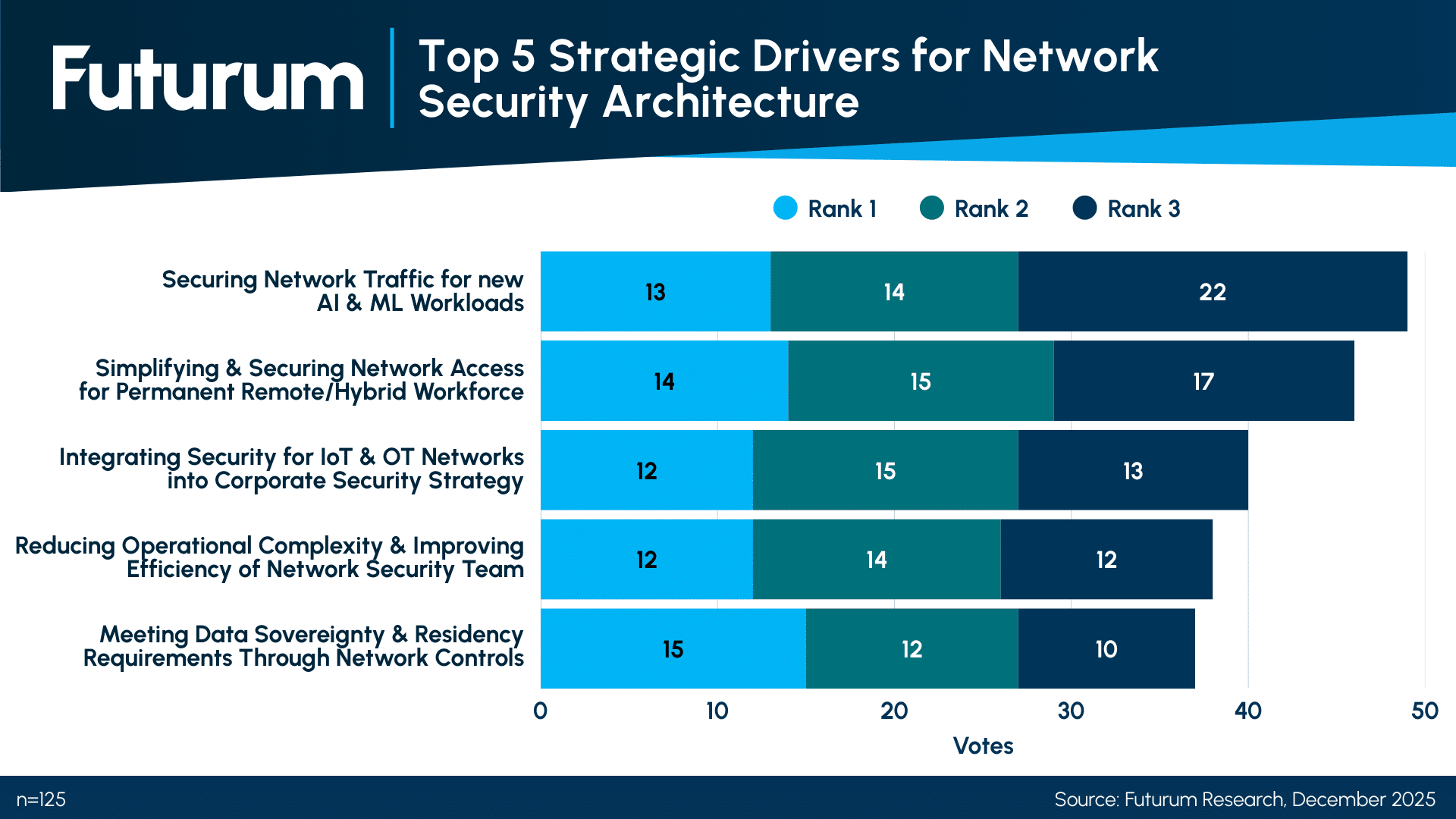
AI and ML Workloads Drive Architectural Shifts
As organizations rapidly integrate both “workforce” and “workload” AI capabilities into the fabric of business, the network is transforming into an active, intelligent, and increasingly autonomous component. This shift requires new security controls capable of managing AI-driven threats without impeding performance and at the necessary scale. The research shows that securing these workloads is now the top priority, reflecting a need for architectures that can handle the increased complexity and specific traffic patterns associated with large-scale ML models and the broad adoption of AI technologies using a variety of cloud-based, on-premises, and hybrid technology deployments.
The Persistent Challenge of Remote and Hybrid Access
Alongside AI, the permanence of hybrid work continues to dissolve the traditional security perimeter. Simplifying and securing network access for this distributed workforce remains a critical secondary driver. Organizations are increasingly focused on implementing controls that provide robust protection without creating friction for end-users, as the “feel” of security on the device remains a significant operational challenge.
“The data clearly demonstrates that the integration of AI into the business environment presents a fundamental network architecture challenge,” stated Fernando Montenegro, Vice President and Practice Lead at Futurum. “As these AI initiatives become the de facto engine of the enterprise, security practitioners are rightly concerned about protecting these new traffic streams. We are seeing a move away from static prevention toward more dynamic, intelligent defenses that can think and respond in real-time. Effectively balancing this technological leap with the ongoing needs of a hybrid workforce will define the next era of business resilience”.
About Futurum Intelligence for Market Leaders
Futurum Intelligence’s Cybersecurity and Resilience IQ service provides actionable insight from analysts, reports, and interactive visualization datasets, helping leaders drive their organizations through transformation and business growth. Subscribers can log into the platform at https://app.futurumgroup.com/, and non-subscribers can find additional information at Futurum Intelligence.
Follow news and updates from Futurum on X and LinkedIn using #Futurum. Visit the Futurum Newsroom for more information and insights.
Declaration of generative AI and AI-assisted technologies in the writing process: This content has been generated with the support of artificial intelligence technologies. Due to the fast pace of content creation and the continuous evolution of data and information, The Futurum Group and its analysts strive to ensure the accuracy and factual integrity of the information presented. However, the opinions and interpretations expressed in this content reflect those of the individual author/analyst. The Futurum Group makes no guarantees regarding the completeness, accuracy, or reliability of any information contained herein. Readers are encouraged to verify facts independently and consult relevant sources for further clarification.
Disclosure: Futurum is a research and advisory firm that engages or has engaged in research, analysis, and advisory services with many technology companies, including those mentioned in this article. The author does not hold any equity positions with any company mentioned in this article.
Analysis and opinions expressed herein are specific to the analyst individually and data and other information that might have been provided for validation, not those of Futurum as a whole.
Read the full Futurum Group Disclosure.
Other Insights From Futurum:
Futurum Research: Cybersecurity Sentiment Points to Resilience and Growth
Are We Clear On What We Mean When We Say “AI Security”? – Report Summary
How Does SASE Evolve in the Age of AI? – Report Summary
Author Information

Fernando Montenegro serves as the Vice President & Practice Lead for Cybersecurity & Resilience at The Futurum Group. In this role, he leads the development and execution of the Cybersecurity research agenda, working closely with the team to drive the practice's growth. His research focuses on addressing critical topics in modern cybersecurity. These include the multifaceted role of AI in cybersecurity, strategies for managing an ever-expanding attack surface, and the evolution of cybersecurity architectures toward more platform-oriented solutions.
Before joining The Futurum Group, Fernando held senior industry analyst roles at Omdia, S&P Global, and 451 Research. His career also includes diverse roles in customer support, security, IT operations, professional services, and sales engineering. He has worked with pioneering Internet Service Providers, established security vendors, and startups across North and South America.
Fernando holds a Bachelor’s degree in Computer Science from Universidade Federal do Rio Grande do Sul in Brazil and various industry certifications. Although he is originally from Brazil, he has been based in Toronto, Canada, for many years.

