
Analyst(s): Mitch Ashley
Publication Date: April 16, 2025
Anthropic, Atlassian, AWS, GitHub, Google, and Microsoft are directing AI agent technologies to tasks developers must perform in the software development lifecycle beyond just generating code. Agentic AI capabilities are now taking on more complex multi-step development tasks, leveraging Model Context Protocol servers to contextualize reasoning of advanced GenAI large language models (LLMs).
Key Points:
- AWS, GitHub, Google, Microsoft, and generative AI LLM vendors are shifting their focus beyond code generation to development work tasks.
- Model Context Protocol rapidly fills the vacuum for a standard LLM access protocol to external resources, but it’s the start down a longer road of interoperable open protocols.
- Development leaders, teams, and individual developers have limited resources to consider and experiment with LLM, AI code generation, and other innovations. Vendors must focus on AI-powered outcomes across the SDLC rather than flooding the zone with the latest features.
Overview:
Business leaders have very high expectations for the impact AI will have on their businesses over the next 24-36 months. A 2025 research study by Futurum and Kearney reveals that CEOs expect AI to have a quantifiable impact in the areas of customer satisfaction, revenue growth, cost savings, and tangible innovations.
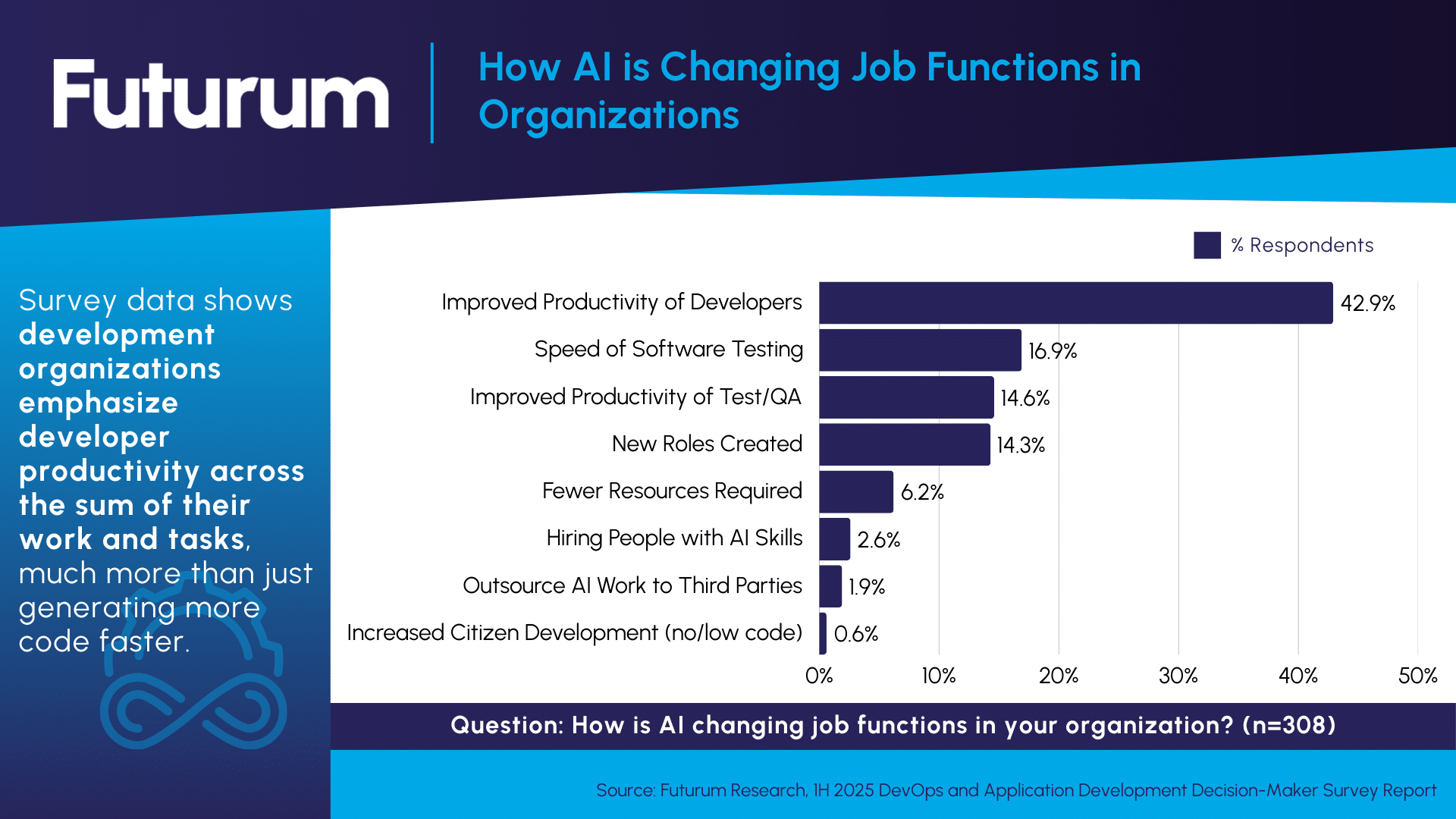
While innovations in AI code generation continue, vendors have yet to demonstrate the exponential benefits of using AI to improve the speed and facility of overall enterprise software development. Futurum Research’s DevOps and Application Development Decision-Maker survey shows development organizations emphasize developer productivity across the sum of their work and tasks, much more than just generating more code faster.
Figure 1: How AI is Changing Job Functions in Organizations (% Respondents)
The market is at an inflection point as technology vendors are turning the focus of AI agents to address the broader work and flow of software development throughout the SDLC instead of endlessly chasing faster, better, cheaper LLMs, and code generation tools. The focus of generating code using AI-powered development tools and LLMs will continue, while also broadening to development tasks such as code reviews, codebase analysis, multi-step processes, applying fixes, setup and configuration, and limited upgrades.
“Business leaders expect AI to deliver real impact across the entire software development lifecycle,” said Mitch Ashley, VP and Practice Lead for DevOps and Application Development at Futurum. “Our latest research shows that developer productivity, not just code generation, is the top priority. The shift toward agentic AI reflects this need, as organizations seek agentic AI agents that improve the flow and speed of software development work—not just code output.”
While vendors are expanding their offerings with agentic AI capabilities, Model Context Protocol (MCP), introduced by Anthropic in late 2024, quickly emerged to aid AIs used for more multi-step and complex software development tasks. MCP’s simple, extensible client-server architecture and open-source licensing under Apache 2.0 have made it a fast favorite among developers and vendors.
“Advanced reasoning models are in part what is fueling the creation of agentic AI agents for software development, though Model Context Protocol makes it much easier for LLMs to access data needed to contextualize AI agents’ work,” said Ashley. “MCP addressed a significant void that is now being addressed through a solid, open, and extensible protocol.”
However, MCP’s early success has also introduced growing pains. Many MCP server implementations are emerging, tailored to specific vendor stacks, which could create fragmentation that risks undermining the protocol’s promise of simplicity and interoperability. As MCP continues to evolve, standardization and consolidation will be critical to minimizing complexity and ensuring sustainable returns on investment for enterprise development teams.
The full report is available via subscription to Futurum Intelligence’s DevOps and Application Development IQ service—click here for inquiry and access.
See the complete press release on Copilot: Agent Mode and MCP Server on github.com.
Futurum clients can read more about it in the DevOps & Application Development Intelligence Platform, and nonclients can learn more here: DevOps & Application Development Practice.
About the Futurum DevOps & Application Development Practice
The Futurum DevOps & Application Development Practice provides actionable, objective insights for market leaders and their teams so they can respond to emerging opportunities and innovate. Public access to our coverage can be seen here. Follow news and updates from the Futurum Practice on LinkedIn and X. Visit the Futurum Newsroom for more information and insights.
Author Information

Mitch Ashley is VP and Practice Lead for the CIO & Technology Buyers and Software Lifecycle Engineering practices at The Futurum Group. A multi-time CIO and CTO with 30+ years leading technical organizations, Mitch built and operated production systems spanning cybersecurity for the U.S. Department of Defense, PKI services for the broadband and 5G industries, SaaS platforms, large-scale telecom and banking systems, and a national broadband network. His work with AI began early, developing expert systems that diagnosed and repaired complex mainframe environments. That operator foundation grounds his analysis in operational consequence, covering the technology buyer's world of software engineering, cybersecurity, DevOps, cloud, and AI.

