January means an influx of trend articles and forecasts for the travel industry. Expedia Group recently published an interesting list of travel tech trends that its internal technology leaders identified for the coming year. What is striking, but not surprising, is how CX-focused these forecast trends are as the industry attempts to regain its footing with its customers, many of whom have been frustrated by their experiences during COVID-19 travel. The following six tech trends are excerpted from the Expedia article:
- Trusted app: As travelers look for more guidance booking their trips, Rathi Murthy, chief technology officer (CTO) for Expedia Services Management, predicts travel apps will make the move from transactional interactions to a trusted travel companion. “From recommendations that shape travel aspirations to seamless transitions between voice, chat, and touch, travel apps will need to adapt to traveler needs moment to moment. Exciting advancements in artificial intelligence (AI) and other new technologies will play a critical role in delivering proactive and personalized services that will make every traveler feel like the platform is built to serve them.” (Rathi Murthy)
- Startup-rich travel ecosystem: Growing traveler expectations for unique, memorable, and sustainable trips, booking flexibility, and fast, omnichannel customer service have risen significantly as some of the most important challenges for travel providers to solve. Jessica Patel, senior vice president for innovation, predicts a boom in tech startups focused on the travel industry, helping to solve these challenges. “We can expect to see startups focused on things like biometrics to help create touchless experiences for hotels and airports, electronic tipping apps as more travelers go cashless, and unique recent assurance offerings to give travelers increased peace of mind.” (Jessica Patel)
- Experience-led tech design: Rachel Kobetz, senior vice president and global head of design, predicts a big cultural shift in how technology will enhance the travel experience from start to finish. “Instead of focusing on the transaction, travel providers need to focus on the relationship travelers have with their brand and building more intuitive, and proactive experiences. With technologies like artificial intelligence and natural-language processing, companies can create hyper-personalized interactions that adapt to a traveler’s context and work across every aspect of their journey.” (Rachel Kobetz)
- Personal and dynamic experiences: Travelers are spending more time, energy, and money curating trips that not only offer memorable experiences, but also support the causes they care about. Tye Strickland, senior vice president of development platforms, security, and infrastructure, predicts a big tech trend in travel next year will be using data analytics and predictive technologies to reshape travel platforms in a way that offers travelers a more personal and dynamic experience. (Tye Strikland)
- Natural language processing (NLP): Travel demand has fluctuated dramatically over the past two years, catching many travel providers off balance, and making self-service options for travelers a necessity. Matt Fryer, vice president of artificial intelligence and data science, predicts that we will see a huge boom in NLP and generation for travel apps. “With Generative Pre-trained Transformer 3 (GPT-3) and access to more data than ever before, 2022 will be a great meeting of opportunity and capability. Creating seamless experiences that combine traditional customer service with modern innovation will drive brand loyalty.” (Matt Fryer)
- Interoperability: Michael Gulmann, technology executive and chief product officer, predicts a rise in the use of data across companies with the help of new architecture tools like data fabric and data lakes, as well as an increase in the exchange of data between companies. “As personalization becomes a key focus for the travel industry and beyond, the expectation for data to be made interoperable and available everywhere will grow. Travel providers will need to use this data to create a good holistic experience so that travelers feel it is worth sharing their data.” (Michael Gulmann)
Each one of these six trends will draw heavily on technologies that are part of the CX ecosystem, leaning particularly on the personalization, contact center, and customer data and analytics segments. Dash Research has mapped this CX ecosystem to include the following segmentation:
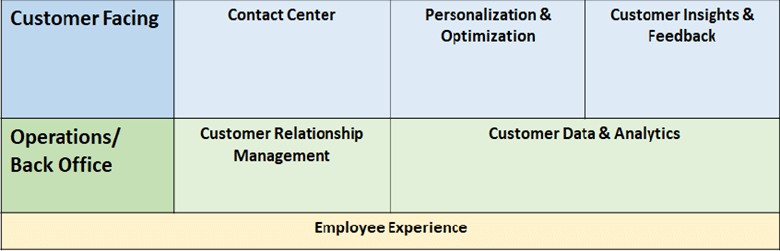
Additionally, the six technology trends suggested by Expedia, particularly NLP, trusted apps, and experience-led tech design each support what Dash Research has identified as the main drivers for the travel & hospitality market seeking a rebound:
- Demand for omnichannel interactions and self-service along the various touchpoints
- Changes in the nature of the travel experience and desire for personalization
- Acceleration of contactless and convenience technologies
- Increased communication needs
The global pandemic has caused many travel and hospitality companies to reassess their priorities and the current technology status and focus on those that will result in even greater efficiencies as they navigate the upcoming recovery, and provide a smooth, friction-free, and positive CX for those traveling. An exploration of CX in this sector demonstrates that it is a market primed to reap the benefits of implementing CX technologies with the global market for CX/consumer engagement (CE) software and services expected to reach $4.3 billion by 2026, according to Dash Research.
Author Information

As a detail-oriented researcher, Sherril is expert at discovering, gathering and compiling industry and market data to create clear, actionable market and competitive intelligence. With deep experience in market analysis and segmentation she is a consummate collaborator with strong communication skills adept at supporting and forming relationships with cross-functional teams in all levels of organizations.
Sherril holds a Master of Business Administration in Marketing from University of Colorado, Boulder and a Bachelor of Arts in Psychology from Rutgers University.