Analyst(s): Brendan Burke
Publication Date: April 2, 2026
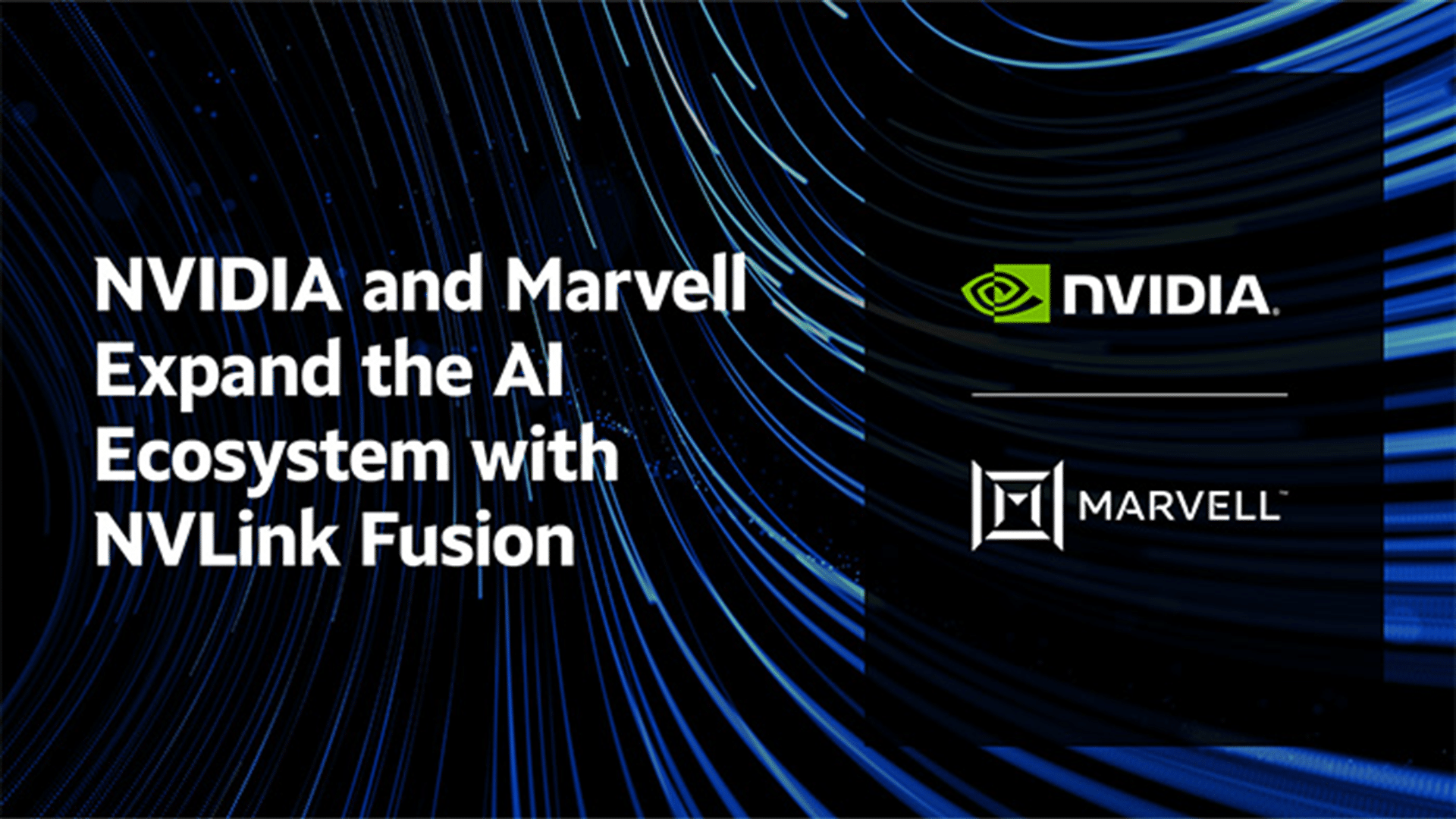
NVIDIA and Marvell formed a strategic partnership anchored on NVLink Fusion and a $2 billion investment, enabling semi-custom AI infrastructure and deeper ecosystem integration. The move highlights a shift toward heterogeneous data centers while reinforcing NVIDIA’s control over the AI stack.
What is Covered in This Article:
- NVIDIA and Marvell announced a strategic partnership connecting Marvell to NVIDIA’s AI factory and AI-RAN ecosystem via NVLink Fusion.
- NVIDIA invested $2 billion in Marvell to strengthen AI compute, networking, and optical interconnect capabilities.
- Marvell will provide custom XPUs and networking, while NVIDIA contributes CPUs, GPUs, DPUs, interconnects, and full-stack infrastructure.
- The partnership supports heterogeneous AI systems, allowing integration of non-NVIDIA silicon into NVIDIA-based environments.
- Collaboration extends to telecom AI infrastructure and silicon photonics, targeting distributed AI workloads and next-generation interconnect.
The News: NVIDIA and Marvell announced a strategic partnership to connect Marvell’s technology portfolio to NVIDIA’s AI factory and AI-RAN ecosystem via NVLink Fusion, a rack-scale platform that enables semi-custom AI infrastructure. As part of the agreement, NVIDIA has invested $2 billion in Marvell, with Marvell contributing custom XPUs and networking technologies, while NVIDIA provides its broader compute, interconnect, and infrastructure stack.
The companies will also collaborate on silicon photonics, optical interconnect solutions, and telecom infrastructure using NVIDIA Aerial AI-RAN for 5G and 6G networks. The partnership enables customers to build heterogeneous AI systems fully compatible with NVIDIA platforms, integrating GPUs, LPUs, networking, and storage while leveraging NVIDIA’s global supply chain ecosystem.
Will NVIDIA Investment Accelerate Marvell’s XPU Growth?
Analyst Take: The NVIDIA Marvell NVLink Fusion partnership underscores the inevitable momentum of NVLink as the dominant fabric in AI data centers. The partnership deepens Marvell’s initial participation in NVLink Fusion, supported by a $2 billion investment that reinforces ecosystem alignment. This allows NVIDIA to meet enterprise demand for flexibility and heterogeneous architectures as a data center architect, with NVLink Fusion acting as the integration layer. The collaboration extends beyond data centers into telecom infrastructure through AI-RAN and silicon photonics, aligning NVIDIA with long-term customer priorities, regardless of vendor. The development reflects a structural shift toward mixed silicon environments anchored by a unified control framework.
Validation of Marvell’s Leadership in the XPU Ecosystem
This deal validates Marvell’s position as a core participant in the emerging XPU landscape and advanced connectivity segment, supported by its acquisitions of Celestial AI and XConn Technologies. Marvell has built a pipeline of 18 XPU sockets expected to accelerate revenue growth in 2027, highlighting its expanding role in custom silicon. Marvell’s positioning reflects its role in enabling infrastructure rather than competing directly with GPU dominance. NVIDIA’s $2 billion investment — twice the cash portion of Marvell’s Celestial AI acquisition — highlights the strategic foresight of aligning early with optical and XPU innovation.
NVLink Fusion and the Shift Toward Heterogeneous Architectures
NVLink Fusion enables integration of non-NVIDIA accelerators into NVIDIA-based systems, directly addressing enterprise demand for heterogeneous AI environments. Enterprises require multiple chip types for different workloads, making single-vendor architectures insufficient. NVIDIA’s approach allows semi-custom silicon to integrate more directly while maintaining control over the interconnect and software layers. This aligns with the broader view that heterogeneity is the destination for enterprise AI deployments. The partnership reinforces NVIDIA’s strategy to control the fabric connecting diverse compute environments rather than limiting participation to proprietary silicon. This also reflects a fragmenting XPU landscape, where Marvell’s growing pipeline of 18 XPU sockets increases pressure on NVIDIA to maintain ecosystem control.
Competing Network Standards and Ecosystem Control
Marvell’s involvement is notable given its support for UALink, an alternative interconnect standard backed by multiple industry players. The coexistence of NVLink and UALink reflects a broader industry trend in which multiple network fabrics will be required to support specialized chip clusters. Marvell’s integration into NVLink enables it to support customers such as AWS, which are embedding NVLink Fusion into their Trainium4 roadmap. NVLink’s expanding adoption across hyperscalers increases its deployability despite competing standards. The development highlights that ecosystem control may be determined by integration depth rather than standardization alone.
Optical and Telecom Expansion as Strategic Drivers
NVIDIA customers are increasingly demanding optical interconnect options, an area the company does not fully control within its supply chain. Marvell’s optical expertise strengthens its XPU proposition and enables NVIDIA to benefit from optical scale-out across the data center. The partnership places significant emphasis on optical interconnects and silicon photonics, areas that are increasingly critical for scaling AI infrastructure. NVIDIA has already invested $4 billion in optical supply chain players Coherent and Lumentum, and this agreement extends that strategy by incorporating Marvell’s optical expertise. Optical interconnects address data-transfer efficiency and power-consumption challenges in large-scale AI deployments. The collaboration also extends into telecom networks through AI-RAN, positioning networks as part of the compute architecture rather than transport layers. This indicates a shift toward a distributed AI infrastructure where data centers and networks operate as a unified system.
What to Watch:
- NVLink adoption across additional chip vendors and its impact on UALink relevance
- Execution timelines and revenue realization from Marvell’s 18 XPU socket pipeline
- Customer uptake of optical interconnect and silicon photonics in large-scale deployments
- Integration of AI-RAN into telecom networks and its effect on distributed inference workloads
- NVIDIA’s continued capital deployment across the AI supply chain and ecosystem partners
See the complete press release on the NVIDIA and Marvell NVLink Fusion partnership and AI infrastructure expansion on the Marvell website.
Disclosure: Futurum is a research and advisory firm that engages or has engaged in research, analysis, and advisory services with many technology companies, including those mentioned in this article. The author does not hold any equity positions with any company mentioned in this article.
Analysis and opinions expressed herein are specific to the analyst individually and data and other information that might have been provided for validation, not those of Futurum as a whole.
Other Insights from Futurum:
Marvell’s XConn Buy Yields a Two-Pronged Open Fabric Play Against NVLink
NVIDIA GTC 2026 Day 1 – Can NVIDIA’s Ecosystem Accelerate the Inference Inflection?
Coherent’s $23 Billion Growth Opportunity Lifted by NVIDIA’s Optical Ambitions
Source: Marvell
Author Information

Brendan is Research Director, Semiconductors, Supply Chain, and Emerging Tech. He advises clients on strategic initiatives and leads the Futurum Semiconductors Practice. He is an experienced tech industry analyst who has guided tech leaders in identifying market opportunities spanning edge processors, generative AI applications, and hyperscale data centers.
Before joining Futurum, Brendan consulted with global AI leaders and served as a Senior Analyst in Emerging Technology Research at PitchBook. At PitchBook, he developed market intelligence tools for AI, highlighted by one of the industry’s most comprehensive AI semiconductor market landscapes encompassing both public and private companies. He has advised Fortune 100 tech giants, growth-stage innovators, global investors, and leading market research firms. Before PitchBook, he led research teams in tech investment banking and market research.
Brendan is based in Seattle, Washington. He has a Bachelor of Arts Degree from Amherst College.