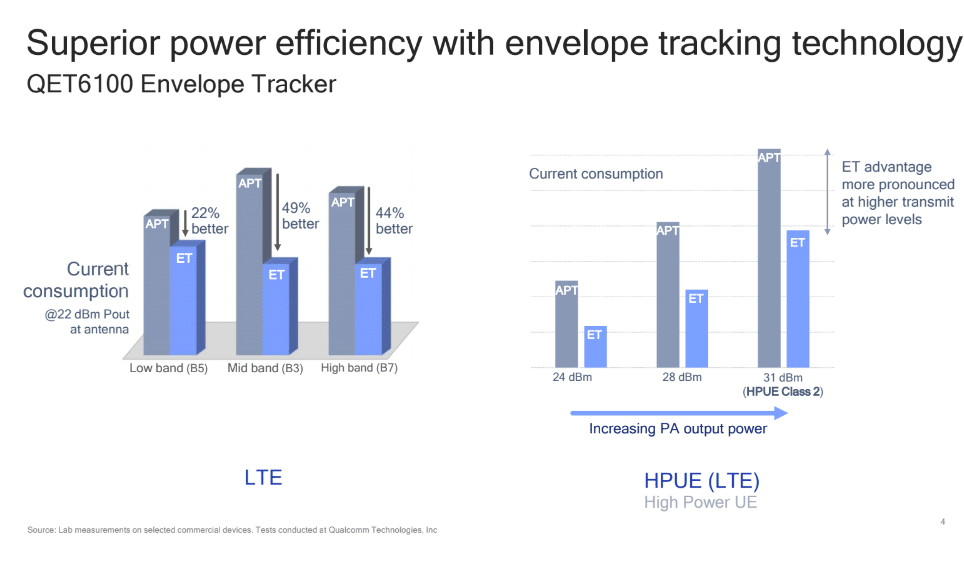
If you spend anywhere near as much time as we do digging into the benefits of 5G, you are bound to start running into a process called envelope tracking. If you aren’t familiar with the term, envelope tracking is a process by which supply voltage being applied to a radio frequency (RF) power amplifier gets continuously adjusted to guarantee peak efficiency, specifically with regard to power. Even if you don’t entirely grasp the inner workings of RF Front End (RFFE), frequencies, or even 5G modems, we can all understand how faster connection speeds and more efficient power management affect our smartphone experience: Faster is better, and a longer battery life between charges is better too.
We have spent a good deal of time validating industry consensus around the fact that Qualcomm is the leader in wireless modems, and particularly in 5G. We’ve also talked quite a bit about Qualcomm’s Snapdragon platform, and how much we like it. What we probably haven’t spent enough time talking about, however, is the RFFE piece, which Qualcomm also gets remarkably right. As 5G deployments begin to scale around the world, this is as good a time as any to start shedding some light on this crucial and yet often-ignored piece of the 5G puzzle.
I was just brushing up on RFFE performance benchmarks, and browsing through Qualcomm specs, and noticed that their new QET6100 5G NR envelope tracking solution, when used in concert with their X55 5G modem, RF IC, and 5G PA modules (QPM6585, QPM5677, and QPM5679) boasted roughly 2x the power efficiency of comparable (premium tier) commercially available solutions, in the mid and high bands.

Translated into real world benefits everyone can understand, that means faster download speeds and longer battery life for smartphone users (at least those powered by Qualcomm chipsets and RFFE solutions), but there is another angle to this that doesn’t get enough coverage benefits to the networks themselves.
Here’s the basic premise: Users connected to a network draw on its resources. The more users are on a network, and the more they place demands on it (downloading videos and other large files, accessing websites, streaming content, making HD video calls, etc.), the more that network struggles to keep up with that demand. That is why when you find yourself in a crowded airport terminal, or a stadium, or a busy cafe, your download speeds typically slow down to a crawl. One of the benefits of 5G deployments is that faster data connections translate into users spending a lot less time drawing on network resources. (If a user can download a movie in twenty seconds instead of five minutes, the network just freed up the remaining four minutes and forty seconds, which can be applied to other users. Now multiply that by thousands of users at any given time, and you should be able to grasp the near-exponential impact on network performance of users like you and me upgrading to phones with fast modems and RFFE solutions.) Those networks depend on a small army of solutions to optimize themselves and deliver at a constant state of peak performance. That is where envelope tracking comes in.
Qualcomm kindly supplied me with data from a recent demo in which they aimed to quantify those network-wide improvement effects using 372 microsites across a major city. What they essentially did was complement an existing LTE network with an additional 5G layer in the 2.5 GHz range, and analyzed deltas in the network’s performance. What they discovered was a spectacular 18x increase in 256 QAM (quadrature amplitude modulation) users on the network, a 25% improvement in throughput (from 44.4GBps to 55.5GBps), a 13% increase in the basic connectivity service area, and impressively, a 27% increase in the HD video call service area. All of this to say that, in addition to making phones faster and more power-efficient, new envelope tracking solutions in 4G and 5G service areas also make networks significantly more efficient in terms of capacity, speed, throughput, and even physical coverage, and the QET6100 certainly appears to be uniquely positioned to lead the charge.

In case you are curious about which phones are currently equipped with Qualcomm’s RFFE solutions, Samsung’s Galaxy S9 and S9+ top the list, alongside Google’s Pixel 2, Sony’s Xperia XZ2, HTC’s U12+ and U11, LG’s G7 ThinQ, the OnePlus 6 and 6T, Motorola’s Moto z3, the Nokia 8, and the Asus Zenfone 5Z. There might be more already, and the list will certainly grow in the coming months, but it is a good place to start.
As our discussions about the benefits and challenges of the global transition to 5G increase in scope and frequency over the next few months, expect RFFE to come up more often than it has in the past.
Author Information

Olivier Blanchard is Research Director, Intelligent Devices. He covers edge semiconductors and intelligent AI-capable devices for Futurum. In addition to having co-authored several books about digital transformation and AI with Futurum Group CEO Daniel Newman, Blanchard brings considerable experience demystifying new and emerging technologies, advising clients on how best to future-proof their organizations, and helping maximize the positive impacts of technology disruption while mitigating their potentially negative effects. Follow his extended analysis on X and LinkedIn.