Analyst(s): Brendan Burke
Publication Date: June 2, 2026
NVIDIA and Microsoft used GTC Taipei to push frontier AI agents onto local hardware, with NVIDIA RTX Spark for personal devices and NVIDIA DGX Station for Windows for the enterprise desk. The move points toward a future where on-device AI relieves a power grid straining under concentrated data center demand. The disclosed specifications and an incomplete software story raise questions about whether these systems can run agents well enough to deliver on that promise.
What is Covered in This Article:
- NVIDIA and Microsoft announced NVIDIA RTX Spark, a 1-petaflop superchip for Windows PCs purpose-built for personal AI agents, alongside NVIDIA DGX Station for Windows, a GB300-based deskside AI supercomputer for enterprise agent infrastructure.
- Both systems are Windows-native and run agents through new Windows security and containment primitives and the NVIDIA OpenShell runtime, with broad OEM support from ASUS, Dell, HP, Lenovo, Microsoft Surface, MSI, and others.
- Our view is that pushing agentic inference to local hardware is becoming a necessary relief valve for an electrical grid that cannot add concentrated data center load fast enough.
- The binding constraint for running agents locally is memory bandwidth, not the headline FLOPS or memory capacity.
- The software story, anchored by NVIDIA OpenShell, is real and open source but explicitly alpha and single-tenant today, which gates the enterprise fleet vision behind DGX Station for Windows more than the personal use case behind RTX Spark.
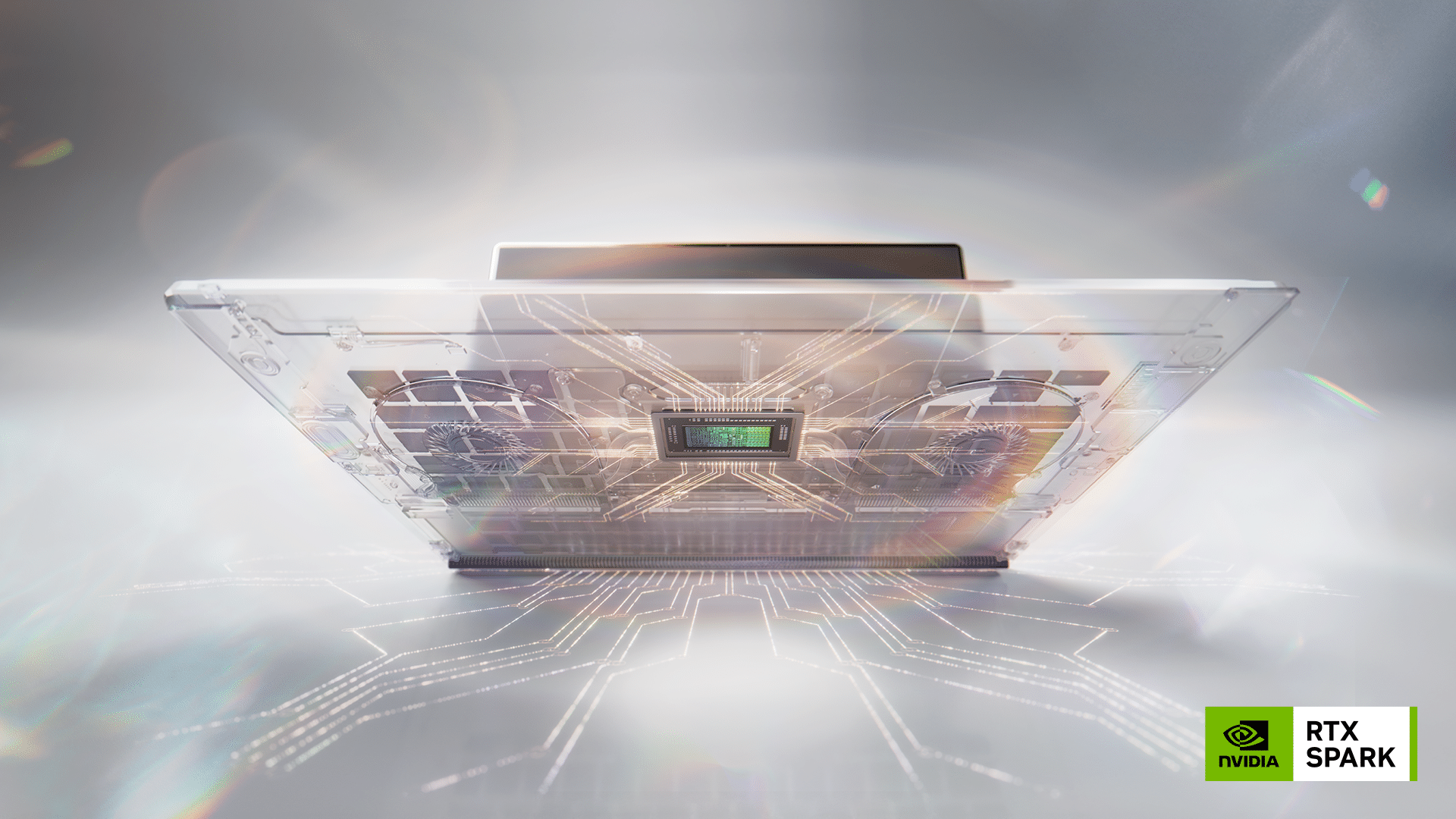
The News: At GTC Taipei, NVIDIA and Microsoft introduced two Windows-native systems built to develop and run AI agents on local hardware. NVIDIA RTX Spark is a new superchip that reinvents the personal computer for on-device agents, pairing a Blackwell RTX GPU of 6,144 CUDA cores and fifth-generation Tensor Cores with a 20-core Grace CPU co-designed with MediaTek over a 600 GB/s NVLink-C2C link. It offers up to 128GB of unified memory and 1 petaflop of FP4 compute, and NVIDIA cites running 120-billion-parameter LLMs with up to 1 million tokens of context locally. RTX Spark laptops and compact desktops arrive this fall from ASUS, Dell, HP, Lenovo, Microsoft Surface, and MSI, with Acer and GIGABYTE to follow.
Alongside it, NVIDIA DGX Station for Windows is a deskside AI supercomputer built on the GB300 Grace Blackwell Ultra Desktop Superchip, with up to 748GB of coherent memory, up to 20 petaflops of FP4, and a ConnectX-8 SuperNIC rated to 800Gb/s. Building on the existing NVIDIA DGX Station system design, it is positioned to run frontier models of up to 1 trillion parameters and to execute hundreds of agents in parallel, shipping in Q4 from ASUS, Dell, GIGABYTE, HP, MSI, and Supermicro. Both tiers run agents through new Windows security and containment primitives and the open-source NVIDIA OpenShell runtime, with Microsoft expected to detail the underlying primitives at Build on June 2 and 3.
Can NVIDIA RTX Spark Make Home AI a Relief Valve for the Grid?
Analyst Take: The headline coverage of NVIDIA RTX Spark will frame it as the reinvention of the PC, a teammate rather than a tool. That story is real, but it is not the most important one for the market. The more consequential read is that NVIDIA is hedging against the single constraint now governing AI buildout, and that NVIDIA RTX Spark and DGX Station for Windows together represent a deliberate bet on moving inference off the centralized grid.
The naming itself is a tell. NVIDIA branded the enterprise-tier DGX Station for Windows rather than extending the RTX line, framing the desk-side box as a node of the AI factory pulled onto the desk and keeping it distinct from the RTX consumer and creator tier that RTX Spark anchors.
Home AI Is Becoming a Necessary Relief Valve for an Overstretched Grid
The binding limit on AI expansion is no longer capital or silicon supply alone. It is where and how fast a new load can be added to the grid. Interconnection queues, substation capacity, and transmission are throttling concentrated AI campuses, and agentic inference is the workload pushing demand the hardest, because it runs continuously and consumes tokens at a far higher rate than chatbot-style interaction.
Pushing that inference to devices users already own and already power changes the load profile rather than the total energy. A laptop or desk-side system draws from distributed residential and commercial circuits with marginal headroom and existing thermal envelopes, and it does so without provisioning new GPUs, cooling, and transmission on a node that is already stressed. The relief is not a reduction in aggregate consumption. It is the redistribution of the fastest-growing, most concentrated load away from the points where the grid is actually breaking. Seen that way, NVIDIA RTX Spark and DGX Station for Windows function as a structural pressure valve for the centralized buildout, and they expand NVIDIA’s addressable market without waiting on a substation.
That thesis only pays off if agents run well enough locally to keep users from reaching back to the cloud. Two gaps stand between the announcement and that outcome.
Memory Bandwidth Will Decide Whether Agents Run
The figures NVIDIA is leading with are capacity and compute numbers. The 128GB of unified memory and 1 petaflop of FP4 describe how large a model fits and how fast it computes in the abstract. Neither is the binding constraint for the workload that matters here. Agentic decode, the token-by-token generation that dominates always-on agent behavior, is memory-bandwidth-bound, not compute-bound. The system reads the active weights for every token it produces, and sustained tokens per second tracks memory bandwidth far more closely than peak FLOPS.
The specification NVIDIA discloses, 600 GB/s, is the NVLink-C2C interconnect between the Grace CPU and the Blackwell GPU. It is not the memory bandwidth feeding the GPU during inference, and the materials do not state that figure. This is the number that will determine whether a local agent feels like a teammate or a delay. Loading a 120B parameter model into 128GB is a capacity claim. Generating tokens from it at a responsive rate is a bandwidth claim, and the announcement answers only the first. The headline maxima also describe separate axes that do not coexist comfortably.
A 120-billion-parameter model and a 1-million-token context window are each plausible in isolation, but the KV cache required to hold a context that long competes directly with model weights for the same unified memory pool. Running near the top of both dimensions at once will strain the 128GB budget well before either limit is reached independently. DGX Station for Windows fares better, since GB300 brings high-bandwidth memory on the Blackwell side, but the same gap between can-load and can-run applies to the 1T parameter claim.
The Software Stack Is Still In Alpha, Leaving an Enterprise Gap
The second gap is software, and a look at the code complicates the easy assumption that OpenShell is vaporware. NVIDIA OpenShell is a live, Apache-2.0 project with published documentation, a command-line interface, a PyPI package, and 14 releases to date, the most recent reaching v0.0.20 in April. It is a serious systems effort, roughly 89% Rust, built around a gateway control plane, per-sandbox isolation, a policy engine, and a privacy router that strips caller credentials and reroutes model calls to controlled backends. The privacy-aware routing and credential containment that the launch materials describe exist in code today, and the runtime already supports agents, including Claude Code, Codex, OpenCode, and GitHub Copilot out of the box, with OpenClaw and Ollama available through a community catalog.
What the repository also makes plain is how early this is. The maintainers describe the project as alpha and, in their own words, “proof-of-life: one developer, one environment, one gateway.” Multi-tenant deployment, the exact capability that justifies DGX Station running hundreds of agents under fleet management, is explicitly still a roadmap item. GPU passthrough, the feature most central to local inference, is labeled experimental and subject to breaking changes. The current isolation model also runs a Kubernetes cluster inside a Docker container, rather than using the new Windows security and containment primitives, and those primitives remain a Microsoft Build story.
The readiness gap is therefore real but asymmetric, favoring the home AI thesis. A single developer running a single secured agent on an RTX Spark device maps cleanly to what OpenShell does today. The enterprise fleet of always-on agents that DGX Station is sold on maps onto what the project says it is building toward. The personal tier is closer to shippable than the enterprise tier, which is the inverse of how the two products were positioned, and it is the strongest evidence yet that the home AI use case, not the data-center-class desk, is where this platform is ready to deliver first.
What to Watch:
- The actual memory bandwidth feeding the GPU on either tier. That figure, not peak FP4, sets the ceiling on agentic token throughput and is the first thing to verify once systems ship.
- OpenShell’s move to multi-tenant deployment and the point at which the new Windows containment primitives replace today’s container-based isolation model.
- Real tokens-per-second benchmarks on representative agentic workloads will determine whether home AI is usable enough to keep inference off the cloud.
- Competitive responses from AMD, Apple, Qualcomm, and the broader Arm PC ecosystem will determine whether on-device agents become a category or an NVIDIA-only premium tier.
- If utilities and regulators begin treating distributed on-device inference as a grid management lever.
See the complete press release on the RTX Spark and the DGX Station in the NVIDIA newsroom.
Disclosure: Futurum is a research and advisory firm that engages or has engaged in research, analysis, and advisory services with many technology companies, including those mentioned in this article. The author does not hold any equity positions with any company mentioned in this article.
Analysis and opinions expressed herein are specific to the analyst individually and data and other information that might have been provided for validation, not those of Futurum as a whole.
Other Insights From Futurum:
NVIDIA Q1 FY2027: Data Center Diversification, Blackwell Scale, CPU Upside
At GTC 2026, NVIDIA Stakes Its Claim on Autonomous Agent Infrastructure
NVIDIA GTC 2026 Day 1 – Can NVIDIA’s Ecosystem Accelerate the Inference Inflection?
Image Credit: NVIDIA
Author Information

Brendan is Research Director, Semiconductors, Supply Chain, and Emerging Tech. He advises clients on strategic initiatives and leads the Futurum Semiconductors Practice. He is an experienced tech industry analyst who has guided tech leaders in identifying market opportunities spanning edge processors, generative AI applications, and hyperscale data centers.
Before joining Futurum, Brendan consulted with global AI leaders and served as a Senior Analyst in Emerging Technology Research at PitchBook. At PitchBook, he developed market intelligence tools for AI, highlighted by one of the industry’s most comprehensive AI semiconductor market landscapes encompassing both public and private companies. He has advised Fortune 100 tech giants, growth-stage innovators, global investors, and leading market research firms. Before PitchBook, he led research teams in tech investment banking and market research.
Brendan is based in Seattle, Washington. He has a Bachelor of Arts Degree from Amherst College.