Analyst(s): Brendan Burke
Publication Date: June 2, 2026
Broadcom has showcased a comprehensive broadband Edge AI portfolio at COMPUTEX, anchored by the BCM68850 50G PON gateway SoC with an integrated neural processing unit and the BCM677x family of fully integrated Wi-Fi 8 SoCs. The portfolio binds 50G fiber, Wi-Fi 8, and AI acceleration into a single architecture, with modest NPUs seeded across the gateways, routers, and set-top boxes Broadcom already ships into the home. The framing positions the residential gateway as an omnipresent, always-on node in a distributed AI fabric, and it treats connectivity rather than raw compute as the gating constraint on what an AI-capable home network can deliver.
What is Covered in This Article:
- The comprehensive broadband Edge AI portfolio that binds 50G PON, Wi-Fi 8, and seeded NPUs into one intelligent edge architecture
- How NPU compute aggregated across gateways, extenders, and set-top boxes reframes the home as a single pooled resource
- Why deterministic, low-latency connectivity is as central to the edge AI story as on-device compute
- The tiered, mix-and-match Wi-Fi 8 SoC portfolio and the supply chain flexibility behind its cost positioning
- The Samsung partnership that delivers Broadcom’s first Wi-Fi 8 fixed wireless access platform
The News: At COMPUTEX 2026, Broadcom showcased a comprehensive broadband Edge AI portfolio spanning a 50G PON gateway SoC, a full Wi-Fi 8 product family, and a joint 5G and Wi-Fi 8 fixed wireless access platform built with Samsung, all designed to deliver the deterministic low latency, localized processing, and reliability that next-generation connected AI applications require across smart homes and enterprises.
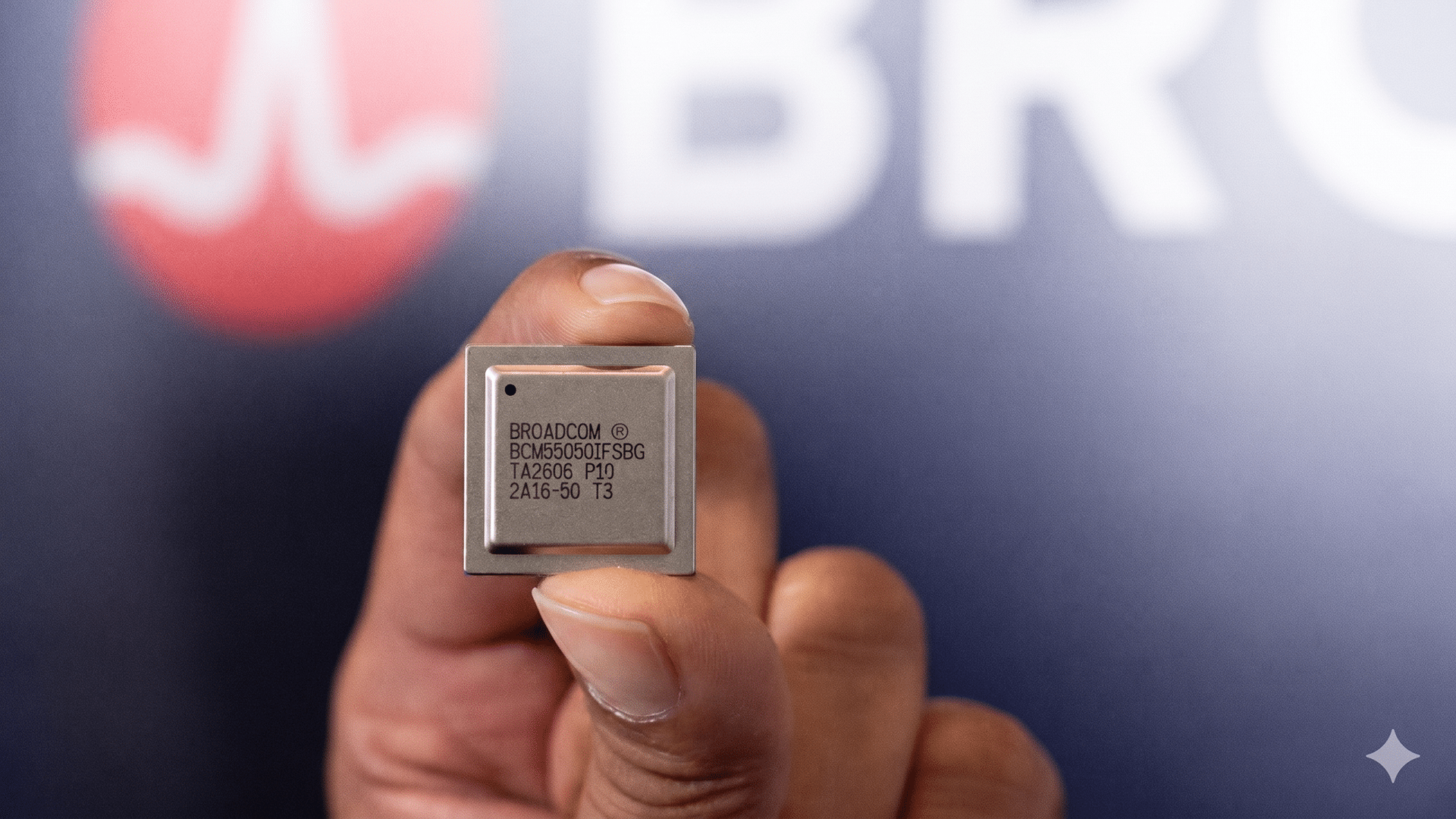
The centerpiece silicon is the BCM68850, the industry’s first 50G ITU-PON home gateway SoC, which combines symmetric 50G throughput, an integrated NPU, native Wi-Fi 8 compatibility, intelligent self-healing, and post-quantum cryptography, paired with the BCM677x family of BCM6772, BCM6774, and BCM6776, the industry’s first fully integrated Wi-Fi 8 SoCs for Ethernet routers and mesh networks. Broadcom frames the CPU and NPU in these devices as intelligent agentic orchestrators that dynamically route compute between edge and cloud while serving as the local agentic compute engine. The portfolio is built on five successive waves of Wi-Fi 8 innovation plus dedicated broadband platforms.
Vijay Nagarajan, vice president of marketing in Broadcom’s Wireless and Broadband Communications Division, said the intelligent broadband edge “requires a fundamentally new foundation for the smart home and the smart enterprise,” and framed the embedded NPUs as a way for service providers to protect user privacy, reduce network congestion, and deliver the multi-gigabit, sub-millisecond connectivity the AI era demands. Partners, including ASUS, NETGEAR, TP-Link, Sagemcom, Sercomm, Arcadyan, and Vantiva, have confirmed early-access sampling and development plans around the new Wi-Fi 8 silicon.
Broadcom Lays the Pipeline for the Intelligent Edge With 50G PON and Wi-Fi 8 at COMPUTEX 2026
Analyst Take: Broadcom is laying connectivity headroom and seeding AI acceleration ahead of demand, so that workloads can migrate to the edge as they prove out rather than being forced there prematurely. The company is the only semiconductor vendor with AI-accelerated silicon spanning hyperscaler XPUs in training clusters and residential gateway NPUs at the subscriber premises, which gives it a coherent inference continuum no competitor currently matches end-to-end. Placing small, low-cost NPUs in devices operators already deploy can unlock a class of distributed AI applications at the intelligent edge well before server-class GPUs are widely deployed as home assistants.
Connectivity Is as Central to the Intelligent Edge as Compute
Broadcom’s main argument is that the edge mirrors the data center. Just as a training cluster is as much about networking as compute, an AI-capable home is as much about connectivity as it is about the processor in any one device. Most endpoints in the home do not need to be intelligent, but they do need to be connected. A camera can remain a low-cost sensor that streams video to the gateway, where presence detection, video processing, or Wi-Fi sensing runs once for the whole home. The gateway earns this role because it is the one device that never leaves. Unlike a phone or a laptop, the broadband box is omnipresent and always on, which makes it the natural candidate to double as the home’s agentic device.
Broadcom extends the logic across the devices that an operator installs together. A gateway, its mesh extenders, and a set-top box can each carry an NPU, and through a proxy interface, their capacity pools into an aggregate compute resource, with an older unit able to draw on the AI functions of a newer one and the reverse.
Agentic Traffic Sets a New Determinism Bar
Autonomous agents generate traffic that bears little resemblance to streaming. Continuous state synchronization between local devices and the cloud occurs as frequent micro-bursts that can interrupt steady-state transmissions on shared fiber strands. A Cisco study cited by Broadcom found that AI inference projects will lift edge network traffic by roughly 63%. Next-generation conversational AI that moves beyond turn-based interaction toward continuous dialogue requires a buffer of under 5 milliseconds and end-to-end latency below 80 milliseconds; a standard 10G PON cannot reliably guarantee this under multi-tenant load.
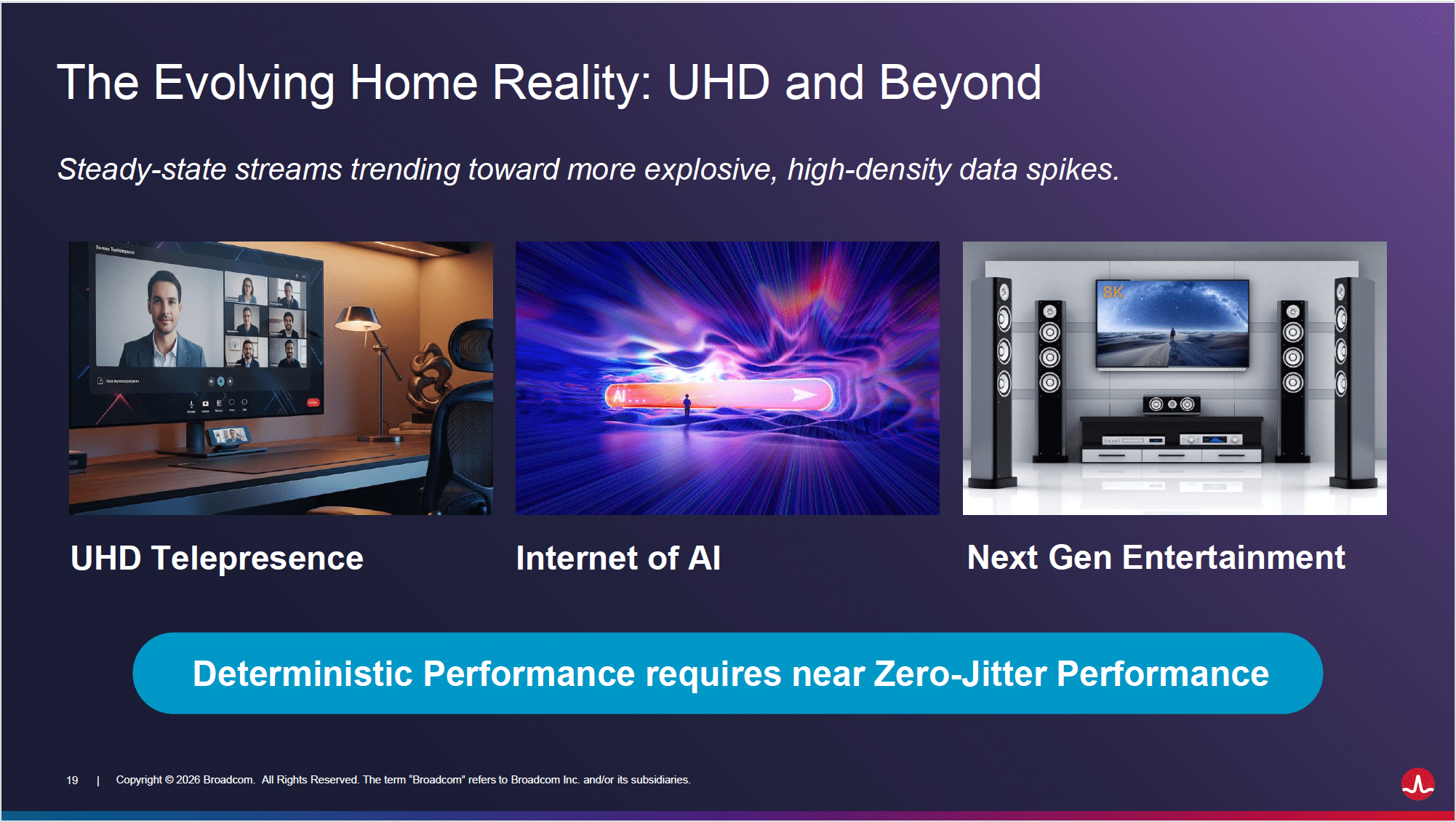
The BCM68850’s symmetric 50G architecture answers this with two concepts, which Broadcom calls optical velocity and node protection. Optical velocity describes how quickly the link absorbs bursty payloads through a burst-and-release mechanism that processes high-density data in sub-millisecond windows before freeing the channel. Servicing one user’s bursty synchronization traffic immediately shields neighbors who need only steady data, yielding deterministic behavior across the shared strand. On a 2 MB synchronization payload typical of AI traffic, Broadcom reports a 5x latency improvement at 50G over 10G.
Tiered Wi-Fi 8 and the Economics of Mix and Match
Broadcom’s fifth Wi-Fi 8 wave marks the decisive shift from multi-chip designs to fully integrated single-chip Wi-Fi 8 SoCs for the retail and mesh markets. The three new parts address distinct price points from one architecture. The BCM6772 targets entry-level retail and service-provider routers with a 2×2 configuration in a compact package and integrated network offload, serving markets where per-user revenue can be as low as $10 per month. The BCM6774 occupies the mainstream with a 2×2 plus 4×4 configuration suited to the dual-band extender topologies common in European deployments. The flagship BCM6776 adds LPDDR support and PCIe Gen3 controllers that enable additional radios for premium routers and gateways, and it is the part Broadcom selected for the Samsung fixed wireless access platform, pairing it with Samsung’s B1320 5G modem to unify 3GPP Release 17 cellular with Wi-Fi 8.
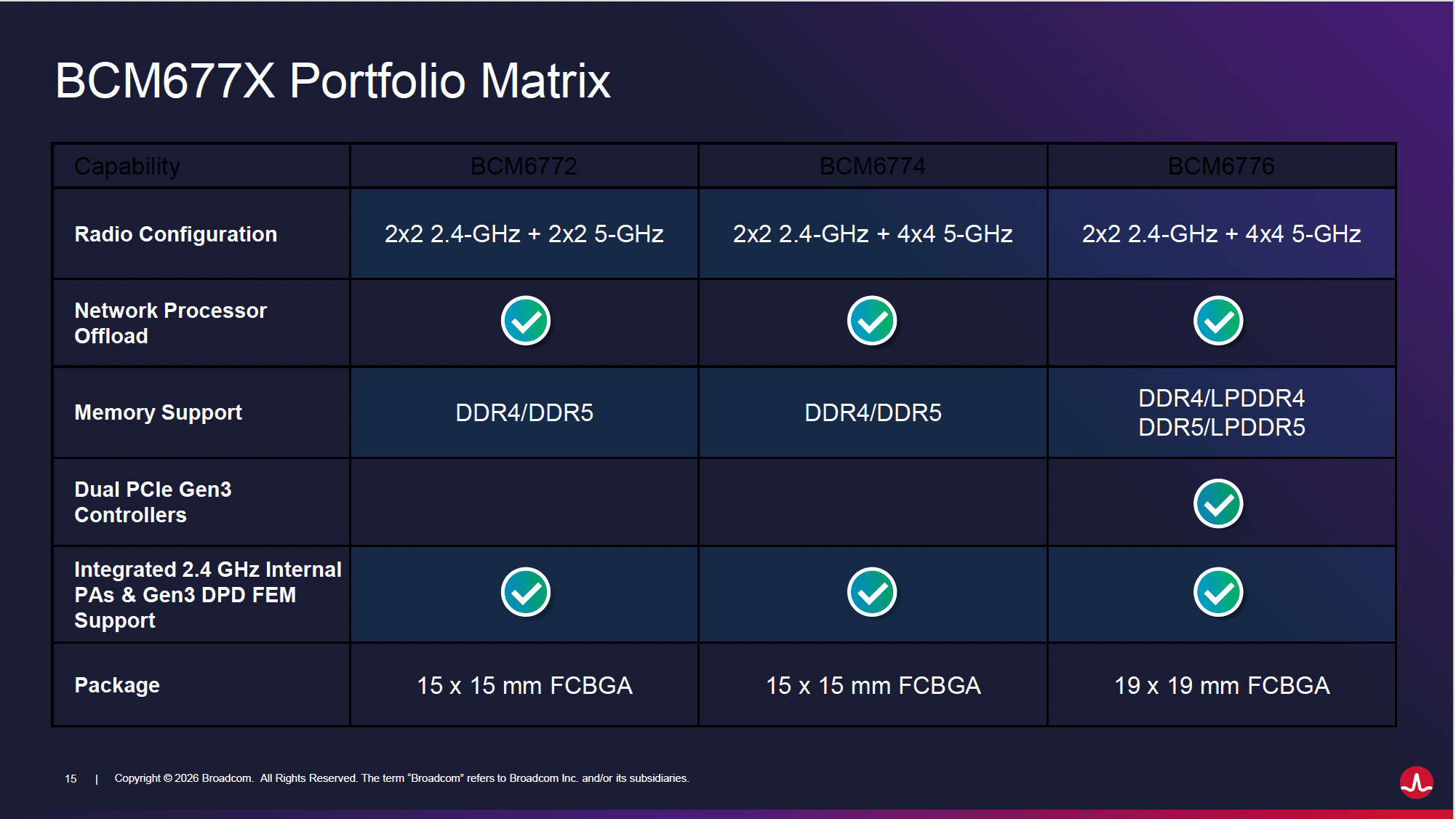
The cost positioning shows three economic constraints of the Intelligent Edge. First, a single architecture produces a wide SKU matrix to achieve product-market fit, with features turned on or off. Second, fab diversity across TSMC and Samsung, with the Wi-Fi 8 parts built on Samsung’s process, provides supply chain flexibility needed for scale. Third, flexible memory support spanning DDR and LPDDR lets partners choose configurations against whatever they can procure, a meaningful advantage amid the current memory crunch and, by Broadcom’s account, a demand driver in its own right. AI is one force pulling Wi-Fi 8 adoption forward, but memory flexibility, standards readiness, and the industry’s roughly four-year refresh cadence are pulling at least as hard, with devices expected to reach the market in early 2027 ahead of certification later that year.
What to Watch:
- Whether operators move from seeded, opex-driven NPU uses such as network monitoring and self-healing toward revenue-generating consumer edge AI, and how quickly the seed-and-scale roadmap adds compute.
- Whether aggregated cross-device NPU compute, pooled through proxy interfaces across gateways, extenders, and set-top boxes, becomes a usable resource or remains a roadmap concept.
- How much AI genuinely pulls Wi-Fi 8 adoption forward relative to memory flexibility, standards readiness, and the four-year refresh cadence, with devices expected ahead of end-2027 certification.
- The pace at which competing silicon vendors answer with integrated CPU-on-SoC Wi-Fi 8 across equivalent tiers, and whether any pursue the costlier phone-class accelerator path that Broadcom has rejected.
- Whether a consumer use case, such as real-time translation, presence-aware entertainment, or security built on low-cost cameras, crosses the threshold that drives an upgrade cycle and materially lifts in-home token demand.
See the full set of these announcements on Broadcom’s investor relations site.
Disclosure: Futurum is a research and advisory firm that engages or has engaged in research, analysis, and advisory services with many technology companies, including those mentioned in this article. The author does not hold any equity positions with any company mentioned in this article.
Analysis and opinions expressed herein are specific to the analyst individually and data and other information that might have been provided for validation, not those of Futurum as a whole.
Other Insights From Futurum:
Broadcom Q1 FY 2026 Earnings Driven by XPU Momentum
Meta’s MTIA Partnership With Broadcom Solidifies the Future of XPUs in Inference Optimization
North Africa’s Cloud Revolution Led by Oracle
Image Credit: Broadcom
Author Information

Brendan is Research Director, Semiconductors, Supply Chain, and Emerging Tech. He advises clients on strategic initiatives and leads the Futurum Semiconductors Practice. He is an experienced tech industry analyst who has guided tech leaders in identifying market opportunities spanning edge processors, generative AI applications, and hyperscale data centers.
Before joining Futurum, Brendan consulted with global AI leaders and served as a Senior Analyst in Emerging Technology Research at PitchBook. At PitchBook, he developed market intelligence tools for AI, highlighted by one of the industry’s most comprehensive AI semiconductor market landscapes encompassing both public and private companies. He has advised Fortune 100 tech giants, growth-stage innovators, global investors, and leading market research firms. Before PitchBook, he led research teams in tech investment banking and market research.
Brendan is based in Seattle, Washington. He has a Bachelor of Arts Degree from Amherst College.