The News: Apple revealed its long-awaited Vision Pro mixed reality (MR) headset at its annual Worldwide Developers Conference (WWDC) on June 5. Among the announced innovations are large advancements in hand and eye tracking, Optic ID for authentication, a new take on pass-through vision, and “personas” that addresses a significant problem with existing market entrants as they try to address communications use cases. The announced price for Vision Pro is $3,499, and it is expected to be available in 2024. The full announcement can be seen here.
Apple Enters the Fray – Are We Ready for Spatial Computing in Communications?
Analyst Take: The Vision Pro headset is packed with innovations that move mixed reality devices much closer to broad adoption. While the hardware is elegant in all the ways we have come to expect for products from the team in Cupertino, you can still see the signs of design struggling against the limits of current technology. Short battery life and the bulky form factor that are hallmarks of MR headsets remain. Still, many of the experiential challenges of its predecessors have been overcome with an array of sensors and raw computing horsepower that only really work if you are Apple and can charge a premium price…a very premium price, in this case.
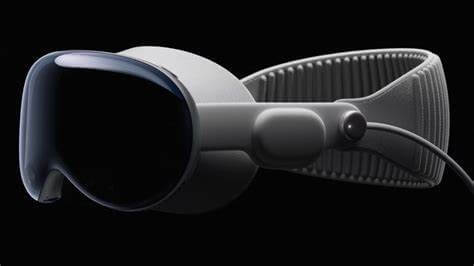
The device includes 12 cameras, five sensors, six microphones, and a couple of speakers. All of this is utilized to create:
- OpticID – A new authentication mechanism similar to Touch ID and Face ID that uses inward-facing cameras to scan the user’s iris for authentication. The effect is that the user is nearly immediately authenticated to the device as soon as they put it on and open their eyes.
- Advanced Eye Tracking – Apple has made tremendous advancements in tracking the very subtle movements of the eye. Humans orient themselves in space with their eyes and are very sensitive to any disruption in the connection between where they are looking and what they are seeing. To achieve any real degree of adoption, eye tracking had to get better and early reports indicate that Apple has this nailed.

- Advanced Gesture Control – Typical gesture control schemes require the user to keep their hands in front of them for outward-facing cameras to capture their movements. This approach often results in fatigue for the user and makes any sense of immersion thin at best. In addition, most headsets have relied on handheld controllers to manage accurate inputs. Apple has opted for no controllers, and to enable that, they have added downward-facing cameras to the normal outward-facing set to make sure they can see your hands. Apple developed a simple control scheme (look at something, put index finger to thumb to click, and motions after that to scroll or move items) to make sure the experience feels intuitive and seamless.
- Net Gen Pass-Through – most headsets have some sort of pass-through vision that allows the user to see what is going around them. Apple has taken things one step further and put an outward-facing OLED screen on the front of the device. For the wearer, an Apple Watch-like digital crown adjusts the amount of the outside world you see around your content. As someone approaches you, the OLED screen on the outside will display a picture of what your eyes are doing inside the headset, giving them the impression that they are making eye contact with you.

What About Communications?
In the keynote, Apple announced that Vision Pro will support FaceTime (of course), Teams, WebEx, and Zoom, and we are confident there will be other platforms on that list over time. But all of our collaboration experiences have become more video-centric in the last 3 years, and the concept of immersive meetings is intuitively attractive. The problem that has bedeviled the industry is that when working together, I want to see you – not you with a TV taped to your face or a cartoon-like representation of you, but actually you.

Cisco’s Hologram has limited itself to one-to-many use cases to avoid the problems of interpersonal connection. Google Starline and Logitech’s Project Ghost use a massive cabinet form factor to get around this limitation. Apple has leaned hard into what they are calling “personas” to solve the problem.
During user onboarding, they use outward-facing cameras to scan their faces in rich 3D.

The result is a more life-like “avatar” than we have seen from any other service that is used to broadcast out to your collaborators.

While early experiences indicate that this has not entirely climbed out of the uncanny valley, it is a huge step forward in allowing headset users to participate fully in collaborative meetings and communications.
Do People Want Immersive Communications?
The concept of immersive communications is intuitively attractive. Removing ourselves from the distractions around us in our remote work settings makes room for deeper connections and more productive work. However, at $3,500? No. But anyone that has watched the tech market for a while knows this price will come way down. Sensors and cameras get cheaper. Hardware margins are sacrificed to make room for software and service revenues. Prices come down with scale.
The bigger question has been, could the technology get to a place where it can fade away and let people communicate? In my opinion, we are not all the way there yet… but the Vision Pro is a massive step forward in addressing the barriers to interpersonal communication that MR devices have struggled with for a long time. Apple will continue to iterate, and the rest of the market will react to it with their own innovations. The form factor will continue to improve, and personas will get more lifelike. Eventually, we will spend a growing portion of our days using augmented reality (AR) devices to bring more information into our meetings and conversations to enrich our experiences as we work together. And if AR gets it right, which it will, it can help us make better connections.
Disclosure: The Futurum Group is a research and advisory firm that engages or has engaged in research, analysis, and advisory services with many technology companies, including those mentioned in this article. The author does not hold any equity positions with any company mentioned in this article.
Analysis and opinions expressed herein are specific to the analyst individually and data and other information that might have been provided for validation, not those of The Futurum Group as a whole.
Other insights from The Futurum Group:
Apple Releases Freeform for Real-Time Digital Whiteboarding Across Mac, iPad, and iPhone Devices
We are Live! Talking Apple, AMD, Qualcomm, Lattice, Zoho and Microsoft
Author Information

Sean is a trusted advisor to and assists industry vendors and enterprises with workplace communications and collaboration strategies, market entry and product assessment, product portfolio analysis, and sales enablement services.
Sean holds a Bachelor of Science in International Business from University of Colorado, Boulder.