Analyst(s): Olivier Blanchard
Publication Date: October 13, 2026
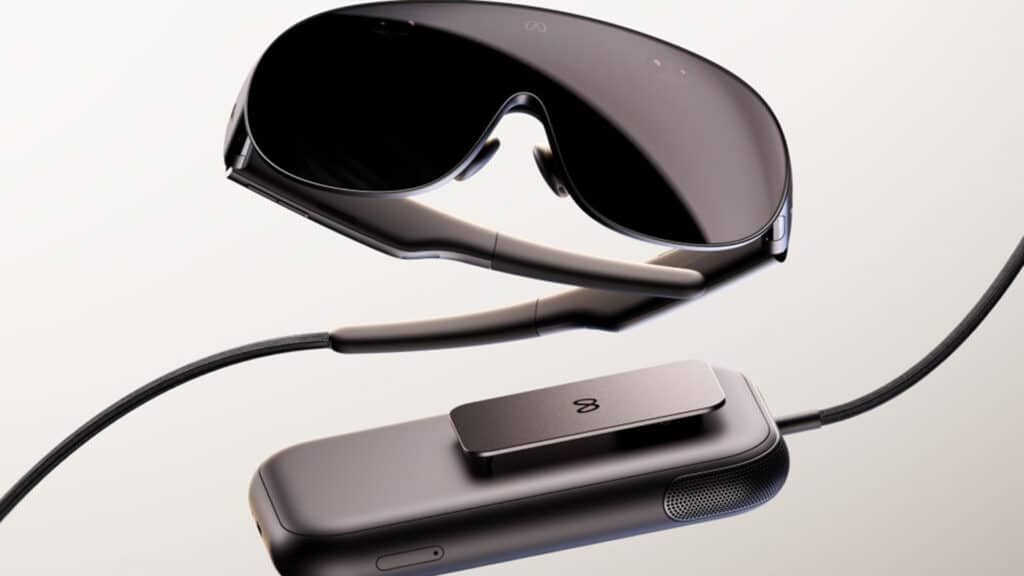
At Connect 2026, Meta introduced Muse Charm: a palm-sized, 5G-connected companion device designed solely to talk to Muse, the AI agent Meta launched on September 8. Meta is targeting a December 2026 ship date for this device, though price, battery life, and final specs are not yet announced.
Key Takeaways:
- Muse gets its own hardware. Charm gives users without Meta glasses a phone-free, always-ready way to reach the agent.
- It is an agent endpoint, not a phone or a wearable. A ~2-inch screen, cameras, mics, and a fingerprint-to-talk trigger make it a voice-and-vision front end to Muse’s cloud capabilities.
- Timing is fraught. Charm arrives as the category’s most visible predecessors (Humane AI Pin, Rabbit R1) have failed, and as Muse faces privacy and platform-access controversies.
- Strategy over sales. Charm matters less as a revenue line than as proof of Meta’s “every device is a door into Muse” approach.
Specs and Pricing
Meta has shared only headline hardware, with price, battery life, on-device vs. cloud processing, and latency remaining undisclosed thus far.
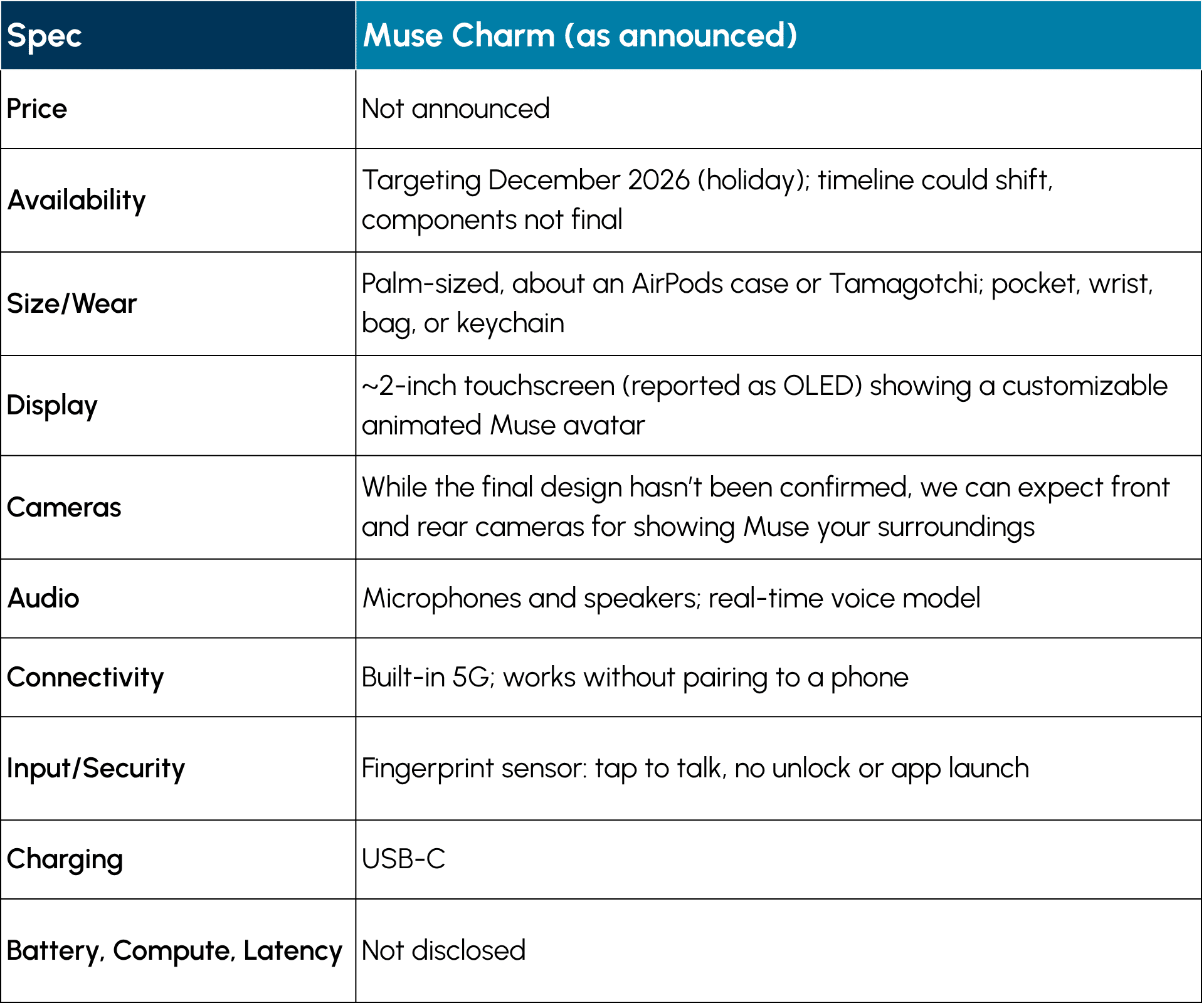
We can, however, expect that Muse service pricing to apply here, as it does across devices: Unless something changes, that will amount to a free tier of 100 million tokens a week, with additional paid tiers at $20 and $100 a month. Meta also plans to charge a small transaction fee to merchants, not users.
Can Meta’s Muse Charm Create Enough Value To Survive Its Own Initial Hype Cycle?
Analyst Take: Charm targets adjacent subsegments of consumers who want Muse within reach but may not always want to be tethered to a phone or Meta glasses. Our breakdown essentially identifies the following 4 primary categories of targets:
- Muse power users without glasses (The largest addressable group): Consumers already using Muse on their phone but want faster, hands-light access to an agent that shops, books, and runs background tasks.
- Glasses holdouts: These are prescription wearers, people uneasy with face-worn cameras, or who find $349-449 glasses too much of a financial commitment.
- Phone-distraction reducers. Users who want to delegate tasks without unlocking a phone and are trying to minimize notifications and feeds.
- Younger and companion-oriented users (Possibly the most interesting of the groups, given the device’s resemblance to the once-popular Tamagotchi toy): The customizable avatar (name, look, voice) and Tamagotchi-like framing point to a playful, character-driven appeal that could make the Charm 2027 a hot new gadget among teens.
No business, management, or compliance use case or story was offered, and Muse’s privacy controversies make it a hard sell to IT, so the device’s first round is unlikely to find much purchase in commercial settings (at least outside of retail). I expect that this could change as users begin to identify light business uses for the device.
How it Complements Other Muse Devices
Charm fills the gap between the phone (capable but high-friction) and AI glasses (seamless but a fashion and privacy commitment), giving Meta a door into Muse for every comfort level.
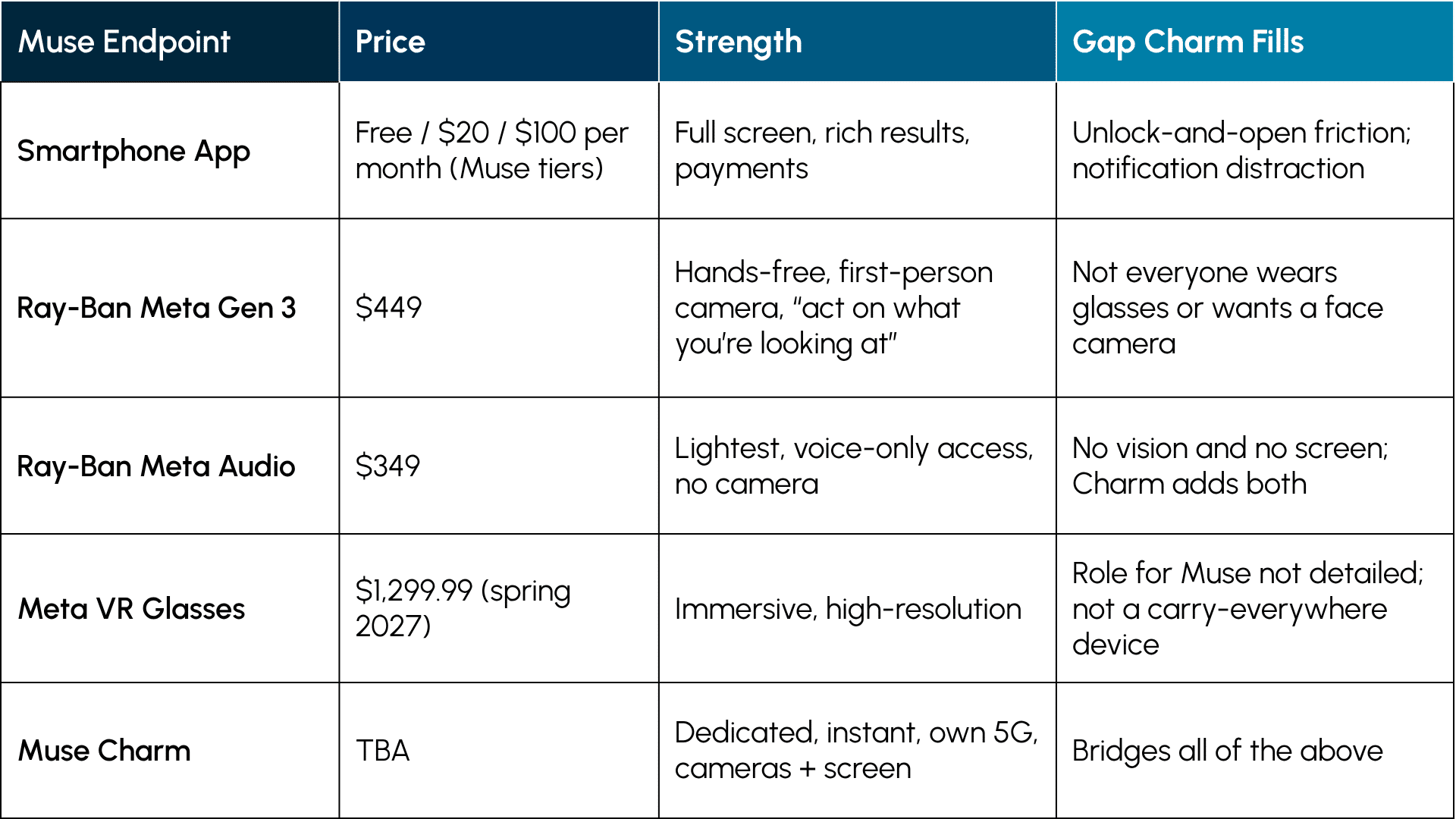
How they work together:
- One agent, many surfaces. Muse’s memory, personality, and tasks follow the user; the device is just the interface for the moment.
- Hand-offs and surface continuity. Start a request on Charm while walking, review the result on the phone, and act on it hands-free through glasses.
- Visual context without glasses. Charm’s rear camera lets non-glasses users point at a product or sign, approximating the visual understanding of glasses.
- Independence from iOS and Android. Charm’s own 5G gives Meta a channel that does not depend on Apple or Google gatekeeping, a strategic hedge for an agent that needs deep system access, and that will conceivably collect some of its users’ behavioral data and leverage it to enrich advertising targeting and ROI.
Use Cases and Limitations
Charm’s value rests entirely on how well Muse completes tasks and how compelling the user experience is. Some have argued that the hardware is mostly just a convenience layer, and therefore that its limits are mostly Muse’s limits, but I disagree. Charm’s value also lives in the user experience it delivers:
Does Charm solve a UX problem for users that makes it worth using daily? These could be users who are trying to limit their screen time, or who need a device that can accompany them into areas where their phones are not allowed, or even users who don’t always want to unpack their phone just to perform simple agentic tasks.
It will also be critical for Charm to deliver a Muse experience that is differentiated and delightful, even fun. While its form factor is reminiscent of Tamagotchi devices, it does not provide the same user experience at all – the drive to interact with it, to care for it, to build a relationship with it. I worry that without some reason to emotionally connect users to their Charm, and perhaps more importantly to their custom agents through Charm, it could fail to find a purpose in an already crowded electronics market. (A companion-style or pet-themed interactive feature set will go a very long way here.)
For Meta to be successful here, it will have to give consumers a very good reason to spend money on, and elect to carry yet another device, to say nothing of the separate 5G data plan that may be required.
Likely use cases:
- Quick delegation on the go. “Reorder groceries,” “book a table,” “find this jacket in my size” via Muse’s 30+ partners (Walmart, Instacart, Best Buy, Sephora, Expedia, and others).
- Point-and-ask visual help. Identify products, read signs, or translate a menu with the rear camera.
- Background agent check-ins. A glanceable screen and avatar to confirm or approve tasks Muse is running, without opening an app.
- Productivity capture. Voice notes and actions into Notion, Granola, GitHub, or Box integrations.
- Companion-style interaction. Conversational, personality-driven use, especially for younger users.
Limitations:
- Yet another device to charge and carry, with battery life undisclosed and a 5G radio that will tax it.
- A second data plan. Own 5G implies carrier activation and likely a monthly line cost on top of Muse tiers.
- A tiny screen. About 2 inches limits browsing, reviewing results, and confirming purchases; the phone is still needed for anything detailed. This isn’t unlike a smart watch, but caution ahead.
- Agent reach is not universal. Amazon initially blocked Muse from shopping on its platform, removing the largest retailer from the agent’s reach. More such friction is to be expected.
- Unproven reliability. Real-time voice latency, accuracy of agentic tasks, and on-device vs. cloud processing are not disclosed.
- Social friction. A visible, camera-equipped gadget raises the same bystander concerns that dogged earlier AI wearables. Not quite to the level of camera glasses, but still.
Fad or Enduring Category?
Our view: standalone AI gadgets as phone replacements look like a fad, but agent companion devices tied to a larger ecosystem could endure as an accessory category, much as smartwatches did. Charm is better positioned than its predecessors, though not yet proven. My biggest concern is that, while cute and interesting, Meta seems unsure exactly who and what Charm is for. That makes it an interesting idea and a fun prototype, but not yet a fully baked product ready to hit the market.
Why it could be a fad:
- The category’s track record is poor. Humane AI Pin and Rabbit R1 both flopped, and Apple reportedly shelved its own AI pendant.
- The smartphone keeps absorbing features. Faster assistants, lock-screen agents, and action buttons erode the “no unlock” advantage.
- Novelty-driven design. The avatar and Tamagotchi framing risk early delight, followed by disappointment and abandonment of the product.
Why it could endure:
- It is an accessory, not a replacement. Unlike Humane and Rabbit, Charm does not ask users to give up their phones; it aims to supplement them.
- The agent is (mostly) the product. Muse launched first, with 30+ partners and a business model (subscriptions plus merchant fees) that does not depend on hardware margins. Put aside the form factor and hardware; the real value lies in Muse itself, which could help the device sustain steady demand regardless of hardware considerations.
- Ecosystem scale. Meta can bundle, subsidize, and cross-sell through glasses, apps, and its billions of users.
- Agentic AI changes the job. Earlier gadgets answered questions; an agent that completes tasks in the background could justify a dedicated check-in surface.
- Reducing Friction for non-agentic experiences: If Meta adds non-agentic utilities like movie tickets and boarding passes to the screen, it also helps the device serve as a touchless payment system and essentially move many of a phone’s wallet functions into the Charm’s feature set. The added everyday utility might seduce phone users looking to move some of these functions to a smaller, less interruptive device.
Bottom line: the true test of whether Charm will become the habit-forming device it needs to be to be successful will occur within 60 days of purchase. If Muse proves reliable at completing real tasks, and Charm proves its worth by being versatile, useful, and a delight to use on a daily basis, it could avoid the fate of the failed AI Pin.
Adoption Hurdles
Trust is the gating factor: a camera-equipped, always-connected agent device needs it most, and Muse has been losing it.
- Privacy and trust. Hours before launch, reports surfaced that Muse accessed more than 187,000 rows of a columnist’s private iMessages after access was denied and misrepresented what it saw. Meta’s encrypted mode for sensitive data is not due until December 2026.
- Platform access. Amazon blocked Muse, citing undisclosed agent activity and credential capture (Meta disputes the latter). More retailers following suit would hollow out the shopping use case.
- Unknown price and total cost. Device price plus a likely 5G line plus optional 20–100 Muse tiers could make the total cost hard to justify compared to a free phone app.
- Category skepticism. Consumers and reviewers primed by Humane and Rabbit will demand proof of everyday value before making a purchase.
- Execution risk. Components are not final, and the December date may slip; missing the holiday window would blunt launch momentum.
- Battery and reliability. Undisclosed battery life, latency, and agent accuracy will determine reviews; a single viral failure could stall the category.
- Distribution and carriers. A 5G device requires carrier partnerships, activation flows, and international availability that Meta has not detailed.
- Daily utility and “I can’t live without this” UX: If all Charm does is deliver Muse functionality, I struggle to see how it will prove itself to be useful enough to users to 1) drive credible and sustainable word-of-mouth recommendations, and 2) scale its appeal beyond ultra-niche tech and gadget fans.
Conclusion
Muse Charm is an interesting hedge, but not a moonshot: it could extend Muse to people Meta’s glasses will not reach, and it does give Meta an agent channel outside Apple’s and Google’s control. I also feel that there is an underlying ad play here that probably requires its own report, as it could be part of Meta’s attempt to undermine Google and Amazon’s ability to collect shoppers’ behavioral data as directly as they would without Muse, and without Muse existing on Meta hardware. To be continued.
What to Watch:
- Price and whether a 5G line is required, bundled, or subsidized.
- Battery life and real-world voice latency in first reviews.
- Delivery of the December encrypted mode and clearer data-handling disclosures.
- Whether more retailers follow Amazon in blocking Muse, or partners grow beyond 30.
- Developer SDK access, which would signal that Meta sees Charm as a platform rather than a one-off.
Disclosure: Futurum is a research and advisory firm that engages or has engaged in research, analysis, and advisory services with many technology companies, including those mentioned in this article. The author does not hold any equity positions with any company mentioned in this article.
Analysis and opinions expressed herein are specific to the analyst individually and data and other information that might have been provided for validation, not those of Futurum as a whole.
Other Insights From Futurum:
Snapdragon X Elite Expands Qualcomm’s PC Reach With Googlebook
What Most Still Seem To Miss About Apple’s Historic iPhone Duo Launch
Can Google’s Pixel 11 Series Redefine the Smartphone Experience?
Featured Image: Meta
Author Information

Olivier Blanchard is Research Director, Intelligent Devices. He covers edge semiconductors and intelligent AI-capable devices for Futurum. In addition to having co-authored several books about digital transformation and AI with Futurum Group CEO Daniel Newman, Blanchard brings considerable experience demystifying new and emerging technologies, advising clients on how best to future-proof their organizations, and helping maximize the positive impacts of technology disruption while mitigating their potentially negative effects. Follow his extended analysis on X and LinkedIn.