Analyst(s): Olivier Blanchard
Publication Date: October 13, 2026
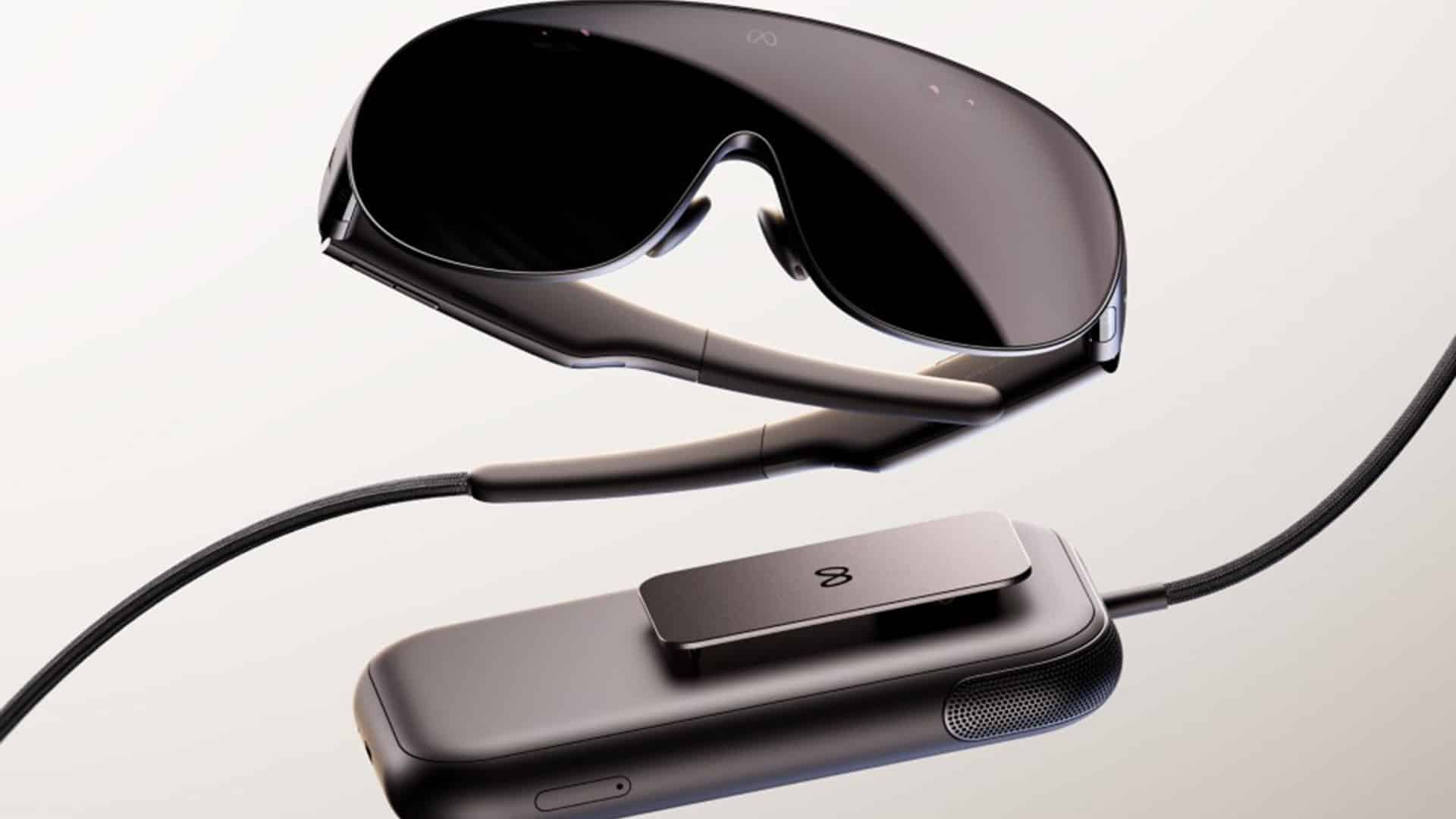
The News: At its Connect 2026 event, Meta unveiled Meta VR Glasses: a ~100-gram, puck-tethered micro-OLED headset priced at $1,299.99 and shipping in spring 2027. It is Meta’s clearest attempt yet to break VR out of the “ski goggles on your face” form factor, trading field of view and untethered freedom for comfort, image quality, and most of all, portability.
Key Takeaways:
- Form factor is the headline. Moving compute and battery into a 300g pocket puck gets the head-worn part down to roughly a deck of cards.
- Display is a generational jump for Meta. Micro-OLED, HDR, Dolby Vision, and IMAX Enhanced certification put media consumption at the center of the pitch.
- The trade-offs are real. A ~70° horizontal FOV, a cable, three hours of battery, and no bundled controllers make this a premium niche device, not a Quest replacement.
- It undercuts Vision Pro by roughly $2,400, which reframes the high-end spatial computing conversation around price and comfort rather than raw fidelity.
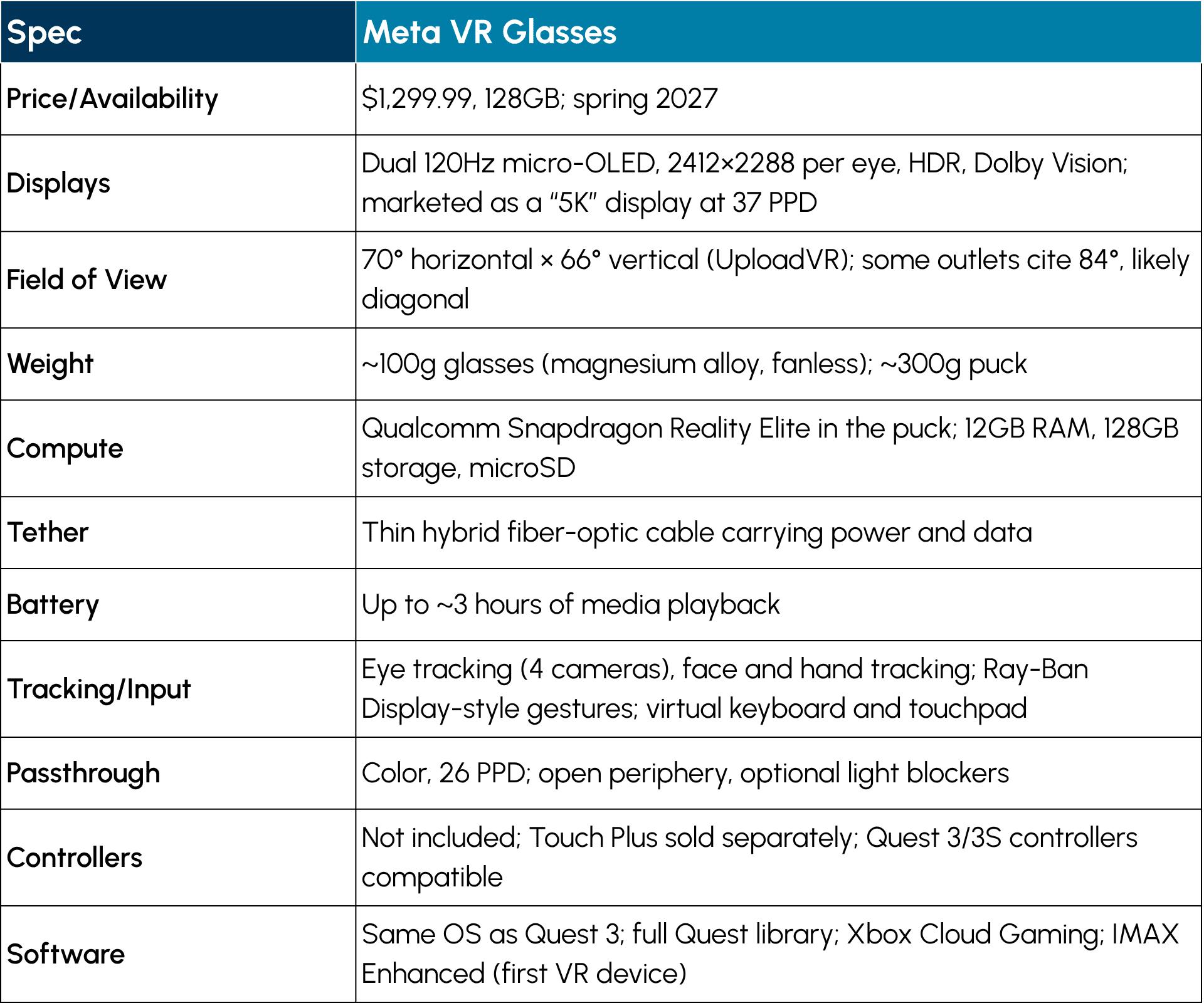
Specs and Pricing
Meta VR Glasses cost $1,299.99 (128GB) and ship in spring 2027; controllers are optional, with bundles in some retail channels.
Meta’s New VR Glasses Challenge Apple Designers To A Spatial Computing Adoption Race
Analyst Take: This is the biggest architectural break in Meta’s VR line since the original Quest: it trades the all-in-one, wide-FOV headset for a split design that prioritizes comfort and pixels.
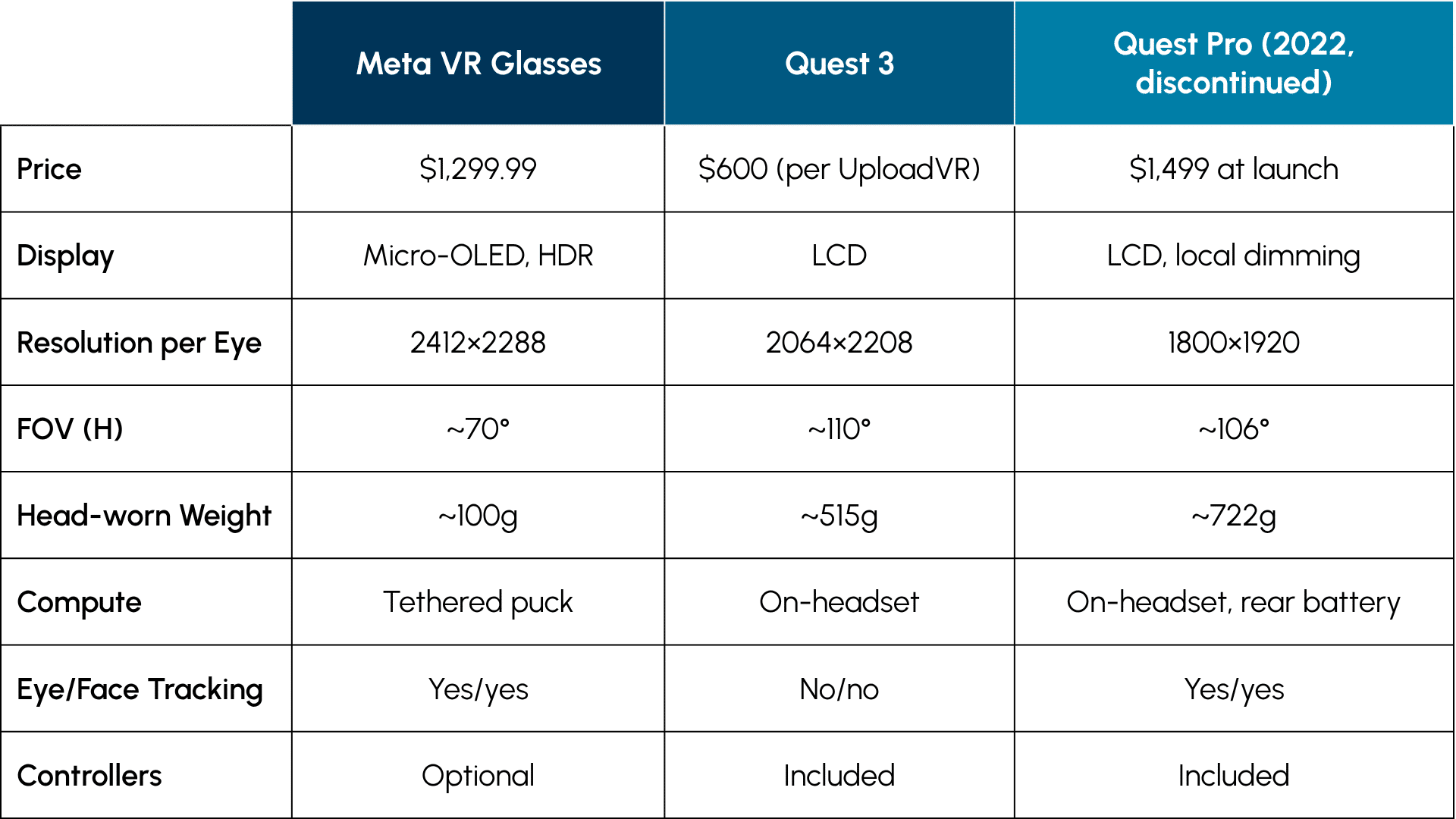
What improved:
- Weight and comfort. Roughly a fifth of Quest 3’s head-worn weight; hands-on reviewers reported less face and head fatigue and no heat on the face.
- Image quality. First non-LCD Meta headset since the 2019 Quest, with the highest resolution Meta has shipped; text and code legibility drew specific praise.
- Input. Eye tracking returns (absent since Quest Pro) and pairs with low-effort, hands-in-lap gestures borrowed from Ray-Ban Display.
- Continuity. Same OS as Quest 3 and full library compatibility, so the content gap that plagues new platforms is not an issue on day one.
What changed, not necessarily for the better:
- Field of view shrinks by about a third horizontally versus Quest 3, which limits VR’s promise of full immersion. As with all trade-offs, most users will likely find the weight savings worth it, but for some, this could feel like a step down from a fully immersive VR UX. Having said that, enabling greater awareness of one’s surroundings with a more portable device (presumably used in public transportation, air travel, professional, and hospital environments) seems like a necessary feature.
- A cable returns, albeit a thin fiber, plus a 300g puck to the pocket. Easy to mitigate, but not as practical or sexy as a truly wireless form factor.
- Controllers are unbundled, signaling that Meta sees media, streaming, collaboration, and productivity, not gaming, as the primary uses.
- Price more than doubles Quest 3, placing it in Quest Pro territory, where Meta has struggled before.
Use Cases and Limitations
Meta’s own framing, “a private cinema, multiple monitor workspace, and game console in one device that fits in your bag,” is a fair map of where this product shines and where it strains.
Strongest use cases:
- Personal cinema and live sports. Micro-OLED, HDR, Dolby Vision/Atmos, and IMAX Enhanced are a natural fit; Meta lined up Prime Video, YouTube, Disney+ (3D Marvel films from November), HBO Max, ESPN, DIRECTV, and 100+ immersive live sports events a year.
- Travel and commuting. At 100g in a bag-friendly kit, this is the first Meta headset plausibly used on a plane or train for hours, not minutes.
- Portable multi-monitor work. Sharp text, eye-plus-gesture input, and a virtual keyboard/touchpad make laptop extension and focused “virtual office” sessions credible.
- Therapy and relaxation: I expect that meditation, visualization, and therapy applications will be among the most popular types of content being experienced through these glasses.
- Mixed reality with situational awareness. The open periphery is a feature for passthrough use, where seeing your surroundings matters more than total immersion. I feel that this is far more of a benefit than a hindrance.
- Casual and cloud gaming. Quest library and Xbox Cloud Gaming access give it a deep catalog, with or without controllers.
Limitations:
- Immersion ceiling. A ~70° FOV is “less immersive than a Quest headset” when light blockers are attached (UploadVR); core VR gamers will notice, but every other user will enjoy the ability to sense their surroundings and be able to exit the experience as needed. This has obvious personal safety implications that I feel are important to emphasize.
- Three-hour battery. Enough for a movie, not a workday or a transatlantic flight without a top-up. This is an area where Meta will need to focus in the next year. 3 hours per charge just isn’t enough for >$1K VR glasses.
- Tether and puck. Reviewers noted the puck runs warm and adds pocket weight; snag and cable management concerns remain unproven at scale. This kind of design friction will keep casual VR-curious consumers from completing their purchase.
- Light leakage. Hands-on demos were in dim rooms; bright-light performance is still an open question.
- Input gaps. The virtual keyboard lacks haptics and felt slightly laggy in demos; the selection highlighting was described as weak. This undermines Meta’s contention that this is a reliable productivity tool. Any recurring or sustained keyboard lag is a non-starter for anyone hoping to use this platform as a productivity alternative to a PC or tablet while on the go.
- Unknowns. Prescription lens fulfillment, real-world puck thermals, and how Muse integrates (unspecified at the keynote) remain unclear.
Pros and Cons vs. Other VR Glasses
Meta VR Glasses sit between two existing camps: display glasses (Xreal, Viture) that are light and cheap but are essentially tethered screens, and lightweight PC-VR headsets (Bigscreen Beyond) that are sharp but need a gaming PC. Meta’s advantage is being the only one in that middle ground with a full standalone platform behind it.
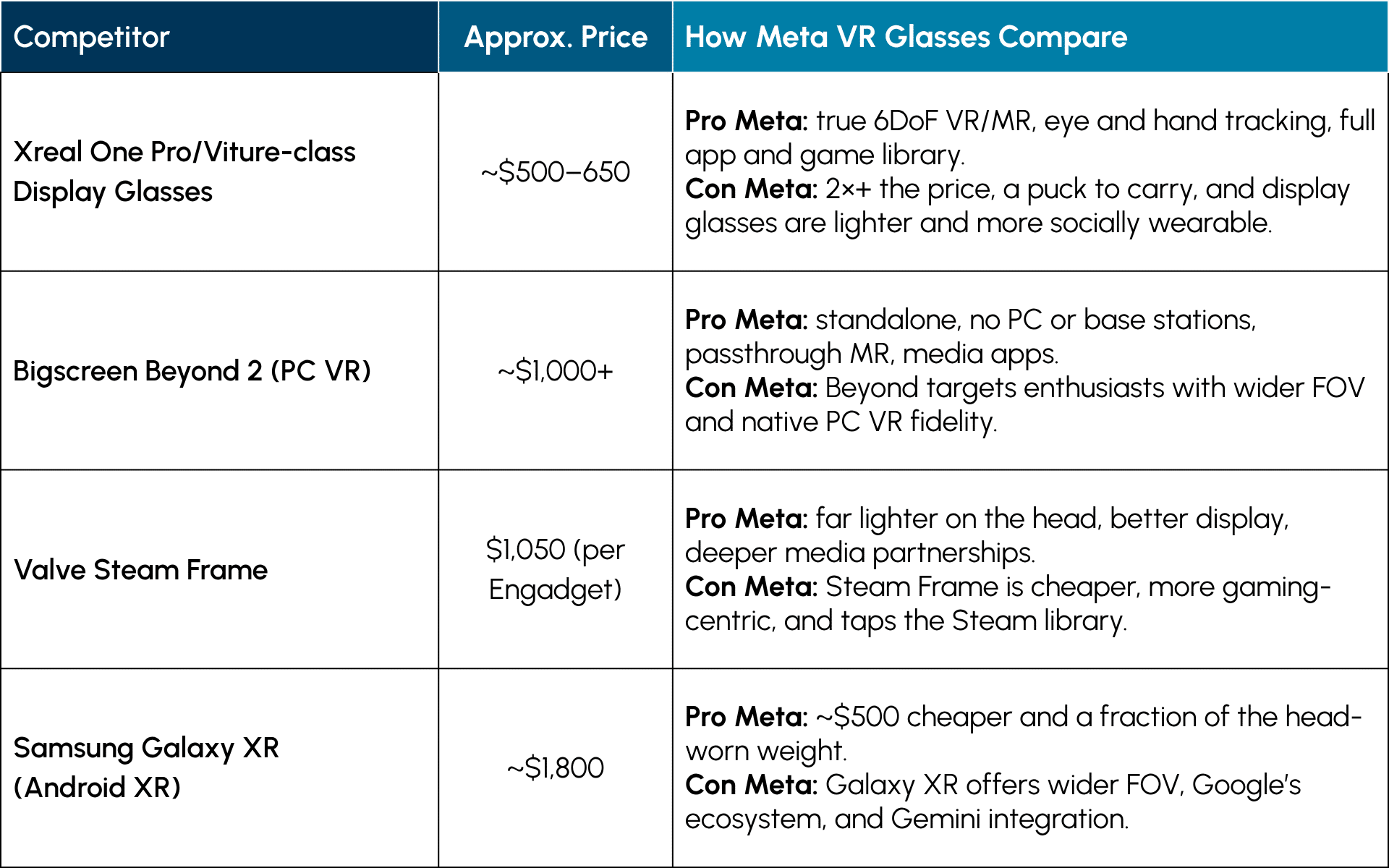
Net pros:
- Best-in-class weight for a full-function standalone VR/MR device.
- Mature content library and developer base from day one.
- Premium media certifications (IMAX Enhanced, Dolby Vision) no glasses-class rival matches.
Net cons:
- Narrower FOV than every true headset in the comparison.
- Tether and puck add friction that display-glasses users don’t have.
- Pricing lands above display glasses without the full immersion of headsets, a positioning reviewers called unclear.
Competitive Comparison vs. Apple Vision Pro
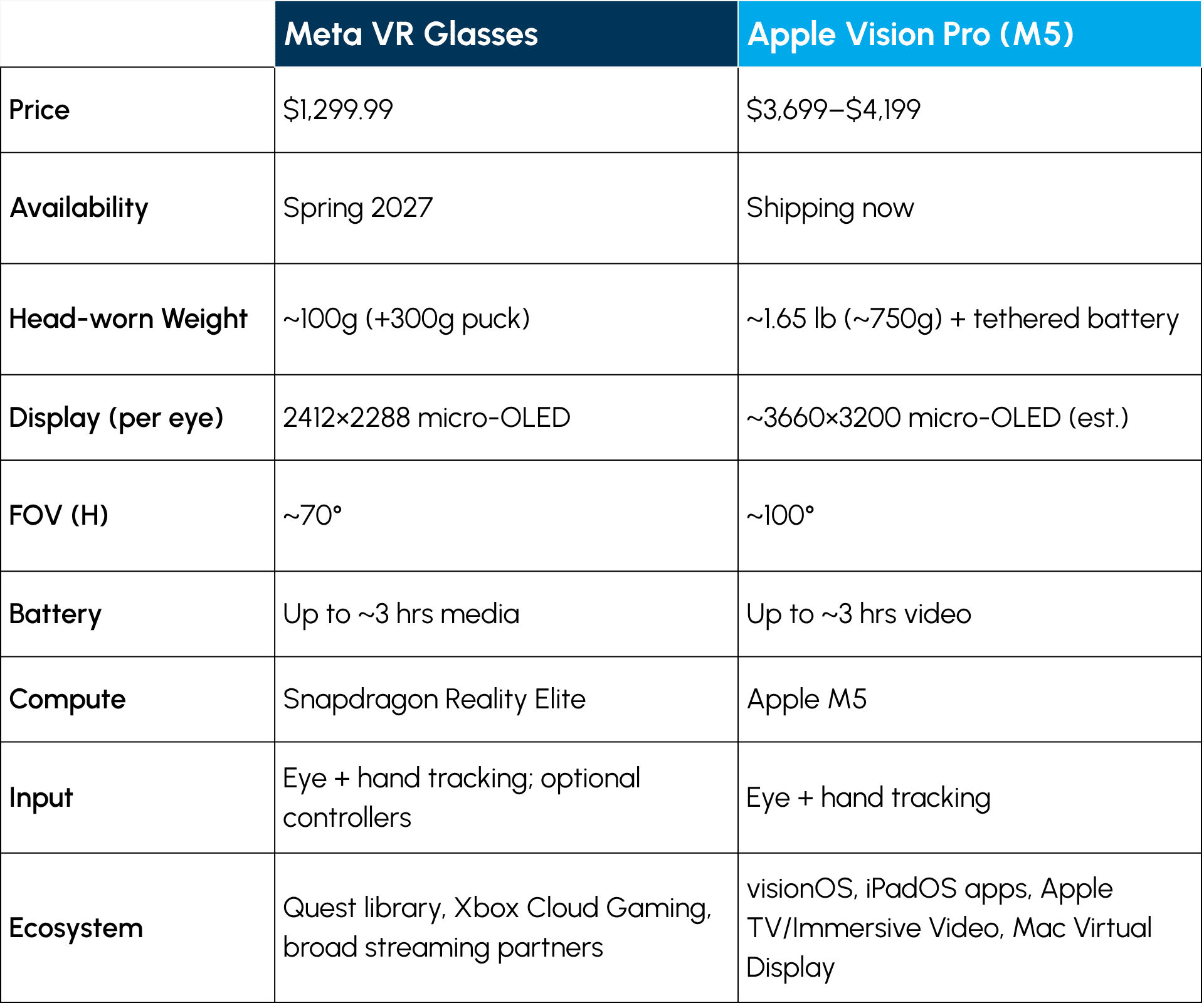
This is precisely the form factor that Apple should have pursued instead of the Vision Pro, so let’s consider both side by side:
Vision Pro could still win on fidelity and polish, but Meta VR Glasses certainly wins on price, weight, and portability, which are precisely the factors that have held Vision Pro back. Patent infringement and product roadmap aside, I sincerely hope that Apple’s next XR product will resemble Meta’s form factor and specs more than its first-generation VR headset, albeit with sleeker Apple styling and a smoother UI.
Where Meta has the edge:
- About a third of the price and roughly a seventh of the head-worn weight.
- Gaming depth through the Quest catalog and controller support, an area where Vision Pro remains thin.
- Media breadth: Prime Video, Disney+, HBO Max, Peacock, Paramount+, ESPN, and 100+ live sports events a year announced as partners.
Where Apple keeps the edge:
- Fidelity and immersion: more pixels and ~30° more horizontal FOV.
- Ecosystem integration: Mac Virtual Display, iPhone/iPad continuity, and a premium app layer for productivity. I feel that this doesn’t scale well enough to justify the price tag, however.
- Available today, while Meta’s device is roughly six months away.
Again, Meta effectively built the product that the market had asked Apple for. If Apple responds with a lighter, cheaper model, Meta could see itself seriously challenged in this category; if not, Meta’s price-to-comfort ratio will likely become the new reference point for premium spatial computing.
Adoption Hurdles
The product solves VR’s comfort problem, but price, category confusion, and Meta’s own track record at the high end remain the biggest obstacles to scale.
- Price in a shrinking market. At $1,299.99, it lands in Quest Pro territory, a tier Meta already retreated from, while the broader consumer VR market has been contracting. Especially in this economy, this is going to be a tough sell for mainstream consumers without a VERY compelling reason.
- Positioning clarity. It is less immersive than Quest and pricier than display glasses; Meta must convince buyers it is a new category, not a compromise. I feel that this is a simple enough task (spatial awareness with a portable system makes sense for all sorts of social, professional, and personal safety reasons), but Meta will have to credibly articulate them in a way that connects with consumers.
- Field of view. Enthusiasts, the early adopters VR has historically relied on, are the buyers most likely to reject a ~70° FOV. I feel that this device targets a much broader audience, so this may be more of a fork in the road than an adoption hurdle.
- The puck and cable. “Glasses” sets a wearability expectation that the tether undercuts; marketing must avoid overpromising. Especially with the added cable and puck, adding friction and discomfort to the experience.
- Battery life. A three-hour limit the flagship travel and work scenarios unless the puck can be charged while in use, or batteries can be easily swapped out. This performance benchmark should have been a non-starter. 3 hours of charge isn’t acceptable for a media-focused product costing more than $1K.
- Social acceptability and privacy. Camera-laden face wear still carries stigma, and Meta’s AI privacy controversies around Connect add scrutiny. Mostly, though, users risk looking goofy in public spaces, and public scorn or negative reactions could spoil an otherwise positive experience.
- Time to market. A spring 2027 ship date gives Apple, Samsung/Google, and Valve two quarters to respond. The announcement also risks stalling Quest 3 sales in the interim, which I feel is the more immediate threat.
- Enterprise readiness. Productivity claims need device management, security certification, and app partners that Meta has not emphasized for this launch. I have no doubt that they will follow, but a bit more clarity and proactive information from Meta at the time of the announcement would have been good.
What to Watch:
Meta VR Glasses are the most important VR hardware Meta has announced since Quest 2, not because they will sell in Quest volumes, but because they redefine what premium spatial computing should weigh and cost. Expect a niche launch with outsized influence on competitors’ roadmaps moving forward.
- Final battery and puck thermals in reviews, and whether pass-through charging is supported.
- Bright-light and outdoor performance with and without light blockers.
- How Muse, Meta’s AI agent, is integrated (unspecified at the keynote).
- Apple’s response: a lighter or lower-cost Vision model would be the clearest sign Meta has reset the market.
- Enterprise and developer programs for productivity use cases.
Disclosure: Futurum is a research and advisory firm that engages or has engaged in research, analysis, and advisory services with many technology companies, including those mentioned in this article. The author does not hold any equity positions with any company mentioned in this article.
Analysis and opinions expressed herein are specific to the analyst individually and data and other information that might have been provided for validation, not those of Futurum as a whole.
Other Insights From Futurum:
Snapdragon X Elite Expands Qualcomm’s PC Reach With Googlebook
What Most Still Seem To Miss About Apple’s Historic iPhone Duo Launch
Featured Image: Meta
Author Information

Olivier Blanchard is Research Director, Intelligent Devices. He covers edge semiconductors and intelligent AI-capable devices for Futurum. In addition to having co-authored several books about digital transformation and AI with Futurum Group CEO Daniel Newman, Blanchard brings considerable experience demystifying new and emerging technologies, advising clients on how best to future-proof their organizations, and helping maximize the positive impacts of technology disruption while mitigating their potentially negative effects. Follow his extended analysis on X and LinkedIn.