
Analyst(s): Brad Shimmin
Publication Date: August 28, 2026
The transition from passive copilots to autonomous execution is reworking the Data Intelligence Platform, promoting Databricks, Snowflake, and Oracle while exposing hyperscaler friction.
Key Points:
- Enterprise data procurement has decisively shifted from read-only AI analytics to converged Lake Transactional/Analytical Processing (LTAP) architectures capable of safely absorbing machine-speed write-backs.
- Databricks and Snowflake cemented Elite tier status while Oracle surged in the Leader rankings by natively integrating transactional execution into their core platforms, while hyperscalers faced architectural friction under bursty agentic workloads.
Overview:
The generative AI honeymoon of 2025 offered executives an appealing demonstration: conversational dashboards capable of summarizing historical business realities. Today, summarizing the business represents the bare minimum. Enterprises are actively industrializing digital labor, rewiring their data architectures to support autonomous, read-write agents explicitly designed to mutate business state.
This maturation completely redefines the core function of the Data Intelligence Platform. The platform has evolved from a passive repository for historical reporting into a deterministic trust engine for probabilistic intelligence. Funding is rapidly draining from experimental prompt-engineering pilots and pouring directly into active intelligence infrastructure. This capital rotation requires a new kind of converged data architecture.
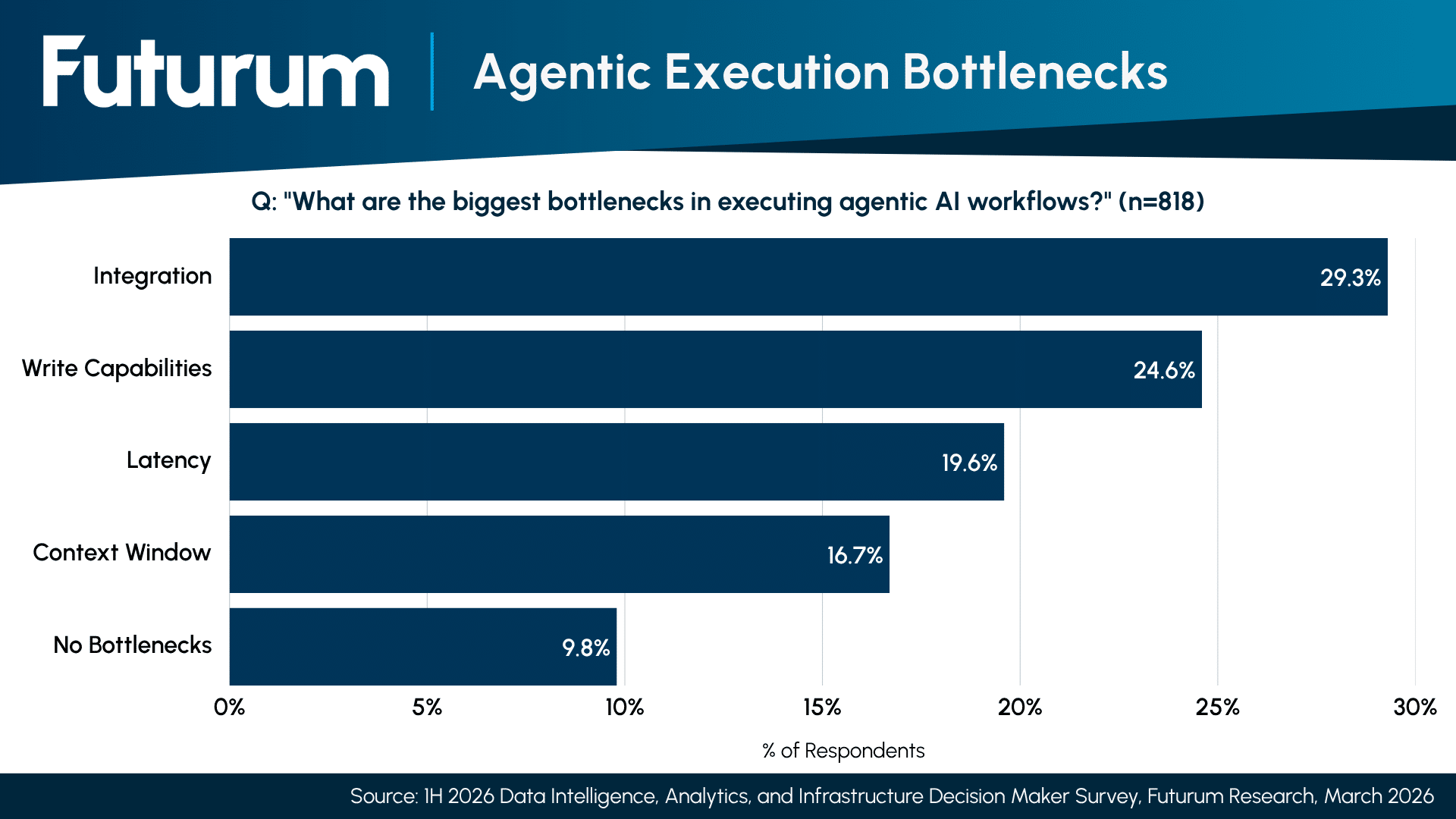
Historically, buyers physically separated reference data (analytical lakehouses) from action data (operational databases). Operating autonomous software across that divide introduces unacceptable latency and consistency risks. To solve this, the market is aggressively pivoting toward conjoined operational and analytical architectures such as Lake Transactional/Analytical Processing (LTAP) to provide a unified substrate where complex semantic reasoning and serializable, ACID-compliant writes happen securely (see Figure 1).
Figure 1: Agentic Execution Bottlenecks
The Vendor Scoreboard Impact
The introduction of our more rigorous, updated Signal evaluation rubric, which measures LTAP readiness and Token FinOps, triggered a massive realignment across the market. Databricks retained its absolute leadership position by tackling the write-back bottleneck head-on, leveraging its Lakebase architecture to give autonomous agents the ability to perform high-concurrency writes directly against open lakehouse storage. Snowflake earned a promotion to the Elite tier by systematically dismantling storage lock-in via the open-sourced Polaris Catalog and delivering native transactional paths through Unistore Hybrid Tables.
Meanwhile, Oracle registered the single largest score increase in the report, leaning heavily into data gravity by embedding agent orchestration directly into its high-performance transaction engine via Oracle AI Database 26ai. Conversely, hyperscalers faced distinct technical friction. Microsoft Fabric’s reliance on optimistic concurrency models created a degree of perceived lock contention under machine-speed agent writes, and Google Cloud suffered a demotion to the Leader zone due to commercial friction and disruptive product renaming cycles.
Conclusion
Unleashing autonomous software into live enterprise systems without deterministic oversight introduces immense systemic risk. As the Data Intelligence market expands toward $1.2 trillion by 2031, the vendors successfully capturing enterprise budget are those providing closed-loop, read-write execution environments protected by stringent ontology portability and cryptographic agent identity. Safe execution, rather than probabilistic reasoning, is the definitive new standard for enterprise AI data infrastructure.
Click here for more information on the latest Futurum Signal Report on Data Intelligence Platforms.
The full report, “Autonomy Over Analytics: The Read-Write Decree Rewiring Enterprise Data Platforms,” is available to read here and via subscription to Futurum Intelligence’s Data Intelligence, Analytics, & Infrastructure IQ service— click here for inquiry and access.
Futurum clients can read more in the Futurum Intelligence Platform, and non-clients can learn more here: Data Intelligence, Analytics, & Infrastructure Practice.
About the Futurum Data Intelligence, Analytics, & Infrastructure Practice
The Futurum Data Intelligence, Analytics, & Infrastructure Practice provides actionable, objective insights for market leaders and their teams so they can respond to emerging opportunities and innovate. Public access to our coverage can be seen here. Follow news and updates from the Futurum Practice on LinkedIn and X. Visit the Futurum Newsroom for more information and insights.
Author Information

Brad Shimmin is Vice President and Practice Lead, Data Intelligence, Analytics, & Infrastructure at Futurum. He provides strategic direction and market analysis to help organizations maximize their investments in data and analytics. Currently, Brad is focused on helping companies establish an AI-first data strategy.
With over 30 years of experience in enterprise IT and emerging technologies, Brad is a distinguished thought leader specializing in data, analytics, artificial intelligence, and enterprise software development. Consulting with Fortune 100 vendors, Brad specializes in industry thought leadership, worldwide market analysis, client development, and strategic advisory services.
Brad earned his Bachelor of Arts from Utah State University, where he graduated Magna Cum Laude. Brad lives in Longmeadow, MA, with his beautiful wife and far too many LEGO sets.

