Analyst(s): Brendan Burke
Publication Date: July 28, 2026
What Is Covered in This Article:
- Helios is in full production, and shipments start at the end of Q3
- 14 GW of AI compute commitments with up to 6 GW each from OpenAI and Meta plus up to 2 GW of Helios from Anthropic
- 6th Gen EPYC launched with up to 256 cores as the CPU foundation for enterprise agentic AI
- AMD raised its 2030 forecasts: $1.4 trillion for AI accelerators, $200 billion-plus for server CPUs, a total TAM approaching $2 trillion
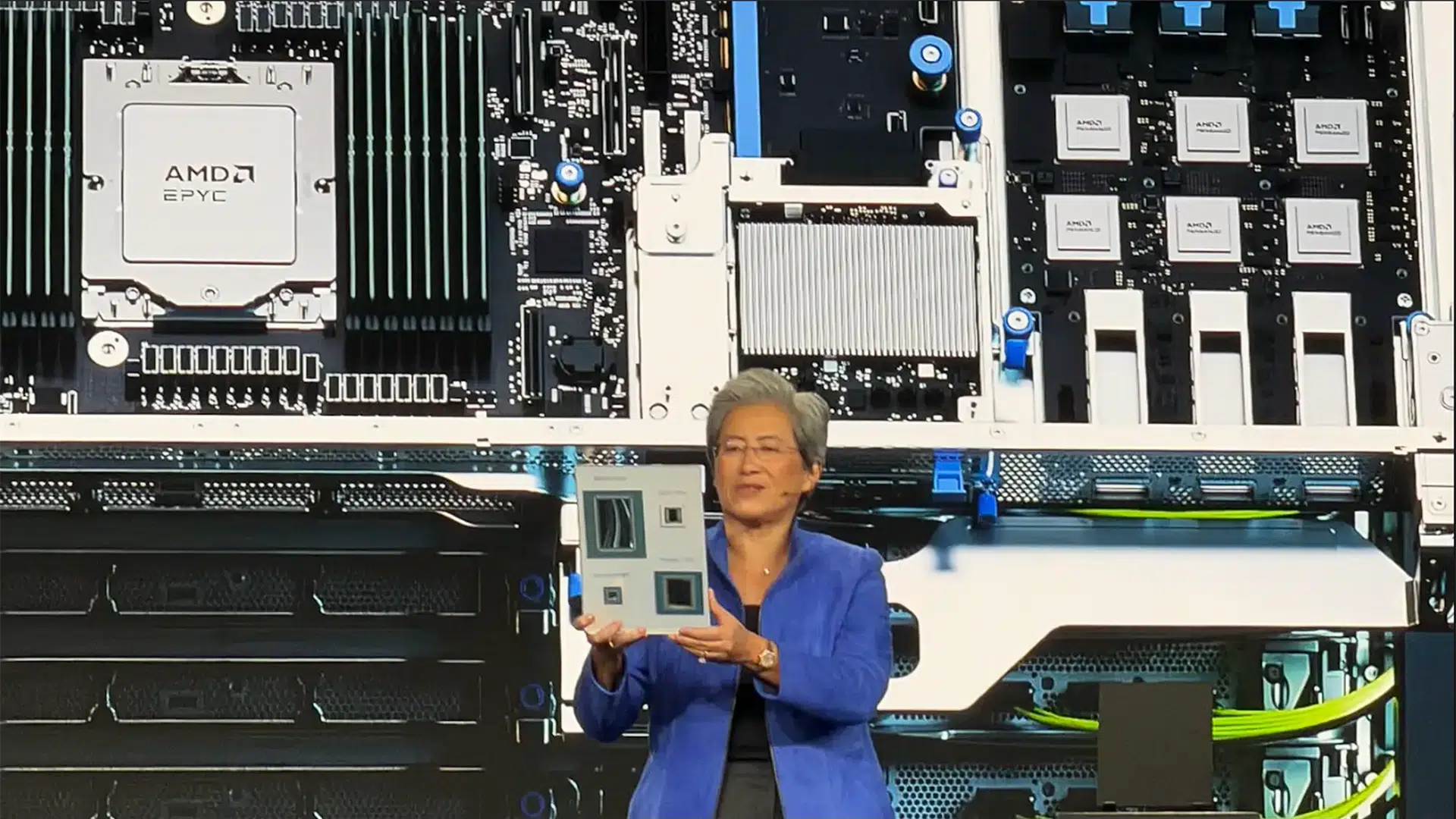
The Event—Major Themes & Vendor Moves: AMD Advancing AI 2026, held July 23 in San Francisco, is AMD’s annual flagship AI event, and CEO Dr. Lisa Su opened her two-hour keynote by calling it the company’s biggest ever. The headline: Helios is in full production, pairing 72 Instinct MI455X GPUs with 6th Gen EPYC CPUs and Pensando networking over open UALink-over-Ethernet, rated at 2.9 exaflops of FP4 compute. AMD claims 15% or more performance than the competition on the largest models, 50% more HBM capacity, and up to 30% more tokens per dollar.
Su did not hedge: “Helios is simply the best AI rack in the world,” and 6th Gen EPYC is “the best CPU in a data center.” OpenAI infrastructure head Sachin Katti described token demand compounding as agents spread across the enterprise, and Anthropic co-founder and Chief Compute Officer Tom Brown explained the 2GW Helios commitment simply: “Helios is an amazing machine.” Meta and Microsoft also deepened deployments.
Those engagements underpinned the event’s biggest number. A year after calling for a $500 billion AI accelerator market by 2028, Su said that figure now “looks conservative” and raised it to $1.4 trillion by 2030, with server CPUs exceeding $200 billion and AMD’s total TAM growing roughly 40% annually toward $2 trillion.
AMD Advancing AI 2026: Does AMD Now Build the World’s Best CPUs and GPUs?
Analyst Take: The real story of AMD Advancing AI 2026 was not any single product — it was AMD raising its own ceiling. By claiming to be the only company building the world’s highest-performing CPUs and GPUs, AMD abandoned its historical price-performance positioning and planted a leadership flag that is now falsifiable.
AMD Advancing AI 2026 Raised the Ceiling and the Stakes
Superlatives such as “Best AI rack in the world” and “best CPU in a data center” invite direct benchmark scrutiny against NVIDIA’s Vera Rubin generation, which ships on a similar timeline. AMD’s 15% performance edge and 30% tokens-per-dollar claims remain vendor math against an unshipped competitor and will be tested in production within two quarters. If they hold, AMD’s share of frontier AI compute inflects; if not, AMD has spent credibility that took a decade to rebuild.
From Client to Cloud, Built on Chiplets and Open Standards
AMD’s challenge to NVIDIA was not a single moonshot but a decade-long campaign that now runs from client to cloud. Chiplet architecture was the foundational bet: disaggregating the die let AMD scale EPYC to 256 cores, mix compute, I/O, and HBM4 silicon in the MI455X, and hit yield and cost points a monolithic design cannot — an approach the rest of the industry has since adopted. That same silicon discipline now spans Ryzen AI PCs at the edge through EPYC and Instinct to full Helios racks, giving AMD a client-to-cloud footprint NVIDIA lacks.
The second differentiator is open standards. Where NVIDIA scaled with proprietary NVLink and InfiniBand, AMD assembled coalitions: UALink for scale-up, Ultra Ethernet for scale-out, a Helios rack design contributed to the Open Compute Project, and open-source ROCm software that Anthropic is now helping optimize. AMD is now turning the ecosystem itself into its moat. The risk is that open coalitions move more slowly than one vendor’s vertical stack, and NVIDIA’s vertical integration still sets the industry’s pace.
Naming the Benchmark: Direct NVIDIA Comparisons on Price and Performance
Advancing AI 2026 also marked a shift in how AMD compares itself. For years, AMD benchmarked EPYC against Intel and framed Instinct on memory capacity and TCO against NVIDIA’s prior generation. This year, NVIDIA was the explicit yardstick on both axes. On GPUs, Su compared Helios to the competition at the rack level: 15% or more performance on the largest models, an average of 10–50% more inference performance at fixed rack power, and up to 30% more tokens per dollar.
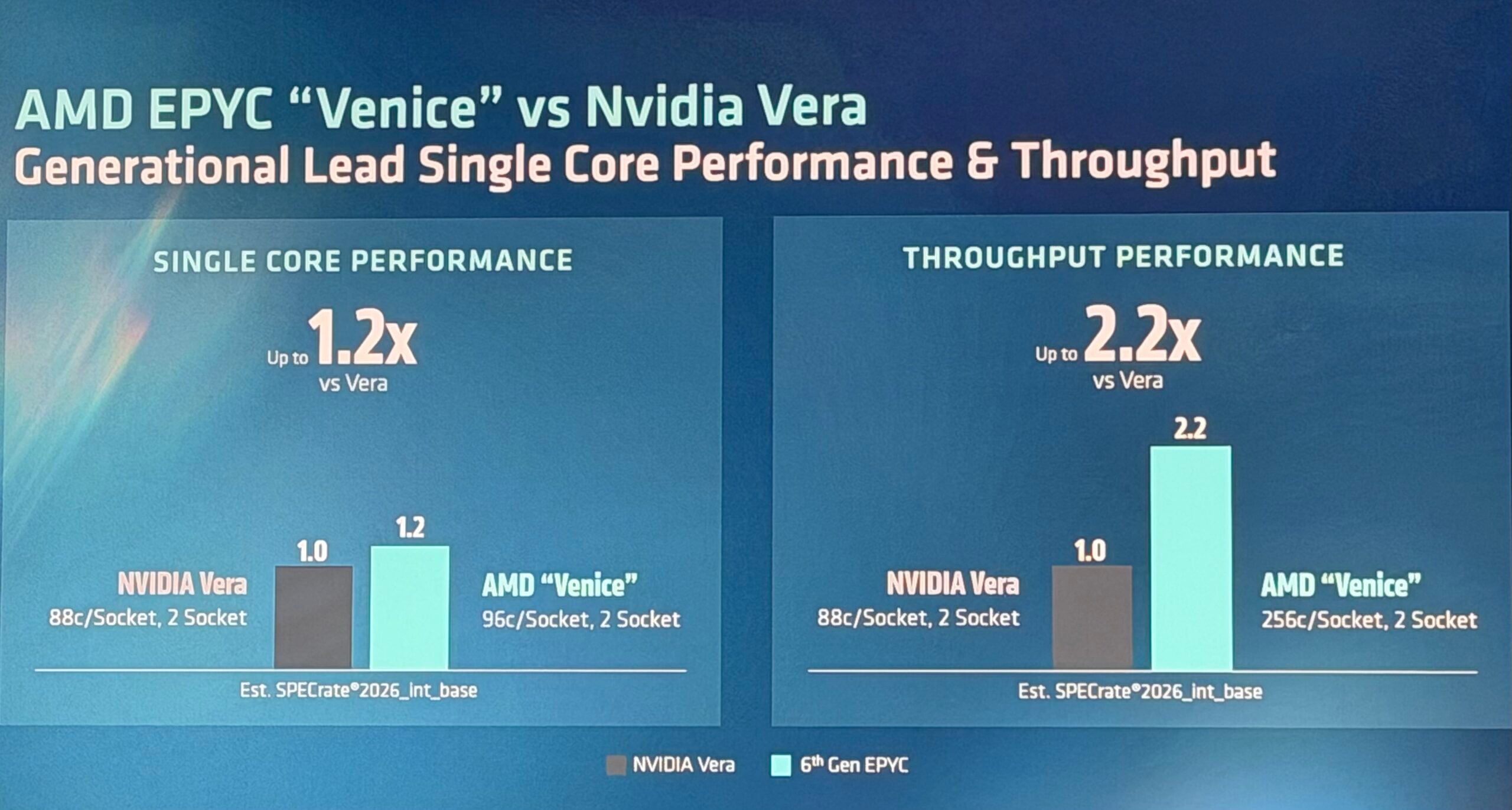
On CPUs, AMD went further than it ever has — beyond a 1.8x tokens-per-second claim over the best competitive x86 processor, Venice was measured directly against the Vera CPU, claiming 20% higher per-core performance and 2.2x more performance at the socket level. Comparing system-to-system against an unshipped Vera Rubin, on token economics rather than spec sheets, treats NVIDIA as a peer to be beaten rather than an incumbent to undercut.
The break from past approaches is stark: AMD used to sell against NVIDIA’s prices; it now sells against NVIDIA’s performance. That posture only holds pending third-party scrutiny.
A TAM Informed by the Buyers at the Frontier
The forecasts also carried more granularity than AMD has offered before. On demand, Su cited more than 35 quadrillion tokens consumed monthly — a nearly 160x increase in two years — and split the workload mix directly: training compute for advanced models still grows roughly 5x per year, but 2026 is the first year the world uses more AI compute to run models than to train them, with roughly 60% of global AI capacity now serving inference. The accelerator TAM moved from last year’s $500 billion-by-2028 call to $1.4 trillion by 2030, with GPUs expected to remain the vast majority. The server CPU forecast more than tripled from a roughly $60 billion outlook a year ago to over $200 billion by 2030 on the logic that every agent step needs CPUs to orchestrate around the GPUs, and AMD quantified the form factors separately: GPU server head nodes, agentic sandboxes measured in agents per watt, and general-purpose compute. The approximately $2 trillion total then extends deliberately beyond the data center, folding in client Ryzen AI devices and edge and physical AI systems.
What separates this TAM raise from typical keynote inflation is that it drew from AMD’s close engagements with OpenAI and Anthropic, the companies actually consuming the compute. At the analyst press conference, Su was direct: “General demand for MI450 and Helios is above our original expectations… we’re increasing production capacity as we go through the next few quarters.” On Anthropic, she noted the company “is going to consume AMD GPUs and CPUs through a number of different sources, including clouds, neoclouds, as well as perhaps some of their own data centers.”
The Agentic Data Center Is Still an Outline
For all the ceiling-raising, AMD’s vision of the agentic data center itself remains limited. The company sized the opportunity but offered only early indications of how CPU+GPU overlap will actually be orchestrated, with claims including EPYC head-node positioning, agents-per-watt density, and an AI-tuner pairing of EPYC with the Instinct MI350 series. What was missing is the orchestration framework that decides where agent workloads run across the heterogeneous compute inside a Helios rack — the layer that will define agentic economics.
Networking told a similar story. AMD is committed to Ethernet as transport, but beyond that it declined to take an opinionated protocol stance for the agentic era — UALink for scale-up, Ultra Ethernet for scale-out, and P4-programmable Pensando silicon that lets Meta co-design custom transports. Programmability is a virtue, but it also defers the architectural decision to customers, where NVIDIA ships an opinion. Meanwhile, the ROCm updates — day-zero model readiness, automated deployment, and serving — continue to focus on GPU utilization rather than orchestrating agents across CPUs, GPUs, and the network. The hardware ceiling went up; the agentic software architecture is still an outline.
What to Watch:
- Independent benchmarks and production tokens-per-dollar data against NVIDIA’s Vera Rubin will validate or break the “best AI rack” claim within two quarters.
- The Q3-to-Q4 Helios ramp will substantiate the supply readiness
- Anthropic’s consumption mix across clouds, neoclouds, and potentially its own data centers signals whether GPU wins pull through EPYC and Pensando networking revenue.
- AMD’s reorganized enterprise AI group must turn the EPYC install base beachhead into Instinct MI350-series attach beyond the frontier labs.
You can read the full press release at AMD’s investor relations site.
Disclosure: Futurum is a research and advisory firm that engages or has engaged in research, analysis, and advisory services with many technology companies, including those mentioned in this article. The author does not hold any equity positions with any company mentioned in this article.
Analysis and opinions expressed herein are specific to the analyst individually and data and other information that might have been provided for validation, not those of Futurum as a whole.
Other Insights From Futurum:
AMD Helios Reaches Parity with Vera Rubin NVL72: Can Open Standards Outflank NVIDIA?
Azure’s AMD Partnership Expands: Is Reinforcement Learning the Hardware Bottleneck?
Can AMD’s Edge Silicon Scale to the Trillion Dollar Orbital Opportunity?
Author Information

Brendan is Research Director, Semiconductors, Supply Chain, and Emerging Tech. He advises clients on strategic initiatives and leads the Futurum Semiconductors Practice. He is an experienced tech industry analyst who has guided tech leaders in identifying market opportunities spanning edge processors, generative AI applications, and hyperscale data centers.
Before joining Futurum, Brendan consulted with global AI leaders and served as a Senior Analyst in Emerging Technology Research at PitchBook. At PitchBook, he developed market intelligence tools for AI, highlighted by one of the industry’s most comprehensive AI semiconductor market landscapes encompassing both public and private companies. He has advised Fortune 100 tech giants, growth-stage innovators, global investors, and leading market research firms. Before PitchBook, he led research teams in tech investment banking and market research.
Brendan is based in Seattle, Washington. He has a Bachelor of Arts Degree from Amherst College.