
Analyst(s): Keith Kirkpatrick
Publication Date: June 4, 2026
AMD, Cisco, Lenovo, HPE, and Huawei are making strategic moves to strengthen their positions in the technology sector. In the latest episode of The Six Five Podcast, Patrick Moorhead and Daniel Newman explore these companies’ acquisitions, innovations, and market challenges as they navigate the rapidly evolving landscapes of AI, cloud computing, and infrastructure solutions. Here are the key takeaways from their discussion.
Key Points:
- AI influences architecture, but isn’t causing broad SaaS abandonment for AI-built substitutes.
- AI development excels at rapid prototyping but lacks the governance, maturity, and deep domain expertise of enterprise SaaS.
- SaaS value resides in orchestration, security, and compliance – hardened capabilities AI tools cannot quickly replicate.
- ETR data confirms 50%–70% of IT leaders maintain existing vendor strategies, with AI-led changes localized rather than universal.
- Disruption varies: Data/BI sees higher AI adoption, while CRM and IT Operations remain stable through integrated AI enhancements.
- In CRM, incumbents such as ServiceNow and Salesforce lead momentum, with AI features serving as a growing priority for 25% of leaders.
- AI’s best use is extending systems of record through customization and lightweight workflows, rather than substituting core platforms.
- Mistaking functional code for production-ready platforms in core or regulated processes is hazardous for enterprises.
Overview:
The rise of AI coding tools such as Cursor, Copilot, and Replit has fueled a compelling narrative: enterprises can now build their own software instead of buying expensive SaaS platforms. The argument is understandable given rising software costs and pressure to simplify bloated application stacks. But the data tells a more nuanced story.
The core flaw in the ‘just build it yourself’ pitch is equating code generation with product delivery. What AI tools produce are prototypes. What enterprises actually run on are mature platforms with years of accumulated infrastructure beneath the surface – data governance, compliance frameworks, identity resolution, cross-functional workflow logic, security controls, and prebuilt integrations. None of that gets generated by a prompt.
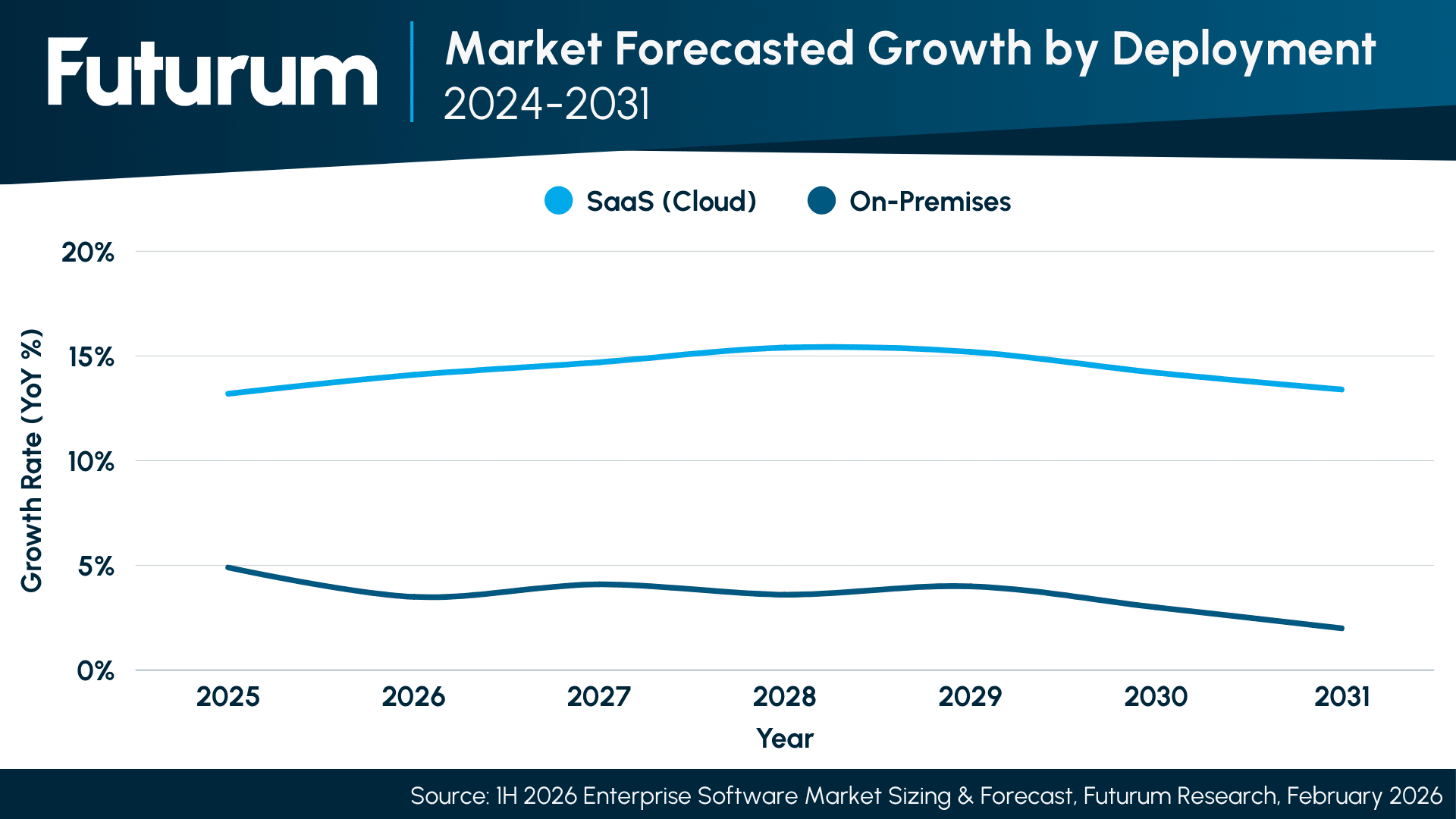
Market data backs this up. The enterprise applications market is projected to grow from $370.9B in 2024 to $604.0B by 2031, with SaaS commanding nearly 75% of deployments by the end of that period. Far from fleeing platforms, 65.9% of enterprise buyers follow a platform-first approach, and 41% are actively consolidating their stacks – moving toward fewer, deeper platforms, not more homegrown tools.
Figure 1: Market Forecasted Growth by Deployment: 2024–2031
ETR’s February 2026 SaaS Displacement study of 152 IT decision makers found that AI-driven replacement of SaaS is not yet a broad reality. In most categories, 50–70% of respondents reported no meaningful vendor strategy change. CRM – one of the categories most often cited as AI-vulnerable – showed 67% of buyers making no change in the past 12 months, with traditional SaaS-to-SaaS switching still the leading driver of change. When AI did show up, it was far more likely to accompany partial displacement (62%) or add-alongside decisions (67%) than full platform replacement (26%).
The reason core platforms remain resilient is the sheer depth of what they’ve built. Microsoft Dynamics led on ecosystem integration (84%) and technical expertise (91%) in ETR’s CRM Observatory, while Salesforce posted the highest difficulty-to-replace score at 68%. These aren’t interface advantages – they’re the result of decades of investment in the connective tissue that links sales, marketing, service, finance, and operations together.
This is especially true for agentic AI. Deploying AI agents safely in an enterprise requires orchestration, permissions, audit trails, escalation paths, and regulatory controls. That’s a governance problem, not a coding problem – and it’s one that vendors like Salesforce, Microsoft, and ServiceNow are building infrastructure to solve.
None of this means AI development tools are irrelevant. Their real value lies in extension, not substitution: custom dashboards, lightweight interfaces, fast integrations, one-off automations, and proof-of-concept work. These are exactly the areas where enterprise platforms feel too slow or rigid to customize through traditional methods.
The right framework is build, buy, or extend. Mission-critical, cross-functional, compliance-sensitive systems should be bought as enterprise SaaS. Departmental customizations and workflow extensions are best handled by extending those platforms with AI-native tools. Short-lived scripts and prototypes are where vibe coding genuinely shines.
The organizations that win won’t be rebuilding Salesforce from scratch with prompts. They’ll be using AI to make their existing platforms more adaptable, connected, and useful.
The full report is available here, and via subscription to Futurum Intelligence’s Enterprise Software & Digital Workflows IQ service—click here for inquiry and access.
Futurum clients can read about it in the Futurum Intelligence Platform, and non-clients can learn more here: Enterprise Software & Digital Workflows Practice.
About the Futurum Enterprise Software & Digital Workflows Practice
The Futurum Enterprise Software & Digital Workflows Practice provides actionable, objective insights for market leaders and their teams so they can respond to emerging opportunities and innovate. Public access to our coverage can be seen here. Follow news and updates from the Futurum Practice on LinkedIn and X. Visit the Futurum Newsroom for more information and insights.
Author Information

Keith Kirkpatrick is VP & Research Director, Enterprise Software & Digital Workflows for The Futurum Group. Keith has over 25 years of experience in research, marketing, and consulting-based fields.
He has authored in-depth reports and market forecast studies covering artificial intelligence, biometrics, data analytics, robotics, high performance computing, and quantum computing, with a specific focus on the use of these technologies within large enterprise organizations and SMBs. He has also established strong working relationships with the international technology vendor community and is a frequent speaker at industry conferences and events.
In his career as a financial and technology journalist he has written for national and trade publications, including BusinessWeek, CNBC.com, Investment Dealers’ Digest, The Red Herring, The Communications of the ACM, and Mobile Computing & Communications, among others.
He is a member of the Association of Independent Information Professionals (AIIP).
Keith holds dual Bachelor of Arts degrees in Magazine Journalism and Sociology from Syracuse University.

