Analyst(s): Olivier Blanchard
Publication Date: April 3, 2026
HP recently introduced HP IQ as a workplace intelligence layer combining on-device AI, proximity-based connectivity, and IT control through WXP. The platform aims to reduce friction across workflows, though ecosystem constraints and competition remain key considerations.
What is Covered in This Article:
- HP introduced HP IQ as a workplace intelligence layer combining on-device AI, proximity-based connectivity, and enterprise manageability across HP devices.
- HP IQ integrates with WXP to provide centralized visibility, governance, security, and operational control for IT teams.
- HP NearSense enables proximity-based collaboration, including file sharing, meeting access, and future device interaction capabilities.
- HP is positioning HP IQ as part of a broader shift toward coordinated, intelligent workplace systems spanning devices, workflows, and environments.
- Competitive offerings from Lenovo and Dell highlight increasing convergence toward AI-driven workplace optimization platforms.
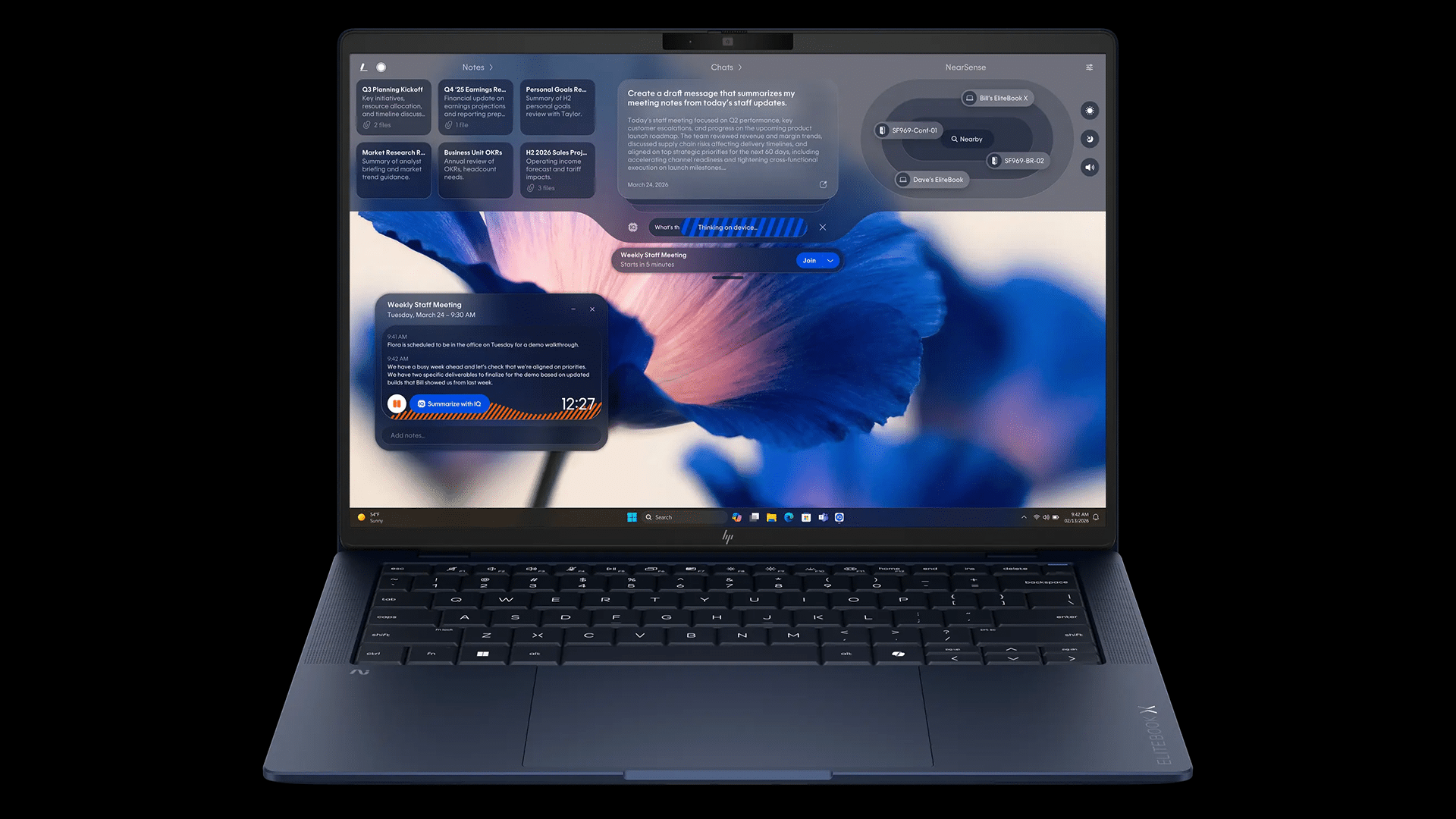
The News: HP introduced HP IQ at HP Imagine 2026 as a workplace intelligence layer designed to coordinate experiences across select HP AI PCs and workplace devices. The platform combines a locally-run up-to 20-billion-parameter model with specialized tools and an orchestrator to enable context-aware interactions, while routing select tasks to the cloud based on enterprise policies and user permissions. Initial capabilities planned for the next generation of HP EliteBook X G2 PCs include Ask IQ, Analyze, Notes & Knowledge, and Meeting Agent, aimed at supporting summarization, contextual responses, persistent knowledge tracking, and in-meeting capture without switching applications.
HP also introduced HP NearSense, a proximity-based capability designed to enable device discovery, secure file sharing, and simplified meeting access across nearby environments. Planned functionality includes drag-and-drop file transfers between nearby users, single-click conference room join, and future capabilities such as device pairing, casting, and printing to nearby devices without drivers. HP IQ integrates with the HP Workforce Experience Platform (WXP) for centralized management and can also be deployed through tools such as Microsoft Intune. Early access is expected to begin in Spring 2026, with broader expansion across additional HP devices planned through H2 2026.
HP IQ Finally Brings Useful On-Device AI To Workspaces
Analyst Take: HP IQ is positioned as a workplace intelligence layer that connects devices, workflows, and environments through a combination of on-device AI and proximity-based coordination. The platform integrates capabilities such as contextual querying, file-based analysis, persistent interaction tracking, and meeting capture into a single interface layer accessed through the Visor experience. HP NearSense extends this further by enabling devices to discover and interact with each other in real time, reducing the need for manual transitions between tools and environments.
HP IQ is also tightly coupled with WXP, which provides an operational layer for visibility, governance, and automated remediation across device fleets. This structure reflects a deliberate move toward embedding intelligence directly into the flow of work rather than isolating it within individual applications.
Coordinating Workflows Across Devices and Environments
HP IQ is designed to reduce friction not just between a user and their PC, but across devices, spaces, and workflows. Capabilities such as Ask IQ, Analyze, Notes & Knowledge, and Meeting Agent are positioned to operate as a continuous intelligence layer that responds to context and intent without requiring users to switch between applications. HP NearSense complements this by enabling proximity-based interactions such as nearby file sharing, conference room access, and device discovery, with additional use cases planned across printing, peripherals, and displays.
The system allows employees to move work between devices more seamlessly while maintaining context, which addresses inefficiencies tied to fragmented workflows. This approach reflects a broader focus on making interactions more consistent across environments rather than optimizing isolated tasks.
The value of HP IQ will ultimately depend on how effectively it can sustain this continuity across real-world workplace scenarios.
On-Device AI as the Primary Execution Layer
HP IQ is built around a local-first architecture powered by a 20-billion-parameter model that runs directly on the device. This design leverages the NPU to support responsiveness, privacy, and operation in environments with limited connectivity, while allowing select tasks to be routed to the cloud only when permitted by enterprise policies.
The platform enables users to interact with documents, generate summaries, capture meeting insights, and query information using natural language without relying entirely on external processing.
What’s key is that the data remains on-device by default, reducing exposure risk and keeping enterprise knowledge within IT-controlled environments. It also helps validate the value of the NPU (beyond improving performance per watt) by delivering the kind of true on-device AI use case that the AI PC category has until now struggled to produce. It is also worth bringing up that moving critical workflows to the device comes with significant latency advantages (translating into productivity boosts) and TCO/ROI advantages (spending tokens internally rather than externally), which could translate into massive AI compute savings that could quickly justify the price of the PC itself.
To be clear, the model is designed to also access external information when needed, depending on configuration and permissions. This structure emphasizes control and responsiveness through intelligent orchestration, but also places importance on how effectively the on-device model evolves over time.
Enterprise Integration Through WXP
HP IQ is not positioned as a standalone feature but as part of a broader enterprise management framework anchored by WXP. The platform provides centralized visibility, policy enforcement, security, and compliance across device fleets, while enabling automated remediation through AI-generated workflows and prioritized actions.
Workflow Builder allows IT teams to codify repeatable responses to recurring issues, while Custom Data Reports enable organizations to focus on relevant telemetry signals across their environments. This integration allows HP IQ to operate within established enterprise workflows rather than requiring new operational structures. At the same time, deployment depends on how well HP IQ aligns with existing management systems already in place within organizations. The effectiveness of this integration will shape how seamlessly HP IQ can scale across enterprise environments.
It is worth noting that both WXP and HP IQ bring credible and quantifiable differentiation for HP in the commercial segment, and also help clarify questions around both the ROI of selecting HP as a workspace solutions vendor and the ROI of investing in AI PCs.
Ecosystem Constraints and Competitive Positioning
HP IQ is introduced as an HP-specific layer spanning devices, collaboration spaces, and management platforms, which shapes both its strengths and limitations: The platform is designed to work closely with HP hardware and WXP, creating a tightly integrated system that coordinates intelligence across endpoints and environments. This is obviously a great demand driver for HP PCs and associated solutions, but the caveat is that it doesn’t address most IT departments’ need to deploy consistent PC experiences across their entire device fleets, regardless of brand.
At the same time, similar approaches are emerging across the market, with competing solutions focusing on unified visibility, automation, and AI-driven optimization across devices and workflows. One detail I want to highlight, however, is that HP IQ could argue it can deliver better performance (NPU integration), stronger security, much greater model flexibility, and more granular management (thanks to WXP integration) than a PC vendor-agnostic alternative from an OS or third-party software company. HP’s advantage is also its plan to make HP IQ extremely customizable for specific domains, making the solution especially appealing to verticals such as Banking and Finance, healthcare, and manufacturing.
HP IQ fits well within the context of a broader shift toward intelligent, experience-centric IT systems that operate continuously in the background. Key for HP in these early days will be how effectively it integrates on-device intelligence with platform-level orchestration across its ecosystem. The extent to which that integration delivers measurable advantages will be a key factor in determining its competitive position.
Phased Rollout and Feature Evolution
HP IQ is being introduced through a staged rollout, beginning with early access on select HP AI PCs in Spring 2026, followed by limited expansion across additional notebooks, desktops, and collaboration devices in Summer 2026. Broader availability across the HP portfolio is expected to follow in H2 2026, with capabilities continuing to evolve through ongoing software updates. Initial deployment is tied to specific device configurations, with expansion planned across additional product categories, including Poly video conferencing solutions and other workplace devices.
The roadmap also includes future proximity-based capabilities such as automated device pairing, casting, and driverless printing and scanning. This phased approach allows HP to extend functionality over time while refining the experience across devices and environments. The pace at which these capabilities mature will determine how quickly HP IQ transitions from a feature set into a fully realized workplace intelligence layer.
What to Watch:
- HP IQ is designed to operate within an HP-centric ecosystem, which may influence deployment in environments using mixed hardware and management platforms.
- Competing approaches are focusing on similar outcomes, including automation, unified visibility, and AI-driven optimization across devices and workflows.
- The platform relies on on-device models that will require ongoing updates to maintain relevance as AI capabilities evolve.
- Deployment is phased across multiple device categories, with broader availability expected over time rather than immediate scale.
- IT teams may approach adoption cautiously, particularly where autonomous or context-driven workflows intersect with governance and control requirements.
See the complete press release on HP’s introduction of HP IQ at HP Imagine 2026 on the HP website.
Declaration of generative AI and AI-assisted technologies in the writing process: This content has been generated with the support of artificial intelligence technologies. Due to the fast pace of content creation and the continuous evolution of data and information, The Futurum Group and its analysts strive to ensure the accuracy and factual integrity of the information presented. However, the opinions and interpretations expressed in this content reflect those of the individual author/analyst. The Futurum Group makes no guarantees regarding the completeness, accuracy, or reliability of any information contained herein. Readers are encouraged to verify facts independently and consult relevant sources for further clarification.
Disclosure: Futurum is a research and advisory firm that engages or has engaged in research, analysis, and advisory services with many technology companies, including those mentioned in this article. The author does not hold any equity positions with any company mentioned in this article.
Analysis and opinions expressed herein are specific to the analyst individually and data and other information that might have been provided for validation, not those of Futurum as a whole.
Other Insights from Futurum:
HP Q1 FY 2026 Earnings: AI PC Momentum, Memory Costs Temper Outlook
AI PCs Drive a 28% Reduction in Enterprise Employee Onboarding Time
Can Intel and HP Finally Make AI PCs a Must-Have for Business?
Image Credit: HP
Author Information

Olivier Blanchard is Research Director, Intelligent Devices. He covers edge semiconductors and intelligent AI-capable devices for Futurum. In addition to having co-authored several books about digital transformation and AI with Futurum Group CEO Daniel Newman, Blanchard brings considerable experience demystifying new and emerging technologies, advising clients on how best to future-proof their organizations, and helping maximize the positive impacts of technology disruption while mitigating their potentially negative effects. Follow his extended analysis on X and LinkedIn.