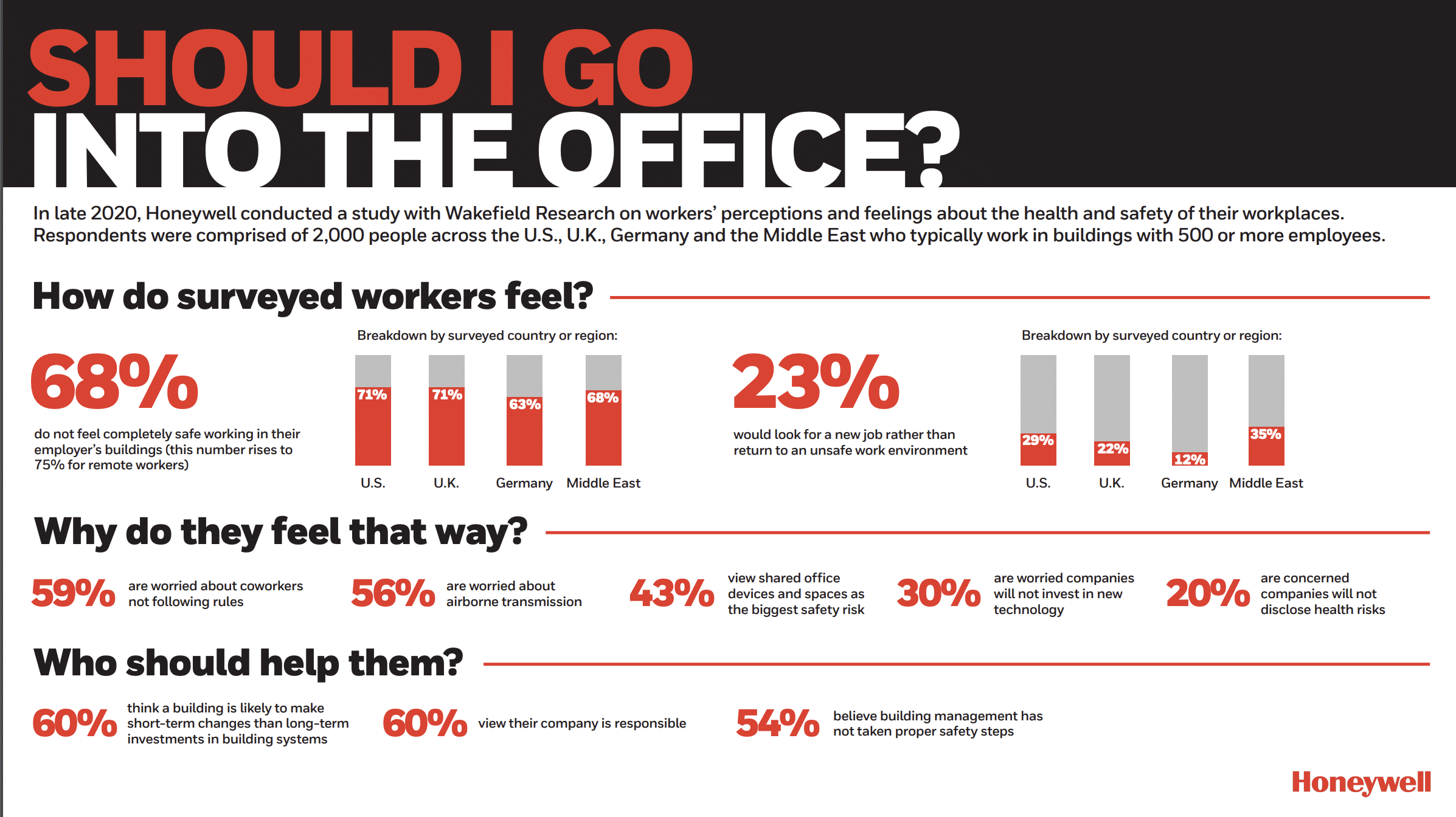
The News: Honeywell (NYSE: HON) today released the results of a comprehensive study on workers’ perceptions and feelings on the health and safety of their workplace. Conducted by Wakefield Research, the study surveyed 500 workers that typically work in buildings with 500 or more employees across the United States and was part of a global study in three other markets. Read the full release from Honeywell.
Analyst Take: One of societies biggest challenges in the coming year will be its efforts to return to a more normal following the devastation to many parts of the economy since Covid-19 started to bare its impact during Q1 2020.
However, with vaccines seeing approval and distribution, we are likely only a few months away from reaching immunity levels that will allow for a measured re-opening that will bring a group of knowledge workers and others that worked in office building back to work–likely in the latter part of 2021.
With the hiatus lasting nearly a year though, some workers are growing increasingly uncomfortable with the idea of returning to work, with safety being the top consideration. In the Honeywell study, a staggering 71% of the U..S. workforce confessed it still had concerns about returning to work, and this number rose to 82% when asked of those workers that have been largely remote since the pandemic’s onset. Some 3 out of 10 remote workers even went as far to say that they would seek a new job if returning to the office too soon became a requirement. This is alarming data as there isn’t really a precedent yet for what makes a workplace completely safe, and exploring this was what made the study particularly interesting in our review.
While the study looked to better understand what would help workers feel most comfortable, the largest survey segment still felt masks and social distancing would be critical to returning to working on-site. at 57%, this number indicates that even when we do return, most won’t be comfortable with an ordinary return, but rather a modified return with things such as temperature checks remaining in tact for some time. Other areas that the data pointed to came down to building systems and building maintenance with top areas of focus being enhanced cleaning procedures (45%), updated air quality systems (29%), touchless door entries (28%), and more contact tracing (19%).
Much of this data probably doesn’t come as a surprise, but one big consideration for any scaled re-open will be important updates to building and system and ways to improve monitoring and control. Managing the quality of the air, updating systems to support no touch entry, and even using computer vision to support contact tracing efforts will in many cases require technology refresh, updating, and investment for building management.
A Return to Work Mean Investment in Building Technology
The return to work for many businesses will mark and important transition from this difficult period. And while hybrid work and more remote work is likely a permanent fixture. There are plenty of cases to be made for a significant percentage of work returning to physical premises. This means investment will be required in technology and controls that can provide more confidence to workers that their buildings are safe. Couple this effort with growing pressures on buildings to be more sustainable and to better utilize data to improve efficiency, I see a material rise in business for building controls and management technologies that run on IoT, Edge, ML, and Analytics–A likely indicator of why Honeywell is investigating this area closely and certainly an opportunity for the industrial and now technology focused giant. It certainly fits within the company’s growing “Enterprise Performance Management” narrative.
Futurum Research provides industry research and analysis. These columns are for educational purposes only and should not be considered in any way investment advice.
Read more analysis from Futurum Research:
IBM Acquires 7Summits to Expand Salesforce Capabilities
Red Hat Buys StackRox to Strengthen Security and Hybrid Cloud
Why Activist Investors Are Targeting Intel and What Lies Ahead
Image: IBM
Author Information

Daniel is the CEO of The Futurum Group. Living his life at the intersection of people and technology, Daniel works with the world’s largest technology brands exploring Digital Transformation and how it is influencing the enterprise.
From the leading edge of AI to global technology policy, Daniel makes the connections between business, people and tech that are required for companies to benefit most from their technology investments. Daniel is a top 5 globally ranked industry analyst and his ideas are regularly cited or shared in television appearances by CNBC, Bloomberg, Wall Street Journal and hundreds of other sites around the world.
A 7x Best-Selling Author including his most recent book “Human/Machine.” Daniel is also a Forbes and MarketWatch (Dow Jones) contributor.
An MBA and Former Graduate Adjunct Faculty, Daniel is an Austin Texas transplant after 40 years in Chicago. His speaking takes him around the world each year as he shares his vision of the role technology will play in our future.