
Austin, Texas, USA, August 6, 2026
According to The Futurum Group’s 1H 2026 AI Platforms Market Sizing & Five-Year Forecast report, covering the global AI platforms market over the CY2025–CY2030 forecast horizon with CY2025 as base year, managed inference reached $23.1B in CY2025 (58.6% of Infrastructure & Core AI Services) versus $16.3B for training (41.4%), a near-complete inversion from the CY2022 split of 73.9% training ($3.4B) and 26.1% inference ($1.2B). Inference reached parity with training in CY2024 and overtook it in CY2025. By CY2030, the Base case projects inference at $106.8B (71.7%) and training at $42.2B (28.3%).
Figure 1: Infrastructure Sub-Segment Mix — Training vs Inference Inversion, CY2022–CY2030 Base (US$ Billion)
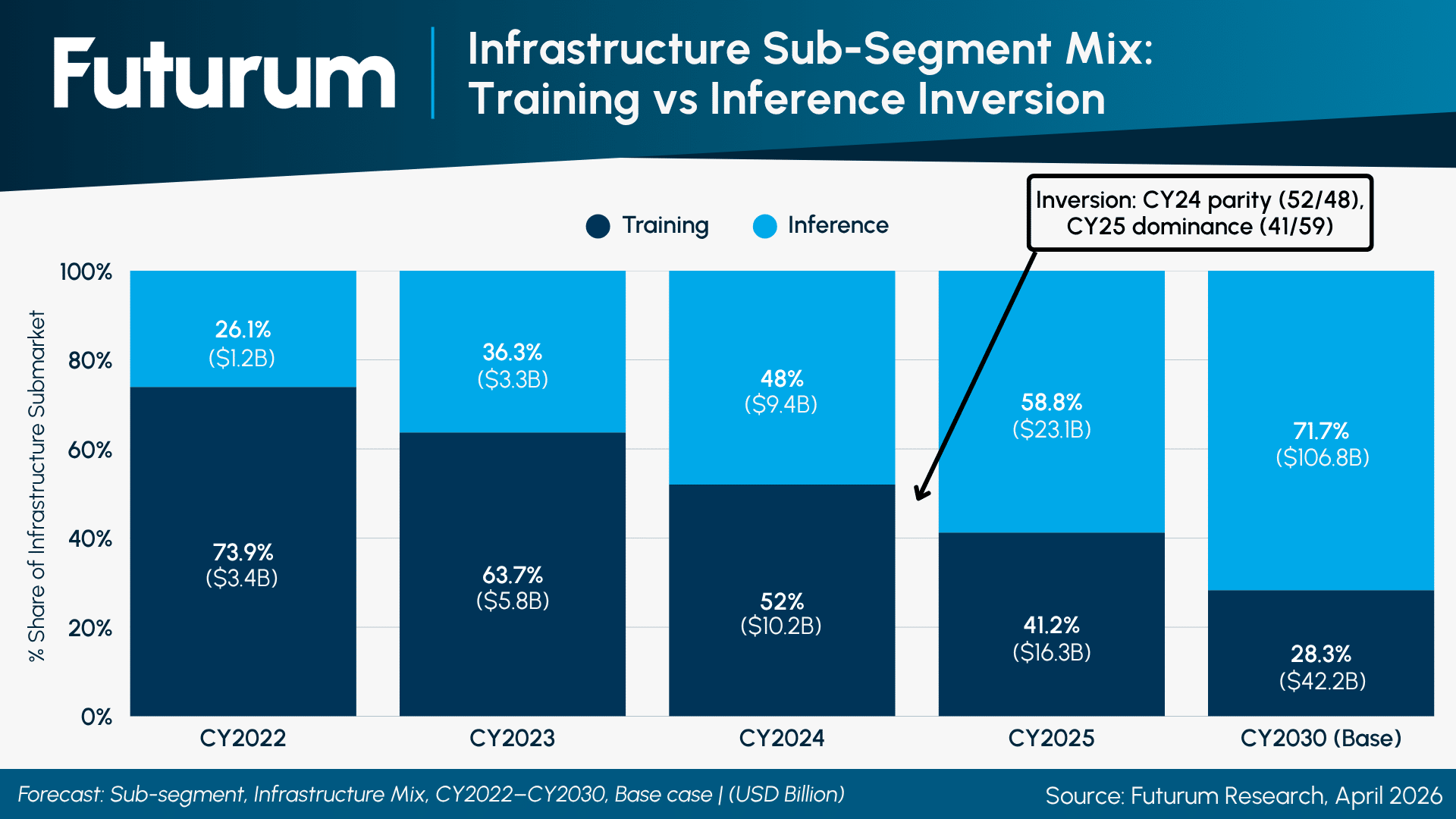
“CY2024 was the parity year, and CY2025 was the dominance year. Managed inference now sits at a 17-point share lead over training, and by CY2030, the Base case puts inference at more than two and a half times the training market in absolute dollars, $106.8B versus $42.2B. The implication for vendors is that infrastructure differentiation now turns on inference economics, time-to-first-token, cost per million tokens, and managed service packaging, rather than on training cluster scale. Buyers are validating this in the survey: provider-managed cloud adoption rises from 57.3% at the experimentation stage to 73.4% at the transformation stage, and the production-readiness metrics enterprises track include accuracy and hallucination rate at 45.2% (the most-tracked metric), model availability at 37.7%, time-to-first-token at 37.6%, and inference cost per request at 32.2%.” — Nick Patience, Practice Lead, AI Platforms, The Futurum Group
The CY2030 forecast highlights several structural shifts in AI platforms infrastructure:
- S-Curve crossover is locked in between CY2024 and CY2025. The training-to-inference inversion completed by CY2025, with the gap widening from 17.2 points in CY2025 to 43.4 points by CY2030-Base.
- Inference is the rocket sub-segment within infrastructure. Managed inference grows from $1.2B in CY2022 to $106.8B in CY2030-Base at a 35.8% five-year CAGR, more than 5 points above the 30.5% CAGR for the overall infrastructure submarket.
- Training remains a plateau line, not a decline line. Training revenue still grows from $16.3B in CY2025 to $42.2B in CY2030-Base at a 21.0% CAGR, but its share contracts as growth concentrates in inference and serving capacity.
Subscribers can read more in the “1H 2026 AI Platforms Market Sizing & Five-Year Forecast Report,” on the Futurum Intelligence Platform. Non-subscribers click here for more information.
About Futurum Intelligence for Market Leaders
Futurum Intelligence’s AI Platforms IQ service provides actionable insight from analysts, reports, and interactive visualization datasets, helping leaders drive their organizations through transformation and business growth. Subscribers can log in to the platform at https://app.futurumgroup.com/, and non-subscribers can find additional information on Futurum Intelligence here.
Follow news and updates from Futurum on X and LinkedIn using #Futurum. Visit the Futurum Newsroom for more information and insights.
Other Insights From Futurum:
AI Capex 2026: The $690B Infrastructure Sprint
Cisco Live EMEA 2026: Can a Networking Giant Become an AI Platform Company?
OpenAI Sora Discontinuation: What the End of a Platform Means for Enterprise AI Strategy
Author Information

Nick Patience is VP and Practice Lead for AI Platforms at The Futurum Group. Nick is a thought leader on AI development, deployment, and adoption - an area he has researched for 25 years. Before Futurum, Nick was a Managing Analyst with S&P Global Market Intelligence, responsible for 451 Research’s coverage of Data, AI, Analytics, Information Security, and Risk. Nick became part of S&P Global through its 2019 acquisition of 451 Research, a pioneering analyst firm that Nick co-founded in 1999. He is a sought-after speaker and advisor, known for his expertise in the drivers of AI adoption, industry use cases, and the infrastructure behind its development and deployment. Nick also spent three years as a product marketing lead at Recommind (now part of OpenText), a machine learning-driven eDiscovery software company. Nick is based in London.

