
Analyst(s): Olivier Blanchard, Brendan Burke
Publication Date: June 15, 2026
Desktop AI hubs could be the answer not only to our AI-related challenges in power grid infrastructure but also to scalable robotics deployments.
Key Points:
- NVIDIA’s DGX Spark could serve as the template for a new category of devices serving as home AI hubs capable of handling concurrent inference for 10–15 active devices locally.
- Next-generation wireless standards (Wi-Fi 8 and 6G) enable a “Local Mesh Orchestrator” model that could reduce cloud dependency for AI inference, optimize battery life for edge peripherals, and enable greater penetration of thin-client AI devices.
- An 86-million-home install base for AI hubs represents a massive, untapped computational infrastructure capable of smoothly operating within the 180 GW safety envelope of the existing US residential grid.
- The decentralized nature of the network, operating within the existing 180 GW residential envelope, allows it to act as a critical stabilizer for the soon-to-be overstretched US power grid by managing peak power demands without requiring industrial generation expansion or overtaxing localized neighborhood power infrastructure.
Making the Case for the Home AI Hub
The next major hardware frontier for chipmakers and device OEMs could be the Home AI Hub (or “AI Compute Router”). This category of device would help shift the AI compute paradigm from today’s binary of cloud-based inference coupled with individual devices carrying battery-draining AI chips to a more federated, more efficiently orchestrated edge-enabled model. This model would hinge on the deployment of small, high-performance local AI inference endpoints that could not only handle a significant portion of a household’s inference workloads without reliance on the cloud, but also serve the compute needs of modern connected households’ entire mesh of devices. And yes, this category of device could also be the key to making consumer robotics scale – a point we will discuss in a moment.
Key Benefits of Edge AI Hubs
As consumers and small businesses come to increasingly rely on AI in their endeavors, the economics of edge AI infrastructure will become financially justifiable by the end of the decade. For consumers, the most significant benefits of adding an AI hub to their home, once inference demand and tokenomics warrant the product category’s introduction to the market, include Data Privacy & Security, Latency Improvements, Unmetered Intelligence, and “Thinner” Client AI Device Enablement (critical when robots begin to scale into homes and small business environments).
Essentially, the home AI hub will transform from what is now a premium professional workstation into a managed utility – a sort of compute router – that will backfill AI compute for AI-enabled connected households, power the next generation of autonomous physical AI, and could even help address critical AI infrastructure bottlenecks.
Mitigating AI Infrastructure Constraints: Operating Within the 180 GW Envelope
One of the more intriguing and valuable aspects of the Home AI Hub category is the structural relief it brings to centralized AI infrastructure bottlenecks. Rather than demanding concentrated, slow-to-build industrial grid expansions, this model shifts execution to the edge.
The structural footprint of this network could be massive. A mature install base of 86 million single-family households would represent a collective baseline electrical grid envelope of around 180 GW. By deploying local hubs operating at an active 140W system-on-chip baseline, the entire 86-million-home network would draw a concurrent peak load of 12.04 GW. This means that the entire decentralized computing grid would utilize less than 6.9% of the existing residential electrical footprint, seamlessly absorbing massive computational workloads within the infrastructure already embedded in the nation’s walls.
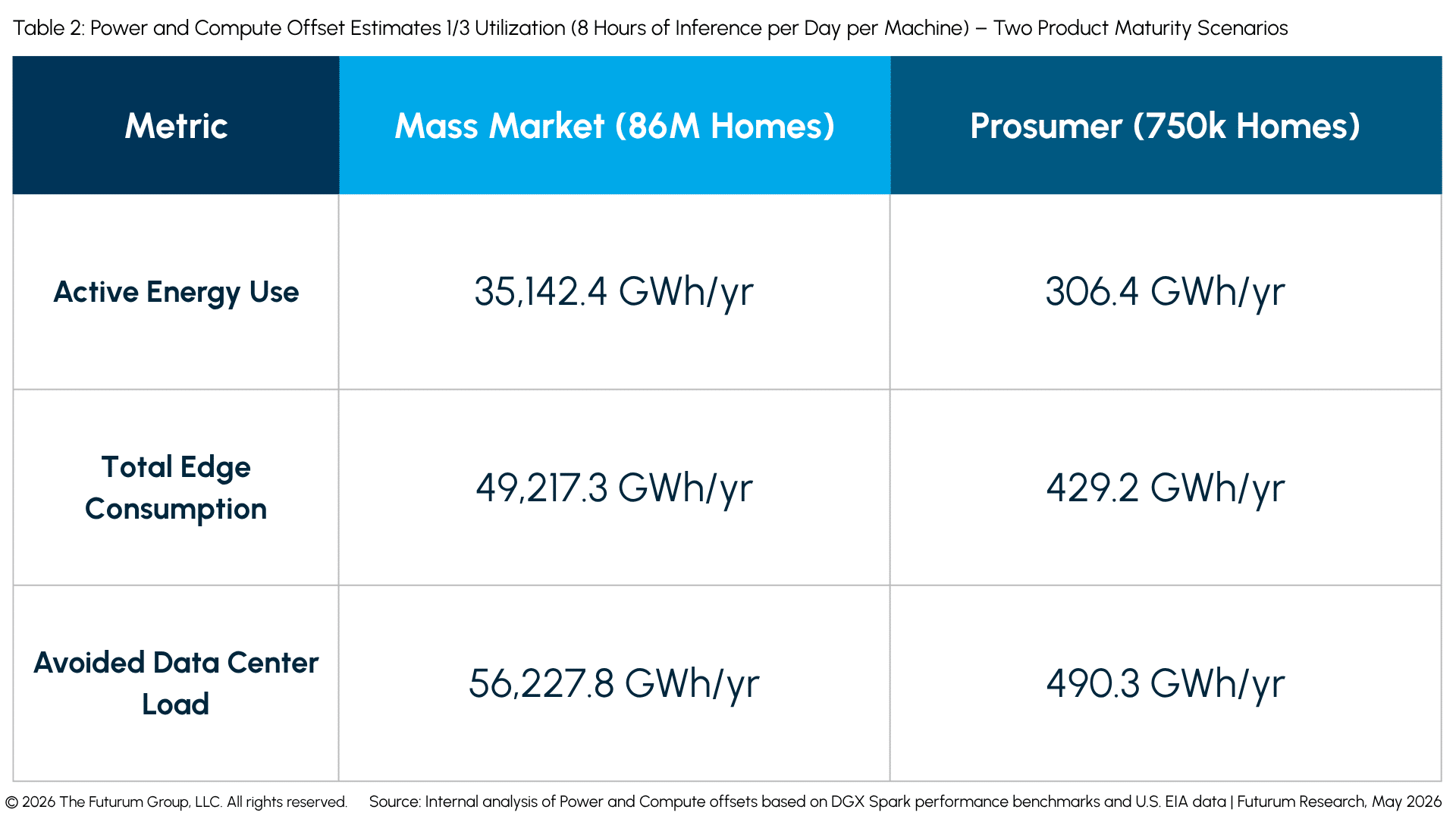
The aggregate impact of an 8-hour daily inference cycle across those same 86 million units would scale into massive industrial infrastructure displacement, saving 56,227.8 GWh (56.23 TWh) of centralized data center load annually. For context, this network could completely sideline roughly 58 hyper-scale (100 MW IT load/~110 MW total grid draw at a 1.1 PUE) AI data centers, or more than 13 massive 500 MW computing campuses, effectively decentralizing the future of AI infrastructure without requiring the slow-to-build, high-voltage industrial transmission lines and dedicated substations typical of centralized computing hubs.
Power and Compute Offset Estimates 1/3 Utilization (8 Hours of Inference per Day per Machine) – Two Product Maturity Scenarios
Conclusion
Looking toward the 2028–2030 timeframe, the Home AI Hub represents a necessary paradigm shift aimed at transforming AI compute from a mostly cloud-centric model into a far more federated, edge-enabled utility model. For consumers, the hub offers compelling benefits such as much-needed new layers of data privacy protection, improved agentic UX through latency improvements, service continuity during network outages, and cost arbitrage for AI tokens, while also serving as a strategic missing link for scaling thin-client robotics. Furthermore, by smoothly operating within the 180 GW envelope of existing US residential capacity and providing a massive 56,227.8 GWh (56.23 TWh) annual offset to industrial data center loads under standard high-utilization cycles, this category of AI compute device is poised to fundamentally transform how we plan for an efficient AI infrastructure and how we design next-generation, thinner-client robots and decentralized AI devices.
The full report is available here and via subscription to Futurum Intelligence’s Intelligent Devices IQ and/or the Semiconductors, Supply Chain, and Emerging Tech IQ service—click here for inquiry and access.
Futurum clients can read more in the Futurum Intelligence Platform, and non-clients can learn more here: Intelligence Devices Practice.
About the Futurum Intelligent Devices Practice
The Futurum Intelligent Devices Practice provides actionable, objective insights for market leaders and their teams so they can respond to emerging opportunities and innovate. Public access to our coverage can be seen here. Follow news and updates from the Futurum Practice on LinkedIn and X. Visit the Futurum Newsroom for more information and insights.
Author Information

Olivier Blanchard is Research Director, Intelligent Devices. He covers edge semiconductors and intelligent AI-capable devices for Futurum. In addition to having co-authored several books about digital transformation and AI with Futurum Group CEO Daniel Newman, Blanchard brings considerable experience demystifying new and emerging technologies, advising clients on how best to future-proof their organizations, and helping maximize the positive impacts of technology disruption while mitigating their potentially negative effects. Follow his extended analysis on X and LinkedIn.

Brendan is Research Director, Semiconductors, Supply Chain, and Emerging Tech. He advises clients on strategic initiatives and leads the Futurum Semiconductors Practice. He is an experienced tech industry analyst who has guided tech leaders in identifying market opportunities spanning edge processors, generative AI applications, and hyperscale data centers.
Before joining Futurum, Brendan consulted with global AI leaders and served as a Senior Analyst in Emerging Technology Research at PitchBook. At PitchBook, he developed market intelligence tools for AI, highlighted by one of the industry’s most comprehensive AI semiconductor market landscapes encompassing both public and private companies. He has advised Fortune 100 tech giants, growth-stage innovators, global investors, and leading market research firms. Before PitchBook, he led research teams in tech investment banking and market research.
Brendan is based in Seattle, Washington. He has a Bachelor of Arts Degree from Amherst College.

