
Austin, Texas, USA, March 14, 2025
Futurum Research Shows That Key Decision-Makers Consider AI Critical to Delivering Developed Software Into Production, Ahead of Automation, Software Security, and Cloud-Native
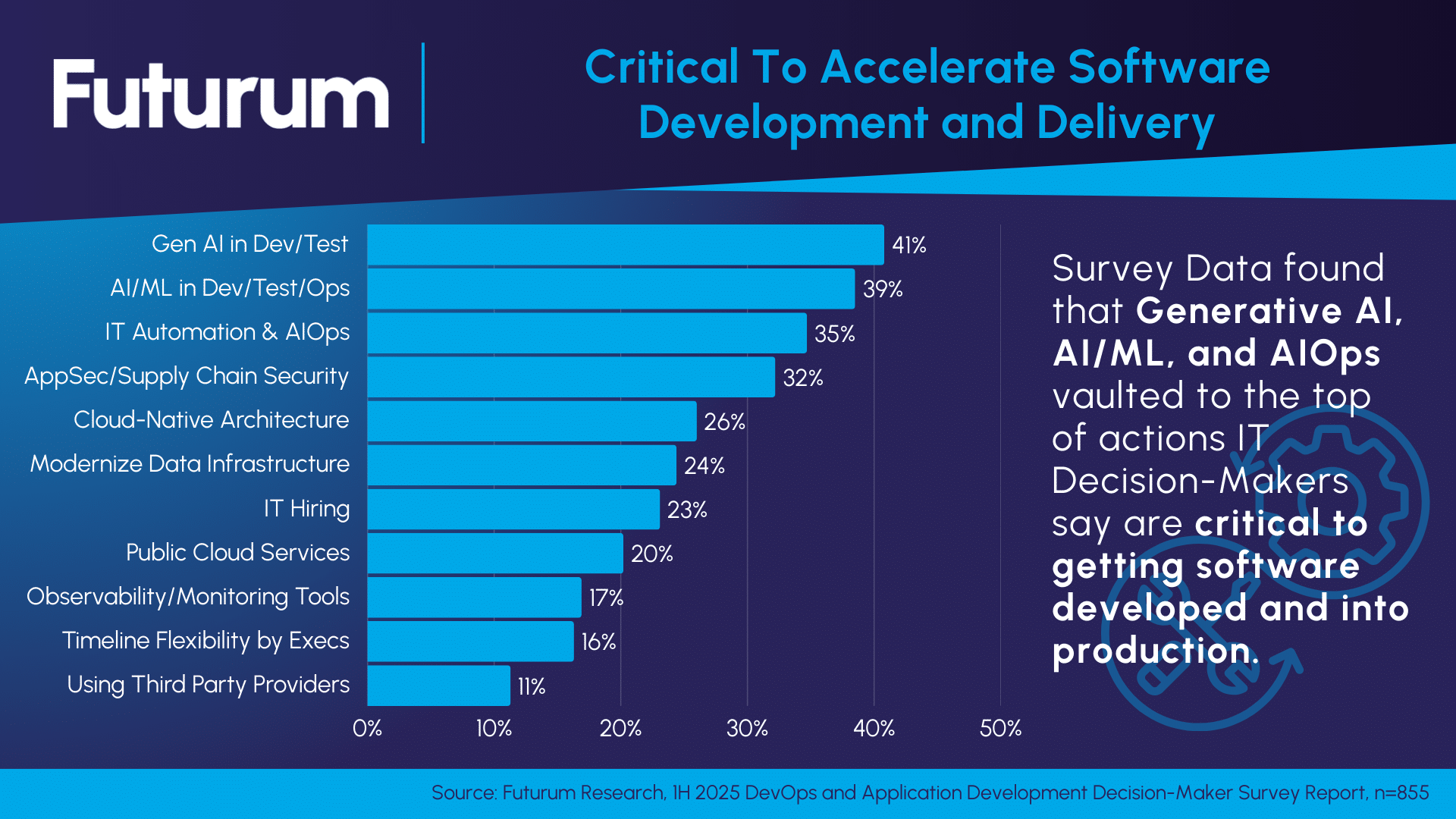
Generative AI, AI/ML, and AIOps vaulted to the top of actions 855 IT decision-makers say are critical to getting software developed and into production, according to Futurum Research’s new DevOps 1H 2025 survey.
Technology buyers are betting on the use of generative AI (40.8%), AI models, and machine learning (38.5%) to perform work, including code generation, code reviews, and test plan creation. They want AI to aid software through the development and testing cycles and deliver value in production.
Closely following AI, IT automation and using AI in Operations (34.7%), application and software supply chain security (32.2%), cloud-native microservices and containers (26%), and modernizing their data infrastructure (24.4%) are seen by one-quarter or more of decision makers are critical actions for their organizations.
Figure 1: Critical To Accelerate Software Development and Delivery
Mitch Ashley, VP & Practice Lead of DevOps and Application Development at Futurum, said, “Organizations have a diverse set of critical technology initiatives necessary to deliver software into production at greater velocity. Leaders want AI to make an impact now, rather than in a year or two, across software development, quality, and operations.”
The research reveals several key priorities for IT leaders:
- One-third of IT decision-makers are expecting AI to make a positive impact across multiple areas of the organization, from development to operations.
- Automation to accelerate development, testing, and operations is a priority for one-third of decision-makers.
- Moving to cloud-native, using containers and microservices, is important to one-quarter of decision-makers.
- One-quarter of decision-makers are also prioritizing modernizing their data infrastructure.
“At the same time, addressing application, open source, images, and package manager security, as well as moving to cloud-native, are important to their success,” noted Ashley.
The Futurum Intelligence IQ DevOps and Application Development dataset, compiled from 855 decision-makers, examines priorities and shifts in spending plans across the software development lifecycle. The research takes a comprehensive approach, exploring the interconnected disciplines across DevOps and Agile, software development and quality, software supply chain security, platform engineering, data, and operations.
Read more in the reports “1H 2025 DevOps and Application Development Market Sizing & Five-Year Forecast” and “1H 2025 DevOps and Application Development Decision Maker Survey,” available to subscribers on the Futurum Intelligence Platform.
About Futurum Intelligence for Market Leaders
Futurum Intelligence’s DevOps and Application Data IQ service provides actionable insight from analysts, reports, and interactive visualization datasets, helping leaders drive their organizations through transformation and business growth. Subscribers can log into the platform at https://app.futurumgroup.com/, and non-subscribers can find additional information at Futurum Intelligence.
Follow news and updates from Futurum on X and LinkedIn using #Futurum. Visit the Futurum Newsroom for more information and insights.
Other insights from The Futurum Group:
Who Wins The Agentic AI Software Development Race?
DevOps and Software Development See Substantial Growth with AI, Security, and Platform Changes
AI Agent and Hybrid Architecture: What It Means for Software Development
Author Information

Mitch Ashley is VP and Practice Lead for the CIO & Technology Buyers and Software Lifecycle Engineering practices at The Futurum Group. A multi-time CIO and CTO with 30+ years leading technical organizations, Mitch built and operated production systems spanning cybersecurity for the U.S. Department of Defense, PKI services for the broadband and 5G industries, SaaS platforms, large-scale telecom and banking systems, and a national broadband network. His work with AI began early, developing expert systems that diagnosed and repaired complex mainframe environments. That operator foundation grounds his analysis in operational consequence, covering the technology buyer's world of software engineering, cybersecurity, DevOps, cloud, and AI.

