
Austin, Texas, USA, May 12, 2026
The fragmentation era of enterprise software is ending. AI is the catalyst forcing the consolidation.
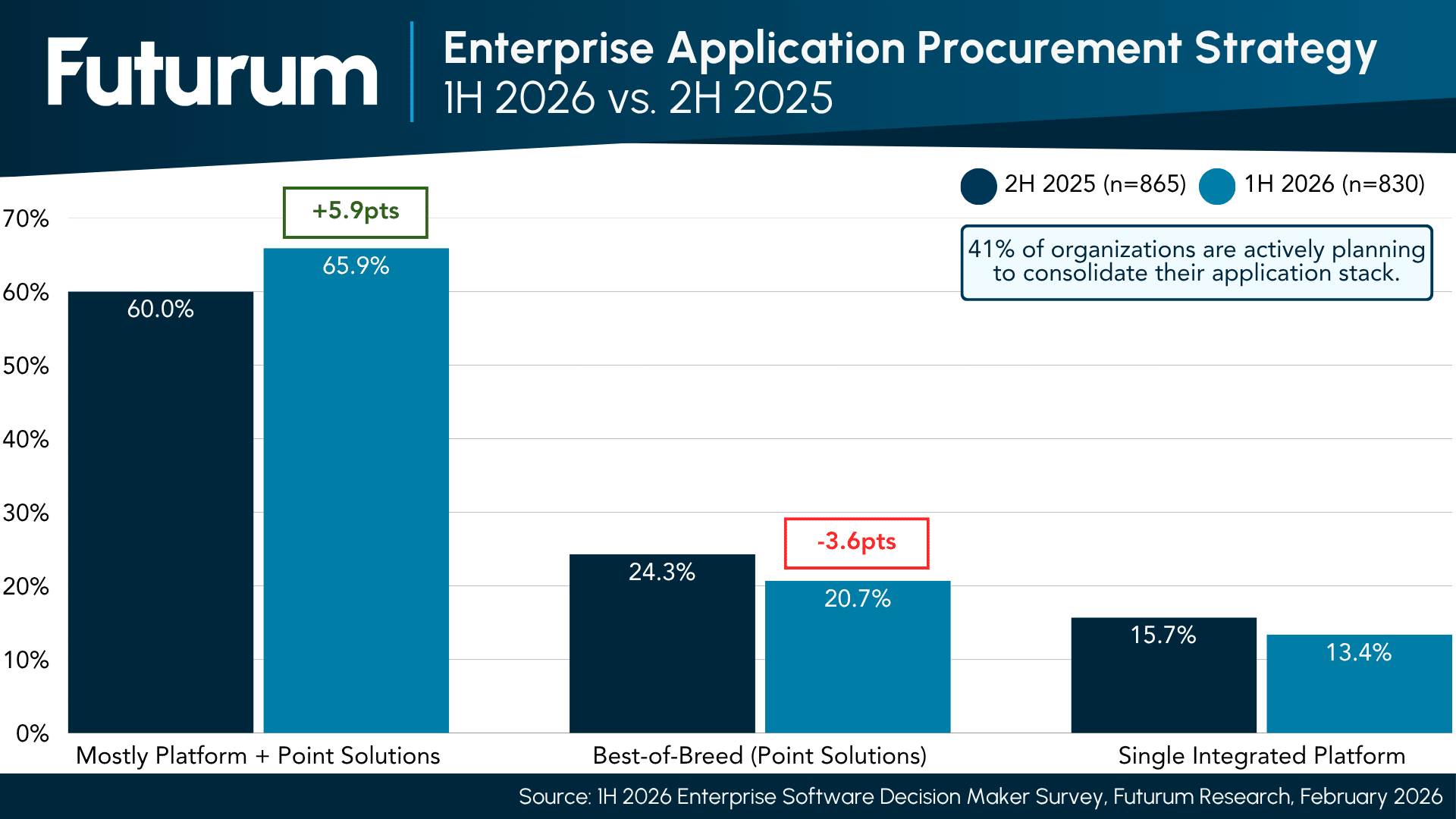
New findings from The Futurum Group’s “1H 2026 Enterprise Software Decision Maker Survey Report,” a study of 830 global IT decision-makers, reveal that the best-of-breed procurement philosophy has fallen to 20.7%, down 3.6 percentage points from 2H 2025, as enterprises consolidate onto integrated platforms to meet the data demands of AI.
As organizations implement more complex human and AI workflows, human and agentic processes, and eventually agent-to-agent workflows, the piecemeal approach to software procurement appears to be falling out of favor among enterprise technology buyers.
The beneficiary is the “mostly platform” model, which surged from 60.0% to 65.9%. Reinforcing the trend, 41.0% of organizations are actively planning to reduce or consolidate their application count, with the most common strategy targeting the elimination of one to four applications in favor of a suite or platform.
Figure 1: Enterprise Application Procurement Strategy, 1H 2026 vs. 2H 2025
“What is driving platform consolidation in 2026 is not cost-cutting, but the increasing use of AI and agentic workflows. Effective AI deployment requires clean, consolidated data that flows across business functions, and organizations that stitch together 10 to 15 point solutions face an integration tax that makes enterprise-wide AI strategies nearly impossible. Platform consolidation eliminates data silos and creates the unified data fabric that AI models need to deliver actionable results.”
— Keith Kirkpatrick, Vice President and Research Director, The Futurum Group
The research reveals several key developments shaping enterprise platform strategy:
- Consolidation timelines are aggressive: Among organizations planning to reduce their application stack, 50.9% are targeting a four-to-six-month implementation window, reflecting urgency rather than gradual migration.
- The pure single-platform model is not the destination: The single integrated platform approach declined slightly from 15.7% to 13.4%, indicating buyers want platform-centric architecture with retained flexibility for specialized needs, not rigid monocultures.
- AI is the primary consolidation driver: Streamlining the use of AI agents ranks as a leading motivation for consolidation alongside reducing IT complexity and improving data exchange. All are prerequisites for enterprise AI deployment at scale.
Subscribers can read more in the full report — “1H 2026 Enterprise Software Decision Maker Survey Report” — on the Futurum Intelligence Platform. Non-subscribers click here for more information.
About Futurum Intelligence for Market Leaders
Futurum Intelligence’s Enterprise Software & Digital Workflows IQ service provides actionable insight from analysts, reports, and interactive visualization datasets, helping leaders drive their organizations through transformation and business growth. Subscribers can log into the platform at https://app.futurumgroup.com/, and non-subscribers can find additional information at Futurum Intelligence.
Follow news and updates from Futurum on X and LinkedIn using #Futurum. Visit the Futurum Newsroom for more information and insights.
Other Insights from Futurum:
Can Qualtrics Help Customers Move From Listening to Insights to Driving Action?
Enterprise Connect 2026: How Will AI’s Emergence Impact CCaaS Vendors?
Can Microsoft’s Frontier Suite Deliver AI Excellence at Scale?
Author Information

Keith Kirkpatrick is VP & Research Director, Enterprise Software & Digital Workflows for The Futurum Group. Keith has over 25 years of experience in research, marketing, and consulting-based fields.
He has authored in-depth reports and market forecast studies covering artificial intelligence, biometrics, data analytics, robotics, high performance computing, and quantum computing, with a specific focus on the use of these technologies within large enterprise organizations and SMBs. He has also established strong working relationships with the international technology vendor community and is a frequent speaker at industry conferences and events.
In his career as a financial and technology journalist he has written for national and trade publications, including BusinessWeek, CNBC.com, Investment Dealers’ Digest, The Red Herring, The Communications of the ACM, and Mobile Computing & Communications, among others.
He is a member of the Association of Independent Information Professionals (AIIP).
Keith holds dual Bachelor of Arts degrees in Magazine Journalism and Sociology from Syracuse University.

