
Analyst(s): Fernando Montenegro, Brad Shimmin
Publication Date: April 17, 2026
Commvault introduced a suite of new capabilities to secure agentic AI transformation. As organizations rapidly scale autonomous workflows, the battle for full-stack agent governance and recovery takes center stage.
What is Covered in This Article:
- Commvault’s launch of Data Activate, AI Protect, and AI Studio for Commvault Cloud.
- The critical shift from static data protection to continuous AI agent discovery and observability.
- How multi-cloud open data formats enable AI adoption without vendor lock-in.
- The intensifying competitive convergence of traditional data resilience vendors, technology platforms, and cybersecurity vendors.
The News: Commvault introduced a suite of unified resilience capabilities focused on secure agentic transformation. The release centers on three core offerings built within Commvault Cloud. First, Data Activate curates and cleans protected backup data for LLM consumption, integrating with platforms such as Microsoft Azure and Snowflake using open formats such as Apache Iceberg and Parquet. Second, AI Protect offers cross-platform discovery and monitoring of AI agents—spanning AWS, Azure, Google Cloud, and SaaS environments—enabling guided, full-stack recovery tied directly to agent-initiated impact. Finally, AI Studio provides a framework to move from experimentation to operation, featuring a centralized Agent Library and a natural-language Agent Builder that leverages Commvault’s Model Context Protocol server to deploy auditable, custom agentic workflows in support of data protection use cases.
How Big A Role Will Commvault Play In Securing Agentic AI?
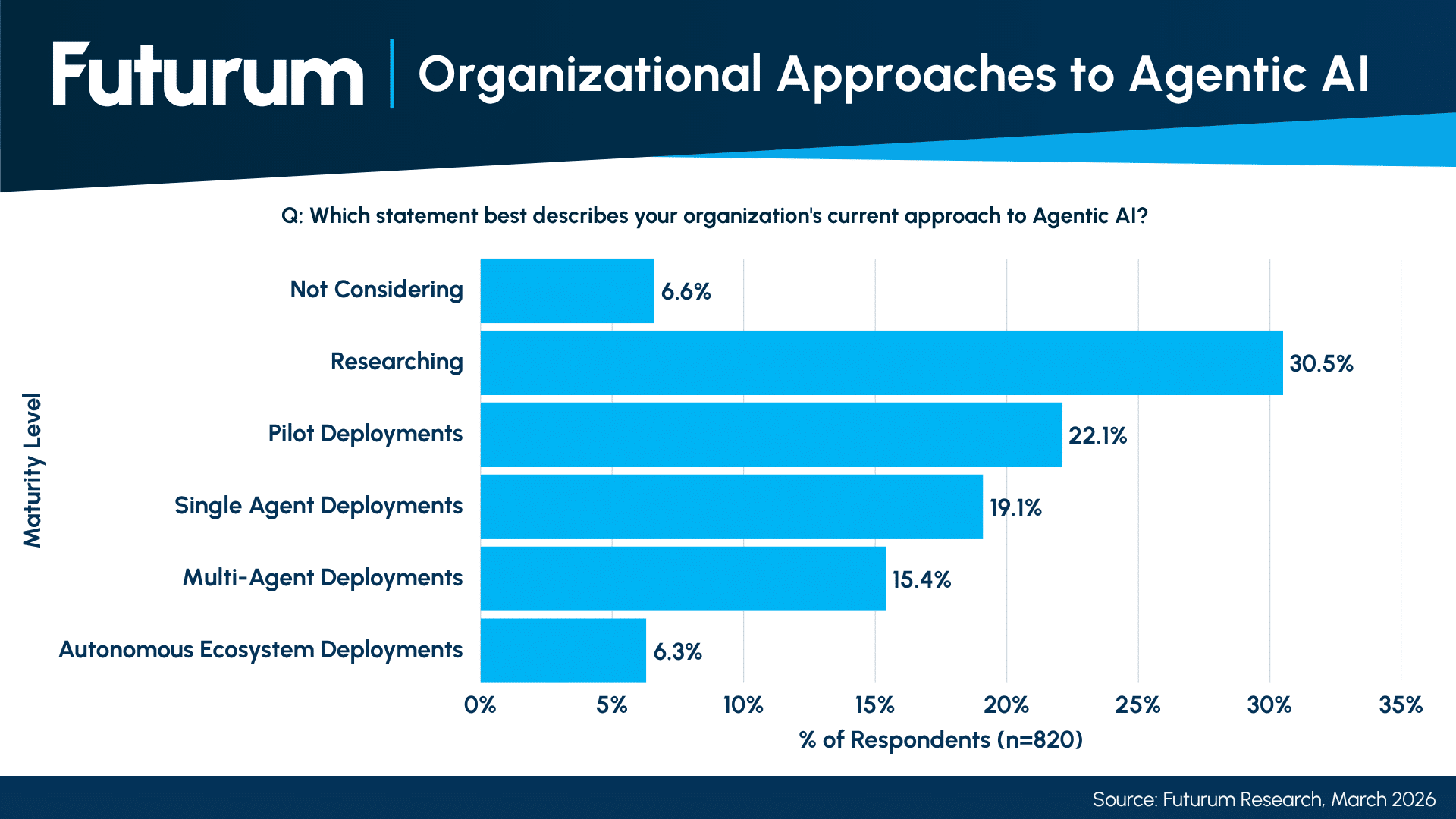
Analyst Take: This release from Commvault is well-timed, addressing a key enterprise concern. According to the recent AI Platform survey from Futurum Research, a full 93% of organizations indicate they are in some level of activity around agentic AI, with nearly 63% currently in different stages of piloting and production.
Figure 1: Organizational Approaches to Agentic AI
Commvault is making a land grab play by positioning its platform not just as a backup tool, but as a system of record for AI resilience. By framing data recovery as the foundational layer of AI trust, Commvault is asserting that compromised data equates to a compromised AI. This is an attempt to elevate its platform from a back-office insurance policy to a front-line AI enabler.
Identity and Data Access as the Core of Governance
Agentic AI forces a reckoning within enterprise architecture. As autonomous agents execute tasks across the network, they operate as non-human identities that require strict oversight and data access controls. Commvault addresses this requirement not through traditional identity management, but via comprehensive agent discovery. Through the AI Protect offering, the platform aims to continuously discover and inventory AI agents and their dependencies, mapping their exact interactions with corporate data, models, and infrastructure. This visibility is crucial for operationalizing governance, enabling security teams to pinpoint exactly what these autonomous actors are touching and where protection gaps exist.
The Threat of Disjointed Legacy Practices
The primary threat facing modern infrastructure is the disjointed, legacy practice of treating data protection, security, and AI operations as isolated domains. This fragmented approach creates severe blind spots, allowing unbounded agents to mutate state across systems without oversight. Commvault positions its approach starkly in contrast to these legacy frameworks by creating a unified system of record. By linking agent activity directly to full-stack recovery, operators have a prescribed path to roll back entire environments, including applications and configurations, if an agent triggers an unwanted cascade. When an autonomous agent goes off the rails, it doesn’t just corrupt a single database. It mutates state across applications, agent configurations, and interdependent systems in a compounding blast radius. Fixing this requires a full-stack rollback to a known good state. Commvault’s AI Protect is specifically designed to untangle this exact scenario.
Multi-Cloud Enablement Without Lock-In
The market increasingly demands flexibility across complex infrastructure. Commvault aims to act as a strategic enabler across hybrid and multi-cloud environments, spanning AWS, Azure, Google Cloud, and SaaS platforms. The Data Activate offering is built to curate protected backup data into logical table formats, such as Apache Iceberg, and physical file formats, such as Parquet. This appears to be an effective method to securely fuel diverse AI platforms. It enables organizations to extract value from historical data without sacrificing data sovereignty or falling into vendor lock-in. Crucially, Data Activate bridges the gap between data engineering and data privacy by automatically identifying and scrubbing PII before datasets are activated for model development. By embedding zero-trust principles right into the data preparation phase, Commvault can effectively neutralize one of the biggest headaches for data officers, namely accidental data leakage into corporate LLMs.
Operationalizing Cyber Resilience
Contextualizing the AI Studio offering requires precision. This is not a generic, boundless agent builder for the wider enterprise. It is a purpose-built framework designed to orchestrate workflows for Commvault Cloud use cases. Operators can build custom agents to automate incident response, monitor storage health, or enforce compliance policies. The question remains how quickly teams will adopt these tools, but the design transitions cyber resilience from a manual administrative burden to a governed, autonomous operation.
The Competitive Landscape and Who is the Right Buyer
In the broader data resilience market, Commvault has been executing well, differentiating itself by moving beyond its traditional backup roots to address the broader operational realities of managing autonomous workflows in complex environments. However, the landscape is highly congested. Traditional rivals, such as Rubrik, Cohesity, and Veeam, are aggressively accelerating their own AI and zero-trust data security architectures.
Furthermore, the battleground for agent discovery and governance extends far beyond data protection. Large compute platforms are embedding these capabilities natively, as seen in ecosystems such as Microsoft’s agent governance frameworks, alongside other technology providers including Google, AWS, Salesforce, IBM, Cisco, and more.
Simultaneously, traditional cybersecurity vendors, including Palo Alto Networks, CrowdStrike, SentinelOne, Fortinet, Okta, and many others, view agent discovery as a natural extension of identity and cloud workload protection. As these diverse factions converge on agentic governance, the pressure on Commvault to prove the unique value of tying observability directly to full-stack recovery will intensify.
What to Watch:
- Will infrastructure teams embrace autonomous resilience? The adoption curve for AI Studio will reveal whether operators are ready to trust custom agents with critical incident response and storage tasks, or if they will require a human strictly in the loop.
- How rapidly will the Data Activate ecosystem expand? It remains to be seen how seamlessly Commvault can integrate its open-format backup data (Iceberg, Parquet) with a continually evolving landscape of emerging AI platforms and hyperscaler models.
- How will cybersecurity and cloud titans respond to agent observability? As Commvault pushes AI Protect, the market will closely monitor whether giants like Microsoft, Palo Alto Networks, or CrowdStrike attempt to commoditize agent discovery within their native platforms.
- Can full-stack recovery execute flawlessly at scale? The promise of rolling back applications, agent configurations, and dependencies to a known good state is compelling, but execution in highly complex, heavily mutated production environments will be the ultimate test.
More details on the release can be found in Commvault’s press release.
Disclosure: Futurum is a research and advisory firm that engages or has engaged in research, analysis, and advisory services with many technology companies, including those mentioned in this article. The author does not hold any equity positions with any company mentioned in this article.
Analysis and opinions expressed herein are specific to the analyst individually and data and other information that might have been provided for validation, not those of Futurum as a whole.
Other Insights from Futurum:
RSAC 2026 Conference: The AI ‘Tragedy of the Commons’
Commvault-CrowdStrike SIEM Link Tests Bi-Directional Resilience
Commvault Introduces Geo Shield. Can One Platform Meet Sovereign Needs?
Author Information

Fernando Montenegro serves as the Vice President & Practice Lead for Cybersecurity & Resilience at The Futurum Group. In this role, he leads the development and execution of the Cybersecurity research agenda, working closely with the team to drive the practice's growth. His research focuses on addressing critical topics in modern cybersecurity. These include the multifaceted role of AI in cybersecurity, strategies for managing an ever-expanding attack surface, and the evolution of cybersecurity architectures toward more platform-oriented solutions.
Before joining The Futurum Group, Fernando held senior industry analyst roles at Omdia, S&P Global, and 451 Research. His career also includes diverse roles in customer support, security, IT operations, professional services, and sales engineering. He has worked with pioneering Internet Service Providers, established security vendors, and startups across North and South America.
Fernando holds a Bachelor’s degree in Computer Science from Universidade Federal do Rio Grande do Sul in Brazil and various industry certifications. Although he is originally from Brazil, he has been based in Toronto, Canada, for many years.

Brad Shimmin is Vice President and Practice Lead, Data Intelligence, Analytics, & Infrastructure at Futurum. He provides strategic direction and market analysis to help organizations maximize their investments in data and analytics. Currently, Brad is focused on helping companies establish an AI-first data strategy.
With over 30 years of experience in enterprise IT and emerging technologies, Brad is a distinguished thought leader specializing in data, analytics, artificial intelligence, and enterprise software development. Consulting with Fortune 100 vendors, Brad specializes in industry thought leadership, worldwide market analysis, client development, and strategic advisory services.
Brad earned his Bachelor of Arts from Utah State University, where he graduated Magna Cum Laude. Brad lives in Longmeadow, MA, with his beautiful wife and far too many LEGO sets.