Analyst(s): Mitch Ashley
Publication Date: March 10, 2026
Microsoft shipped VS Code 1.110 with agent plugins, lifecycle hooks, and a Git-based distribution, establishing an agent development control surface at the IDE layer. Whether these capabilities connect to GitHub Agent HQ’s enterprise policy model or operate as a separate system is an open and consequential question for enterprise buyers.
What is Covered in This Article:
- VS Code 1.110 introduces agent plugins that bundle slash commands, agent skills, custom agents, hooks, and MCP servers into installable, versioned packages distributed through Git repositories.
- Git-based distribution provides organizations with version control, pull request review, and access controls for AI agent configurations, including support for private organizational marketplaces.
- Lifecycle hooks execute shell commands at agent lifecycle events, enforcing organizational policy outside the AI model’s own decision-making.
- Persistent session memory now spans Copilot coding agent, Copilot CLI, and code review, accumulating context across tools rather than resetting per session.
- Platform engineers are now accountable for packaging, versioning, and governing AI agent configurations, a scope expansion most organizations have not yet recognized..
The News: Microsoft released the February 2026 Visual Studio Code update (version 1.110) in early March 2026 agent plugins are now available in preview. A single plugin bundles any combination of slash commands, agent skills, custom agents, lifecycle hooks, and MCP servers into an installable package discoverable from the Extensions sidebar. Plugins are distributed through Git repositories: VS Code discovers packages from the public copilot-plugins and awesome-copilot repositories by default, and organizations can configure private repositories for controlled distribution using GitHub shorthand, HTTPS remotes, or local file URIs. Plugins compose with local customizations rather than replacing them. Enable with the chat.plugins.enabled setting in VS Code 1.110.
The release includes additional capabilities extending agent behavior management at the IDE layer. Lifecycle hooks execute shell commands at key agent events: before a command runs, after edits are applied, and when a session starts. Session memory persists across Copilot coding agent, Copilot CLI, and code review, building context over time. Chat session forking creates independent sessions that inherit existing conversation history, allowing developers to branch from any checkpoint. A new Agent Debug panel provides visibility into agent behavior as customizations from multiple plugins and local configurations accumulate.
Did GitHub Agent HQ Quietly Show Up in Microsoft VS Code 1.110?
Analyst Take: VS Code 1.110 shipped without a launch event. Agent plugins, hooks, Git-based distribution, and persistent memory arrived as preview features in a numbered release. Microsoft did not announce an agent development control surface. It built one, quietly, establishing ecosystem gravity before the market recognized what VS Code was becoming. The strategic intent and the user-facing narrative are not the same thing.
What shipped in 1.110 is governance infrastructure: versioned agent configuration with organizational review workflows, policy enforcement through lifecycle hooks that operate outside model decision-making, shared memory that accumulates across tools, and private distribution channels that organizations already know how to manage. These are agent development control surface capabilities. They just arrived inside a text editor.
The IDE Is Acquiring Agent Control Properties
The IDE started as a workbench for human developers. AI assistance made it a smarter workbench. VS Code 1.110 introduces a fundamentally different approach: a development environment with agent-control-plane properties, where developers configure, govern, and operate AI agent behavior rather than directly authoring code.
Configuration is now the primary governance artifact. When agent behavior is packaged, versioned, reviewed via pull requests, and distributed through organizational channels, the plugin controls how AI agents work for a team. That shifts the developer’s relationship to the tool. The question is no longer, “What can I ask the agent to do?” It is, “What agent behavior has my organization sanctioned, and what can I build on top of it?”
The hooks capability makes the structural change concrete. Enforcing policy via shell commands at agent lifecycle points lets teams enforce organizational rules without relying on the model to do so. Block certain terminal commands. Run linting before edits are applied. Log every tool invocation. This is a deterministic policy layered over probabilistic model behavior. The separation is architecturally significant. It is also the pattern enterprise governance requires.
Is This GitHub Agent HQ or Something Else?
VS Code 1.110’s agent plugins, hooks, and Git-based marketplaces clearly move the IDE toward agent control plane territory, but they are not explicitly branded or documented as part of GitHub Agent HQ or the Enterprise AI Controls “agent control plane.” Agent HQ, announced at GitHub Universe 2025, is described as GitHub’s mission control for agents—“any agent, any way you work”—backed by centralized enterprise AI controls, policies, and cross-surface visibility. By contrast, the 1.110 materials discuss VS Code-local governance: plugins, hooks, and debug tooling that live in the editor and use Git repos for distribution, without stating how those artifacts participate in Agent HQ’s policy model or telemetry.
Figure 1: IDE as the Agent Development Control Surface
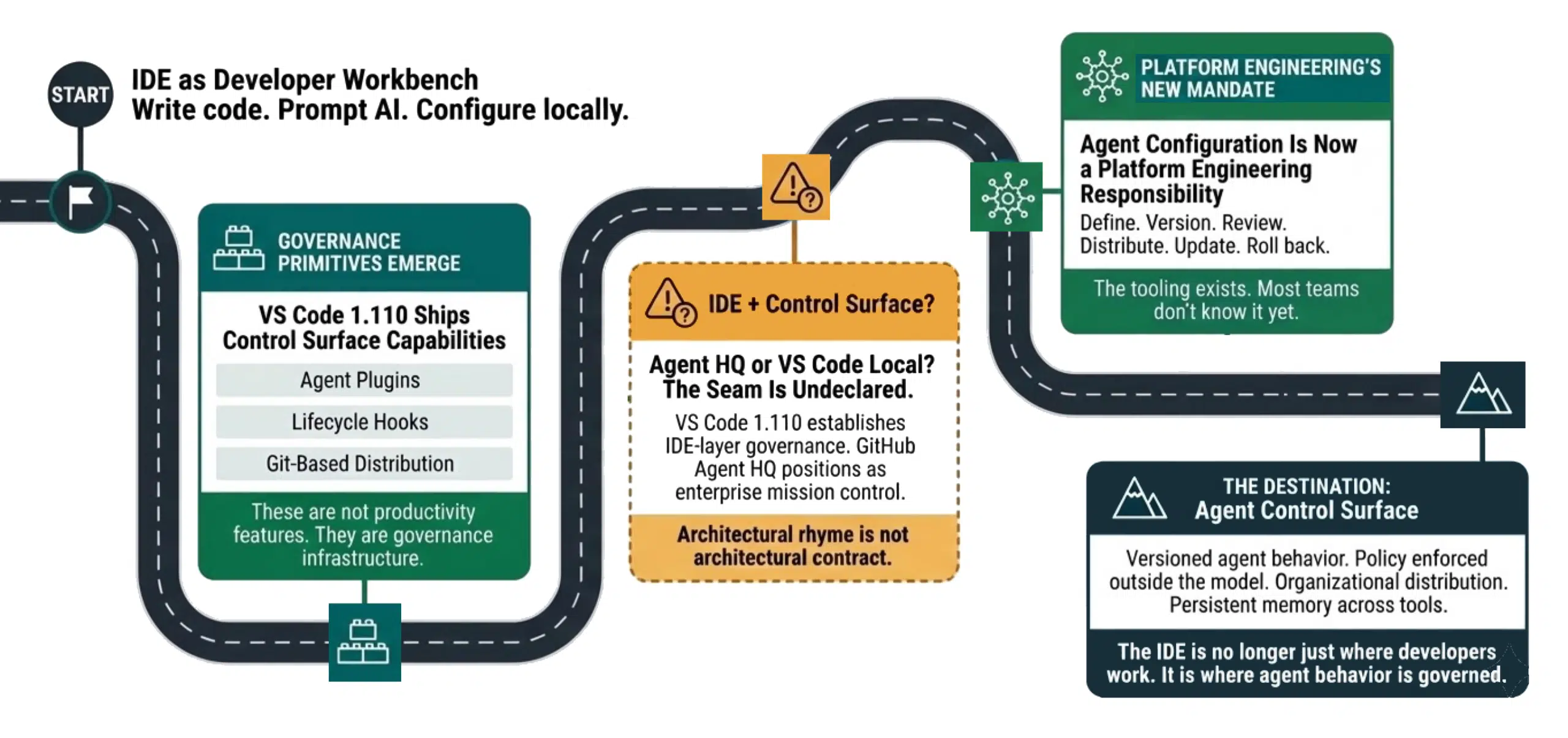
That ambiguity matters if the long-term vision is a coherent stack in which Agent HQ is the top-level control hub and VS Code serves as an IDE-layer control surface under it. GitHub’s Enterprise Agent Control Plane centralizes administration and policy enforcement across agent fleets, but without an explicit contract defining how those enterprise policies flow down into IDE plugins and hooks, and how IDE-side events and safeguards report back into the GitHub agent control plane, vendors and enterprise buyers are left to guess whether they are integrating with one system or two loosely related ones.
Public information does not show whether this is a coordination lag between Microsoft (VS Code) and GitHub, a deliberate “ship pieces first, narrate later” strategy, or simply a roadmap step that has not been announced; what is visible today is a strong architectural rhyme between Agent HQ’s mission control and VS Code’s emerging agent control surface, without a formally declared seam between them.
Platform Engineering Capabilities Just Expanded
Platform engineers are the ultimate beneficiaries here. Most of the coverage frames this as a developer productivity improvement. The operational reality is that platform engineers now have a pathway to configure and deliver AI agent behavior governance: packaging standard configurations, versioning them, distributing them through organizational channels, managing updates, and handling rollbacks when agent behavior breaks. 2026 research found that 76.6% of organizations were already using AI tools across development activities (Source: Futurum 2026 Software Lifecycle Engineering Decision-Maker Survey). At that adoption level, ad hoc agent configuration on individual machines is not a productivity gap; it is a governance gap.
Agent plugins introduce the same lifecycle that GitOps and infrastructure-as-code introduced for the software infrastructure stack. Define, version, review, distribute, update, and roll back. The failure modes follow the same pattern: configuration drift, unauthorized changes, and inconsistent agent behavior across teams when governance breaks down. The tooling now exists, but platform engineering teams shouldn’t gloss over the subtleties in how this was introduced.
Microsoft’s Bigger Ecosystem Play
Microsoft is establishing distribution infrastructure and developer habits before competitors replicate the model. The Git-based marketplace architecture inherits everything teams already have for code: access to software innovations, version control, pull request review, branch management, access controls, and CI/CD pipelines. An organization that builds a private plugin marketplace creates an organizational dependency on that distribution model. A plugin update goes through the same review process as a code change. Audit trails exist because it is all in Git.
This is a platform control play executed to improve the developer experience. The quiet shipping strategy is not accidental. Ecosystem gravity gets established before the market recognizes what VS Code has become.
What to Watch:
- The relationship between IDE-layer governance and runtime control planes. Hooks and plugins enforce policy at the development layer. Conflicts with governance embedded in execution environments or deployment pipelines will surface as adoption deepens.
- Enterprise platform engineering adoption signals. Whether organizations extend IaC-style governance to agent configuration management determines how quickly this accountability shift becomes visible in hiring, tooling, and team structure.
- Microsoft’s own portfolio tension between VS Code Copilot and GitHub Copilot standalone. As IDE-layer governance matures, the boundary between editor-layer and platform-layer control becomes a strategic question that needs to be resolved.
- How enterprise policies from Agent HQ flow down into IDE‑local plugins and hooks, and how IDE‑side governance reports back into the GitHub agent control plane. That boundary is still open architecture and open territory for vendors
See the VS Code 1.110 release notes on Microsoft’s Visual Studio website for more information. Read about GitHub’s Agent HQ blog for more information.
Disclosure: Futurum is a research and advisory firm that engages or has engaged in research, analysis, and advisory services with many technology companies, including those mentioned in this article. The author does not hold any equity positions with any company mentioned in this article.
Analysis and opinions expressed herein are specific to the analyst individually and data and other information that might have been provided for validation, not those of Futurum as a whole.
Other Insights from Futurum:
GitHub Boldly Maps Out The Agentic Development Universe
The Seven Principles of Observability-Native
Google ADK Is Not a Toolkit – It Is an Agent Execution Framework
AWS’s Deploy-to-AWS Plugin: Frictionless Deployment or Developer Honeypot?
Author Information

Mitch Ashley is VP and Practice Lead of Software Lifecycle Engineering for The Futurum Group. Mitch has over 30+ years of experience as an entrepreneur, industry analyst, product development, and IT leader, with expertise in software engineering, cybersecurity, DevOps, DevSecOps, cloud, and AI. As an entrepreneur, CTO, CIO, and head of engineering, Mitch led the creation of award-winning cybersecurity products utilized in the private and public sectors, including the U.S. Department of Defense and all military branches. Mitch also led managed PKI services for broadband, Wi-Fi, IoT, energy management and 5G industries, product certification test labs, an online SaaS (93m transactions annually), and the development of video-on-demand and Internet cable services, and a national broadband network.
Mitch shares his experiences as an analyst, keynote and conference speaker, panelist, host, moderator, and expert interviewer discussing CIO/CTO leadership, product and software development, DevOps, DevSecOps, containerization, container orchestration, AI/ML/GenAI, platform engineering, SRE, and cybersecurity. He publishes his research on futurumgroup.com and TechstrongResearch.com/resources. He hosts multiple award-winning video and podcast series, including DevOps Unbound, CISO Talk, and Techstrong Gang.