Analyst(s): Keith Kirkpatrick, Brad Shimmin
Publication Date: March 2, 2026
Salesforce has simplified Data 360 pricing, introducing a flex credit model, profile-based options, and unmetered Tableau analytics to address long-standing enterprise pain points around predictability and alignment of spend with value. With more than 112 trillion rows of data ingested in FY26 and $2.9B in ARR across agentic and Informatica-driven use cases, Salesforce is betting on these changes to shift Data 360 from a technical platform to an enterprise-wide value engine, particularly as competitors like Adobe and Microsoft double down on composable CDPs and flexible pricing.
What is Covered in This Article:
- A breakdown of Salesforce’s new Data 360 flex credit and profile-based pricing models
- Analysis of the operational and strategic impact for enterprise data leaders
- Competitive context versus Adobe, Microsoft, and emerging CDP vendors
- Risks and execution challenges tied to predictability, adoption, and multiple pricing model complexity
- Forward-looking assessment of market implications and buyer guidance
The News: Salesforce has announced a comprehensive overhaul of its Data 360 pricing and packaging, available today for all customers. Key changes include the addition of Data 360 to the flex credit model (enabling fungible, pooled spend across services), a new profile-based SKU ($240 per 1,000 profiles baseline, $420 for premium), and the un-metering of Data 360 usage within Tableau analytics, thereby eliminating the need for separate Data 360 scoping for analytics workloads.
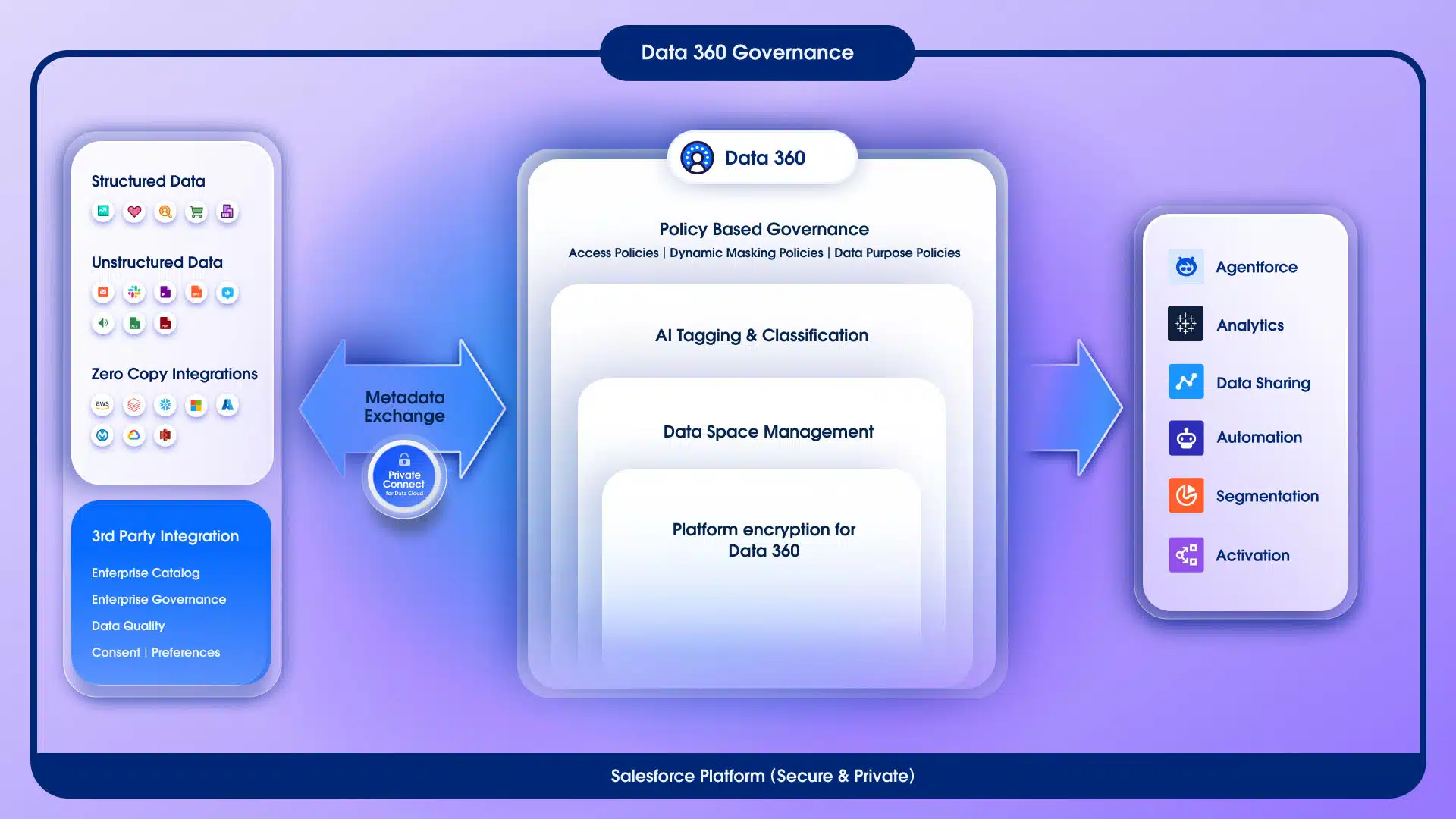
The company reports that nearly half of all ingested data now comes via zero-copy partnerships (Snowflake, BigQuery, Databricks), and that customers processed more than 18TB of unstructured data last year, most in the past few months. The new pricing calculator and digital wallet features, including proactive usage alerts and forecasting dashboards, are designed to help customers better estimate, track, and optimize their Data 360 investments.
Can Salesforce’s Data 360 Pricing Overhaul Deliver Predictable ROI?
Analyst Take: Salesforce’s Data 360 pricing reset is not just about removing friction; it’s a calculated move to reposition the platform as the default enterprise data platform and activation layer, at a moment when composability, predictability, and AI-driven context are table stakes. The new model directly targets the CFO and data leader pain points that have historically limited data platform adoption beyond marketing, but also introduces new complexity in how enterprises must evaluate and operationalize spend.
From Consumption Chaos to Predictable Value: Will Enterprises Bite?
By moving Data 360 onto the flex credit model and introducing profile-based SKUs, Salesforce is acknowledging a structural flaw in the traditional consumption-based approach: it forced customers to forecast future use cases and data volumes with unrealistic precision, often leading to over-purchasing, under-utilization, or surprise overages.
The profile-based option, which Salesforce already says is gaining traction with customers, offers a secure total cost of ownership and aligns with how marketing and CX leaders budget. But the real test will be whether these models scale to complex, multi-departmental deployments, especially as data teams increasingly blur lines between marketing, sales, service, and analytics. Salesforce’s move is a direct answer, but only if the new pricing models prove as simple in practice as they are in theory.
Execution Risk: Multi-Model Complexity and Buyer Confusion
Salesforce’s focus on demonstrating value in its offerings – particularly with AI (note the new announcement of the Agentic Work Unit, which will be the focal point of an upcoming Futurum Analyst Insight Report) – aligns with the larger organizational goal of aligning Salesforce’s goals with those of its customers. While the company is seeing strong adoption of Agenforce, those solutions require readily accessible data, and Salesforce needs to do all it can to ensure customers continue to rely on Data 360 as their primary management platform.
Although the simplification narrative is powerful, the reality is that enterprises now face a menu of purchasing options: flex credits, profile-based SKUs, and unmetered visualization analytics, each with its own operational nuances. This could create a new form of complexity, especially for organizations with overlapping use cases (e.g., data science, marketing, and service teams all leveraging Data 360 differently). A Salesforce representative noted that these various models make it easier for organizations with overlapping use cases to predict and align spend to ROI. Customers can either work directly with Salesforce to scope the right pricing model for them or leverage its External Pricing Tool to compare pricing options and determine their best path forward. Furthermore, Salesforce said that its customers can choose to use both flex and profile models, if needed, for their specific use case.
Salesforce’s new calculator and digital wallet features are a step forward, but success will depend on Salesforce’s ability to deliver not just transparency, but actionable guidance and ongoing support for hybrid pricing models.
Competitive Dynamics: Preempting Adobe, Microsoft, and the Rise of Composable CDPs
Salesforce’s overhaul is as much a defensive play as an offensive one. Adobe has pushed hard on composable CDP architectures, while Microsoft is bundling data and analytics services more tightly with Azure Synapse and Fabric. By un-metering Tableau analytics and consolidating credits, Salesforce is trying to drive additional stickiness and value for customers at the analytics layer, where switching costs and data gravity are highest.
Zero-copy partnerships with Snowflake and Databricks further cement Data 360’s role as the activation layer for enterprise data. However, the window to establish Data 360 as the default is closing: vendors like Twilio Segment and emerging AI-native CDPs are aggressively targeting greenfield and mid-market buyers with simpler, usage-based models. The question is whether Salesforce’s hybrid approach can balance flexibility and simplicity, or risk being outflanked by nimbler, more focused competitors.
What to Watch:
- Adoption rates of profile-based SKUs among enterprise marketing and CX teams over the next two quarters
- Customer sentiment and NPS around the new flex credit and digital wallet features by Q3 2026
- Competitive moves from Adobe and Microsoft—will they follow with similar unmetered or hybrid pricing for analytics and CDP workloads?
- Emergence of third-party tools or consulting practices to help enterprises optimize across hybrid pricing models—signal of ecosystem complexity or opportunity
Disclosure: Futurum is a research and advisory firm that engages or has engaged in research, analysis, and advisory services with many technology companies, including those mentioned in this article. The author does not hold any equity positions with any company mentioned in this article.
Analysis and opinions expressed herein are specific to the analyst individually and data and other information that might have been provided for validation, not those of Futurum as a whole.
Other Insights from Futurum:
Will Salesforce’s Latest Acquisition Provide Momentum For its Agentic Workflows?
ServiceNow Buys Pyramid: Does this Spell the End of the BI Dashboard?
Will Vendors Enable More Complex Agentic Workflows in 2026?
Image Credit: Salesforce
Author Information

Keith Kirkpatrick is VP & Research Director, Enterprise Software & Digital Workflows for The Futurum Group. Keith has over 25 years of experience in research, marketing, and consulting-based fields.
He has authored in-depth reports and market forecast studies covering artificial intelligence, biometrics, data analytics, robotics, high performance computing, and quantum computing, with a specific focus on the use of these technologies within large enterprise organizations and SMBs. He has also established strong working relationships with the international technology vendor community and is a frequent speaker at industry conferences and events.
In his career as a financial and technology journalist he has written for national and trade publications, including BusinessWeek, CNBC.com, Investment Dealers’ Digest, The Red Herring, The Communications of the ACM, and Mobile Computing & Communications, among others.
He is a member of the Association of Independent Information Professionals (AIIP).
Keith holds dual Bachelor of Arts degrees in Magazine Journalism and Sociology from Syracuse University.

Brad Shimmin is Vice President and Practice Lead, Data Intelligence, Analytics, & Infrastructure at Futurum. He provides strategic direction and market analysis to help organizations maximize their investments in data and analytics. Currently, Brad is focused on helping companies establish an AI-first data strategy.
With over 30 years of experience in enterprise IT and emerging technologies, Brad is a distinguished thought leader specializing in data, analytics, artificial intelligence, and enterprise software development. Consulting with Fortune 100 vendors, Brad specializes in industry thought leadership, worldwide market analysis, client development, and strategic advisory services.
Brad earned his Bachelor of Arts from Utah State University, where he graduated Magna Cum Laude. Brad lives in Longmeadow, MA, with his beautiful wife and far too many LEGO sets.