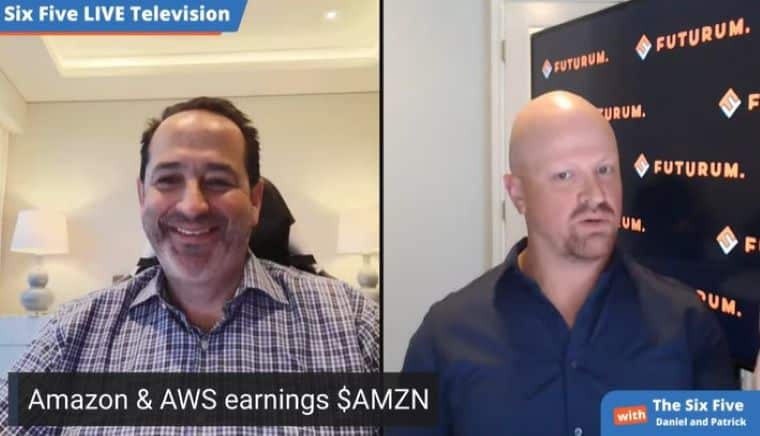
The Six Five team dives into Amazon/AWS’s earnings for this episode of Earnings Palooza!
If you are interested in watching the full episode you can check it out here.
Disclaimer: The Six Five Webcast is for information and entertainment purposes only. Over the course of this webcast, we may talk about companies that are publicly traded and we may even reference that fact and their equity share price, but please do not take anything that we say as a recommendation about what you should do with your investment dollars. We are not investment advisors and we do not ask that you treat us as such.
Transcript:
Daniel Newman: Where do we start, Pat? I know we want to talk about the cloud, and that’s a good one. Look, AWS, I’m going to leave a little bit to you. Amazon as a whole. I just found this really good graphic. I want to pull this up really quickly. Their Q3 ’22 income statements. $53 billion in amazon.com. Their physical store, by the way, I don’t know if you know this. $28 billion. Third-party services is $9 billion. Prime is about a $10 billion business. Their advertising business.
Prime is nine. Advertising is nine. AWS cloud is almost 21. And then, they got $1.3 billion of other. There’s a great graphic online. I’m just looking through this. It actually shows all their revenue sources, how their revenue comes out. On the other end of $127 billion in revenue was $2.9 billion in profit. What we know for sure is that all the OpInc plus some was generated by AWS. Amazon is this company that’s continuing to build this moat of basically being the world’s biggest eCommerce company, but very clearly, they’re actually very hyper-dependent on their cloud business to generate the OpInc for the organization.
I think the revenue is less the problem to people. I think what people are trying to look at is, “How much of Amazon’s results are indicative of what’s happening in our broader economy?” Pat, we didn’t talk about Apple on the show, although I’ve referenced this several times. Apple is always, in my opinion, indicative of the top-end of the market. Meaning … How successful are successful people when they can continue to upgrade their phones and buy super overpriced laptops?
People that have money apparently still have money, but Amazon is more of, “I need toilet paper. I need fruit snacks for my kid’s lunchbox. I need supplies for school. I need socks and underwear.” Well, when their revenue starts slowing … And that was really what people got upset with this. Their guide was down by $15 billion. Now, they’re only going to do $140 billion next quarter, but the market thought they were going to do $155, which is huge.
And so, what I see this as indicative of is we’re heading into the biggest quarter of the year. We’re heading into the part of the year where this is going to say, “How much are people spending on holidays?” Christmas, Hanukkah, different holidays where spending tends to go up. It looks like it’s going to go down. As I was alluding to in the Alphabet, when I was talking about the broad economy, what I think is happening is we are really starting to see clear cracks in the system that we are heading towards a recession.
Sorry. I know everybody thinks it’s perfect. Now, we’ve got the FX. Europe is on stilts. US is slowing down. We’ve got seven plus percent mortgage rates, tight credit markets. Amazon, by the way, should be a bellwether. I know, by the way, that our policy makers should not … Their mandate is not to look at stocks when they make decisions about Fed policy. But Pat, how can you not look at Amazon’s results and not think, “Gosh. This is a pretty good leading indicator that people’s home household budgets are getting smaller.” Things are tightening up. That’s what is going on there.
I’m just going to kick it over and just say, Pat, I know everybody’s really negative on the AWS thing because their revenue has slowed down, but 27% year-on-year growth at over $20 billion. There’s a lot of large numbers here. Because I’m pretty sure, if you look at their growth, they grew via Google over the course of the year in terms of their total number, their Google Cloud number. When you’re growing 30% and you’re at $20 billion, isn’t that like $6 billion in annual run rate growth?
They by the whole grew their number for the quarter. I guess there’s a little bit of that push and pull. Because Google is doing great, but so is Amazon. And so, I know we’re sometimes super positive, but I don’t think AWS is in as much trouble. I don’t think cloud business is slowing as much as people think. I think it’s slowing a little bit. Projects are elongating. Customers are being a bit more cautious. And I think we’re seeing that in a more mature cloud business like AWS.
Patrick Moorhead: Good analysis. Take a deep breath. I’ll take the baton and go the 100 meters for you, buddy. The AWS story this quarter is really a repeat of the last two quarters. In that, the rest of the company lost business. In fact, the rest of the company lost $111 million in operating income, and AWS made $4.8 billion in operating income. Essentially, all of the operating income was AWS, which is just an incredible feat.
By the way, when it comes to regulators, I can’t believe that regulators wouldn’t look at that. It’s not illegal to use something as a loss leader, but it certainly shows power and the ability for the retail side to operate at a loss. Anyways, I’m not an antitrust lawyer. I only play one on TV once a quarter. But once again, AWS is at an $80 billion run rate, which is absolutely astounding when you look at that audacious profit pool. They are being rewarded for being first and getting a jump on everybody going the widest. I also think there’s a huge effect from them using their own homegrown silicon on reducing their cost of goods.
One interesting thing that I saw, Daniel, in the press release was that typically they went division by division and talked about it. With this change now to going into characteristics, which is obsessing over the customer experience, inventing on behalf of customers, empowering employees and delivery service providers, supporting communities, and protecting the environment. It’s a key indicator on where the new senior management wants to go with it.
Now, it is harder for me to pick apart and look at some of the highlights that it had. I want to shift to a future view here. We have AWS re:Invent coming up. You and I will be there along with The Six Five for a couple days and I’m super excited about it. A couple of things I would love to see out of AWS at the show. First of all, multi-cloud. They’re starting to get dinged by certain analyst firms for the quote, unquote, “Lack of multi-cloud offerings.” It is a fact when you look at the amount of multi-cloud offerings that AWS has versus other companies, they don’t have as many.
I also understand that with AWS in the driver’s seat for IAS, they’re less motivated to be multi-cloud, because it would probably mean that they would lose business as opposed to gain business. Maybe another way to look at it is, as Andy Jassy said, “We’re only 10% into the cloud build-out.” What about that other 90%? Could the company start losing business because enterprise CIOs are looking more to multi-cloud?
And the second thing that is on my hit list. Man, I want to see Trainium and what it is. As I said, AWS has a lot of its own homegrown silicon. Companies have yet to even start to dethrone NVIDIA for training. Intel Habana has a good offering, but I’m not seeing a lot of design wins or talk about it. But Trainium could be the first training solution to put a dent into NVIDIA. I’ve got nothing against NVIDIA. I just think the industry needs more competition when it comes to that.
Daniel Newman: That’s a good analysis, Pat. I will say two things. One is they did have good advertising growth, which you mentioned they might earlier. Two is, I have to correct myself, because I can’t read an infographic apparently. I hate giving wrong numbers.
Physical store is $4.7. Third-parties, $28.7 billion. I read those a little bit awkwardly earlier when we talked. I said physical was $28.7. It seemed big to me. It was big, because it was wrong.
Patrick Moorhead: Dan Newman was wrong.
Daniel Newman: Mark those words. 35 minutes, 29 seconds into today’s episode. That’s for you, Twitter trolls.
Author Information

Daniel is the CEO of The Futurum Group. Living his life at the intersection of people and technology, Daniel works with the world’s largest technology brands exploring Digital Transformation and how it is influencing the enterprise.
From the leading edge of AI to global technology policy, Daniel makes the connections between business, people and tech that are required for companies to benefit most from their technology investments. Daniel is a top 5 globally ranked industry analyst and his ideas are regularly cited or shared in television appearances by CNBC, Bloomberg, Wall Street Journal and hundreds of other sites around the world.
A 7x Best-Selling Author including his most recent book “Human/Machine.” Daniel is also a Forbes and MarketWatch (Dow Jones) contributor.
An MBA and Former Graduate Adjunct Faculty, Daniel is an Austin Texas transplant after 40 years in Chicago. His speaking takes him around the world each year as he shares his vision of the role technology will play in our future.