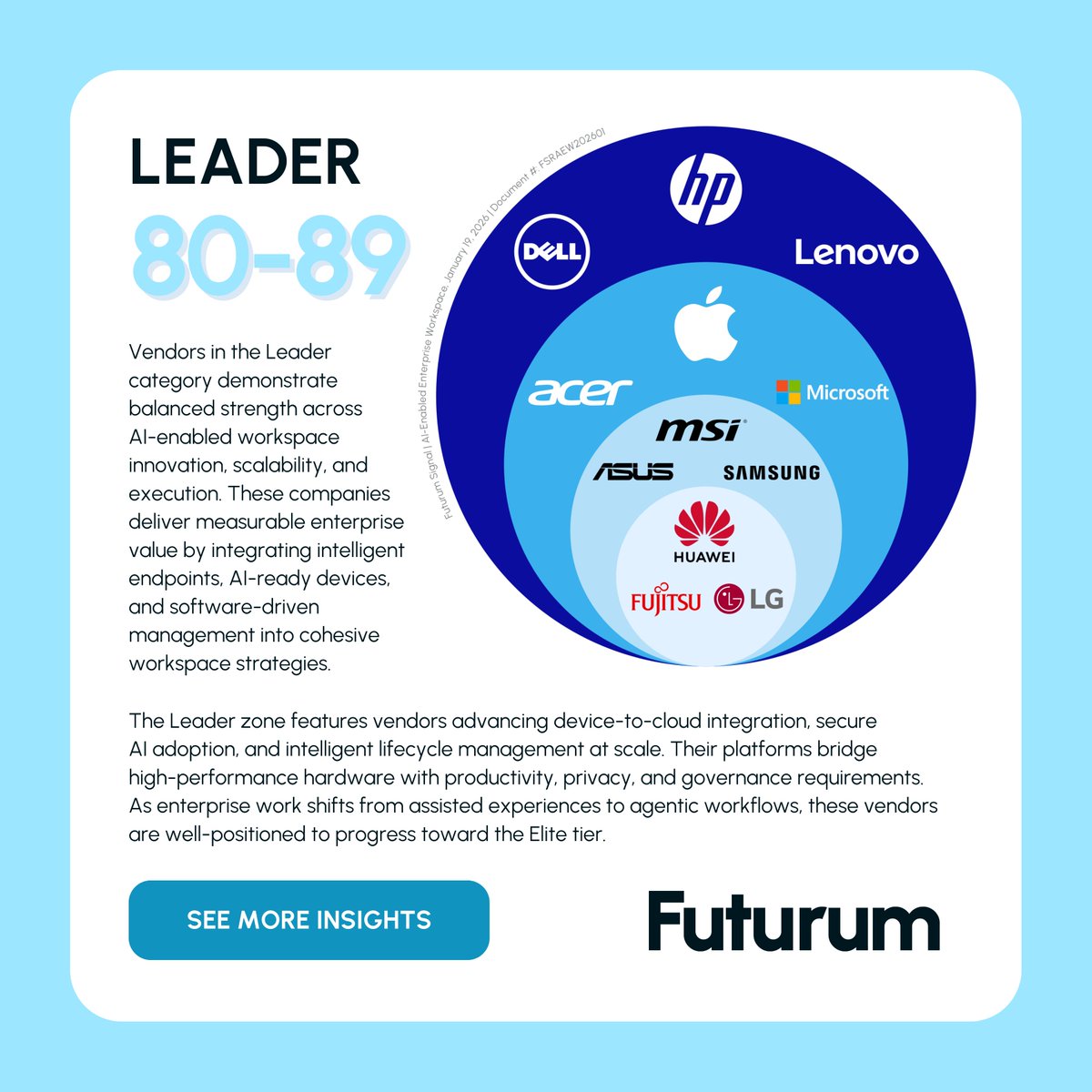
“The AI PC is, first and foremost, a radically better PC than pre-AI PCs. It is tangibly faster, more powerful, more capable and more useful. The all-day battery life alone is such a radical system improvement that even without its AI capabilities, it would be worth the upgrade. But perhaps more importantly in the long term, the AI PC also lays the necessary foundation for the next generation of software experience, which will be dominated by agentic AI. As agentic AI begins to insert itself into every application, from search, system management and security to productivity and creativity software, users in both the consumer and the commercial segments will need PCs designed securely to handle agentic AI workloads both in the cloud and locally, in order to take full advantage of the coming disruption/opportunity.”

Olivier Blanchard

Research Director & Practice Lead, Intelligent Devices

AI PCs Continue to Drive PC Market Refresh While On-Device AI Capabilities Redefine UX Across Key Device Categories

AI-capable PCs (PCs equipped with an NPU and capable of running some AI training and inference workloads locally) will come to represent at least 40% of new PC shipments by the end of 2025.

Three primary reasons are driving this change.

  • NPU for PCs: The introduction of NPUs into device system architectures, which includes PCs, is enabling devices to perform previously energy-intensive tasks far more efficiently than they could with traditional CPUs and GPUs. This new capability unlocks next-gen AI training and inference capabilities directly on the device, which in turn creates entirely new horizons of added utility for users and their organizations. NPU-equipped PCs also happen to deliver vastly superior performance per watt to their predecessors, translating into all-day (and even multi-day) battery life to users.
  • OEM Commitment to the Transition: Every major PC OEM is fully committed to this market transition, with aggressive competition between silicon vendors Qualcomm, AMD, and Intel accelerating performance improvements at both the processor and system levels. NVIDIA is also rumored to enter the market within 6-12 months. The PC ecosystem is moving forward, not backwards. AI PCs are already beginning to replace soon-to-be-obsolete traditional pre-AI PCs.
  • PC Resfresh Cycle: The end of support for Windows 10 (slated for October 2025) will also help drive the PC refresh cycle towards AI PCs and accelerate the adoption of AI PCs in the commercial segment.

As AI-capable PCs are an evolution of pre-AI PCs, all previous use cases for PCs still apply. However, new use cases have already begun and will continue to emerge.

  • Moving some AI Processing from the Cloud to Devices to expand the reach of AI beyond the data center. As large language models and large mixed models (multimodal AI) become more efficient, and AI PC systems become more capable, AI PCs will accelerate the expansion of AI workloads from the cloud to AI-enabled devices. Many of the large language models trained in the cloud a year ago can already be trained directly on-device today. As that trend continues, organizations will increasingly be able to train, test and fine-tune many of these models securely, onsite and at a fraction of the cost they would have otherwise incurred. Additionally, AI PCs allow pre-trained models to be quickly and securely customized by organizations locally rather than in the cloud.

  • Agentic AI in the PC. As agentic AI begins to transform the way users interface with apps and software, AI-capable PCs will be uniquely positioned to deliver secure, local, highly individualized on-device agentic-AI experiences to users concurrent with more general-use cloud-based agentic AI experiences, Use case examples range from AI agents drafting email responses, managing calendars and performing complex searches in seconds to reducing the time it takes to design a presentation, report or proposal from hours to minutes.

  • All Day & Multi-Day Battery Life. PCs capable of delivering all-day and multi-day battery life even in thin-lightweight form factors will also transform the way users work and play with their PCs, not only in hybrid and remote work scenarios but at the office as well, with notebook PCs becoming far easier to carry around between meetings. 


Research Director Olivier Blanchard covers Intelligent Devices for Futurum. In addition to having co-authored several books about digital transformation and AI with Futurum Group CEO Daniel Newman, Blanchard brings considerable experience demystifying new and emerging technologies, advising clients on how best to future-proof their organizations, and helping maximize the positive impacts of technology disruption while mitigating their potentially negative effects. Follow his extended analysis on X and LinkedIn.

Recent Insights, News & Research

Industrial AI
April 23, 2026

Can Lenovo’s AI Manufacturing Push at Hannover Messe Rewrite the Playbook for Industrial Scale?

Lenovo showcases AI solutions at Hannover Messe 2026, claiming 85% faster lead times. With 94% of manufacturers planning AI investment increases, competition intensifies between Lenovo, Siemens, and Rockwell Automation....
Qualcomm’s Snapdragon Wear Elite Redefines the AI Wearable Stakes—But Who Wins the Wrist War?
April 22, 2026

Qualcomm’s Snapdragon Wear Elite Redefines the AI Wearable Stakes—But Who Wins the Wrist War?

Qualcomm's Snapdragon Wear Elite marks a turning point in wearable AI, delivering a dedicated neural processing unit for on-device intelligence, privacy, and real-time voice interactions—positioning the company against Apple and...
pple’s CEO Transition- Can John Ternus Build on Tim Cook’s Legacy or Rewrite It?
April 21, 2026

Apple’s CEO Transition: Can John Ternus Build on Tim Cook’s Legacy or Rewrite It?

Apple's leadership transition to hardware veteran John Ternus signals a strategic shift. Analysts question whether his product-focused background can match Tim Cook's operational excellence while navigating AI disruption and intensifying...
Edge AI
April 21, 2026

Can Qualcomm’s Arduino Ventuno Q Break Nvidia’s Grip on Edge AI for Robotics?

Qualcomm's Arduino Ventuno Q single-board computer challenges NVIDIA Jetson by delivering edge AI for robotics at under $300, leveraging the Dragonwing IQ8 processor for cost-effective vertical integration....
Self-Driving Tech
April 21, 2026

Will AMD, Arm, and Qualcomm’s Bet on Wayve Rewrite the Self-Driving Tech Playbook?

Wayve's $60M funding round from semiconductor giants AMD, Arm, and Qualcomm signals a shift: chip makers are entering autonomous vehicle development, challenging automakers and hyperscalers for platform dominance....
Robotics Leads at 9.9% CAGR as the $278B Edge Silicon Market Charts a Destination-Driven Path to $340B
April 21, 2026

Robotics Leads at 9.9% CAGR as the $278B Edge Silicon Market Charts a Destination-Driven Path to $340B

Futurum Research's 1H 2026 edge silicon market forecast finds a $278B market heading to $340B by 2030, with Robotics leading at 9.9% CAGR and IoT registering a near-flat -0.2% CAGR...

Book a Demo

Newsletter Sign-up Form

Get important insights straight to your inbox, receive first looks at eBooks, exclusive event invitations, custom content, and more. We promise not to spam you or sell your name to anyone. You can always unsubscribe at any time.

All fields are required


Thank you, we received your request, a member of our team will be in contact with you.