
Austin, Texas, USA, September 30, 2026
Futurum releases its 2H 2026 Data Intelligence, Analytics, & Infrastructure market forecast alongside buyer research from 444 organizations building AI applications.
Two independent instruments are pointing at the same gap in the enterprise data stack. The Futurum Group’s 2H 2026 Data Intelligence, Analytics & Infrastructure Market Sizing & Five-Year Forecast sizes the global DIAI market at $343.2 billion in the CY2025 base year and forecasts it to reach $751.2 billion by CY2031. Within it, the Semantic & Context Layer carries the highest growth rate of any sub-market in every year of the window, peaking at 29.0% in CY2028. Separately, buyer-side research finds that of six data challenges tracked for AI applications, data enrichment (e.g., data labeling) is the only one on an unbroken upward path. The supply side and the demand side describe the same constraint from opposite ends of the spectrum.
Figure 1: The Metadata Bottleneck: Labeling Emerges as a Growing Friction Point for AI
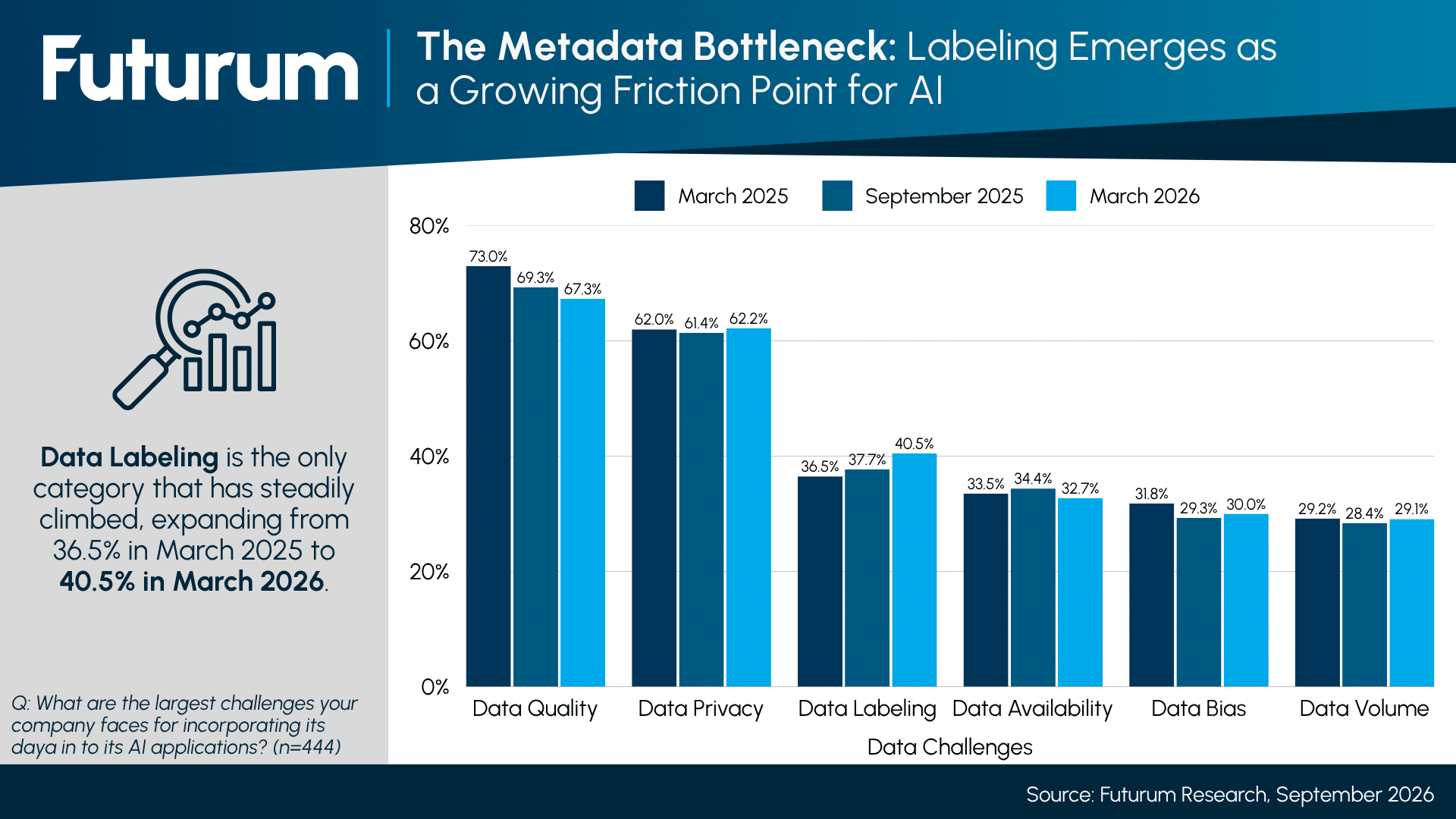
The pattern is stable almost everywhere. Data volume (29.1%), bias (30.0%), and availability (32.7%) have barely moved across the last three surveys, and privacy has held effectively flat at 62.2%. Two categories are moving in opposite directions. Data quality, the perennial leader, has fallen 5.7 points over twelve months, from 73.0% to 67.3%. Data labeling has climbed 4.0 points, from 36.5% to 40.5%, the only challenge on an unbroken upward path.
That divergence is telling. Enterprises are making measurable progress in determining whether their data is correct, but are running into a harder question: whether a system can tell what the data means. Moving AI from conversational interfaces to agent-driven workflows requires explicit domain context, not just clean records. A model cannot execute an action or answer a business question reliably if it cannot distinguish among competing definitions of an “active customer” across siloed data sources. The rise in labeling represents a broader trend, namely the hands-on work of supplying that context, and it is the leading indicator for the tier the forecast says is about to accelerate.
Brad Shimmin, Vice President & Practice Lead, Data Intelligence, Analytics, & Infrastructure at The Futurum Group, said, “A lot of teams spent the last two years assuming that modern foundation models would magically decipher messy enterprise schemas on their own. They’re finding out the hard way that raw data without explicit business context only creates faster hallucinations. The steady uptick in labeling challenges isn’t about annotating images or training models from scratch anymore. It’s about data enrichment: tagging entities, clarifying metric lineage, and teaching systems what internal data actually represents. You cannot build a governed semantic layer out of raw, ambiguous tables. If you want software agents to run reliable queries and safely write back to production systems, this kind of metadata groundwork is the price of entry.”
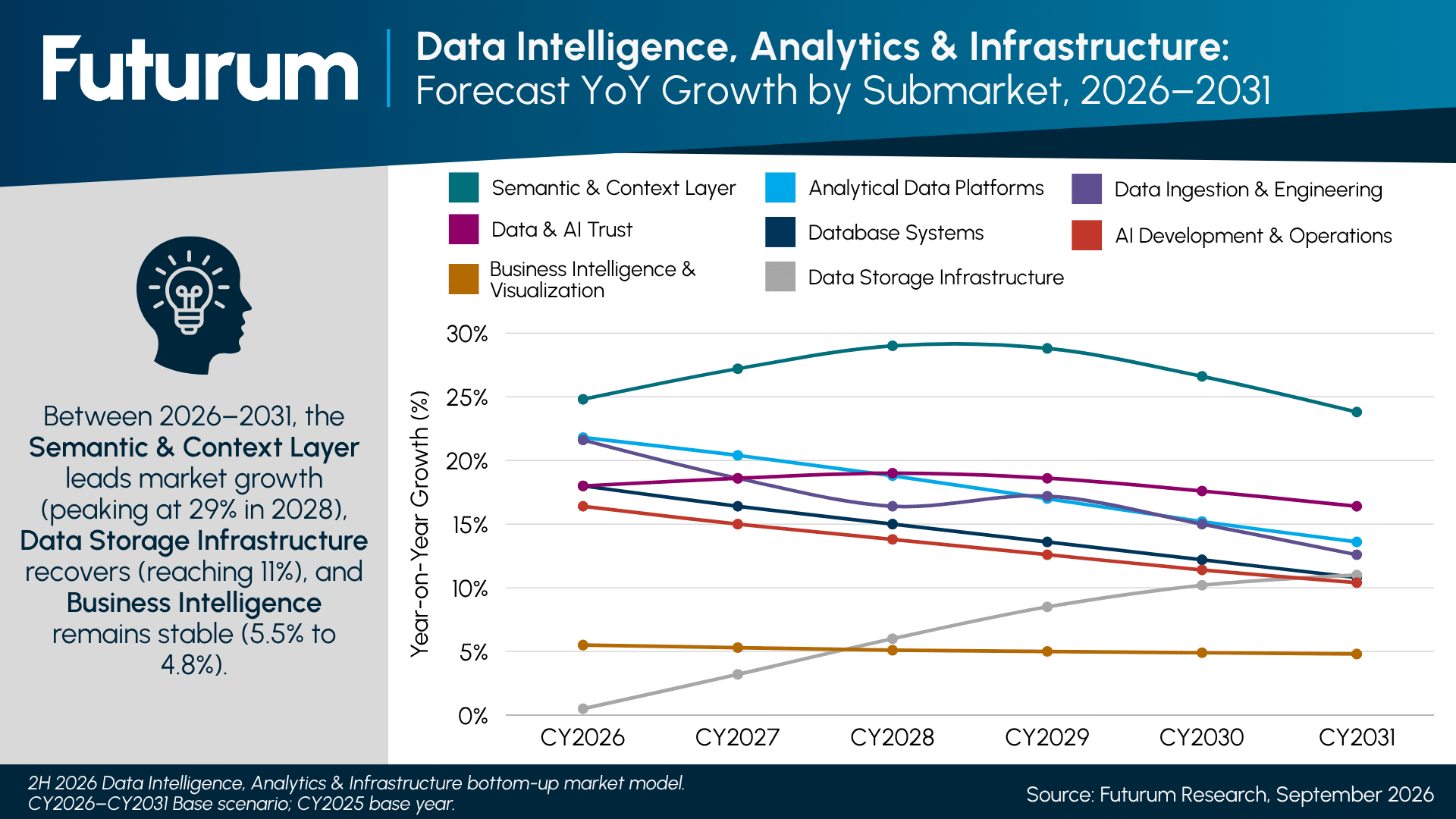
The forecast tells the other half of this same story. Core infrastructure segments, including database systems, analytical data platforms, and data ingestion pipelines, all taper steadily through 2031. The Semantic & Context Layer does the opposite, opening at 24.8% in CY2026, building to 29.0% by CY2028, and easing to a still-dominant 23.8% by CY2031. It leads every other sub-market every year of the forecast.
Figure 2: Forecast YoY Growth by Submarket, 2026 to 2031
The 2H 2026 research reveals several structural shifts across Data Intelligence, Analytics, & Infrastructure:
- Labeling is the only rising challenge. Across three waves, it climbed from 36.5% to 37.7% to 40.5%, a four-point gain, while every other category held flat or fell.
- Data quality as a target outcome is falling as data enrichment rises. Quality dropped 5.7 points to 67.3% over the same period, so enterprises are solving whether the data is right and colliding with whether the system knows what it means.
- The Semantic & Context Layer leads every year. It carries the highest growth rate of any sub-market in all six forecast years and is the only one to clear 29%, peaking at 29.0% in CY2028.
- Storage completes a full reversal. Data Storage Infrastructure posts the sharpest swing of any sub-market, opening at 0.5% growth in CY2026 and closing at 11.0% in CY2031, a path Futurum attributes to AI data-gravity demand re-accelerating a tier that had gone nearly flat.
Subscribers can read more in the full reports, “2H 2026 Data Intelligence, Analytics & Infrastructure Decision-Maker Survey Report,” and the “2H 2026 Data Intelligence, Analytics & Infrastructure Market Sizing & Five-Year Forecast“, on the Futurum Intelligence Platform. Non-subscribers click here for more information.
About Futurum Intelligence for Market Leaders
Futurum Intelligence’s Data Intelligence, Analytics, and Infrastructure IQ service provides actionable insight from analysts, reports, and interactive visualization datasets, helping leaders drive their organizations through transformation and business growth. Subscribers can log in to the platform at https://app.futurumgroup.com/, and non-subscribers can find additional information on Futurum Intelligence.
Follow news and updates from Futurum on X and LinkedIn using #Futurum. Visit the Futurum Newsroom for more information and insights.
Other Insights from Futurum:
Autonomy Over Analytics: The Read-Write Decree Rewiring Enterprise Data Platforms
Autonomous Agents Rewrite the Rules for Data Intelligence Platforms
AWS and the End of the Naive Agent: Collapsing the Semantic Divide
Author Information

Brad Shimmin is Vice President and Practice Lead, Data Intelligence, Analytics, & Infrastructure at Futurum. He provides strategic direction and market analysis to help organizations maximize their investments in data and analytics. Currently, Brad is focused on helping companies establish an AI-first data strategy.
With over 30 years of experience in enterprise IT and emerging technologies, Brad is a distinguished thought leader specializing in data, analytics, artificial intelligence, and enterprise software development. Consulting with Fortune 100 vendors, Brad specializes in industry thought leadership, worldwide market analysis, client development, and strategic advisory services.
Brad earned his Bachelor of Arts from Utah State University, where he graduated Magna Cum Laude. Brad lives in Longmeadow, MA, with his beautiful wife and far too many LEGO sets.

