
Austin, Texas, USA, August 27, 2026
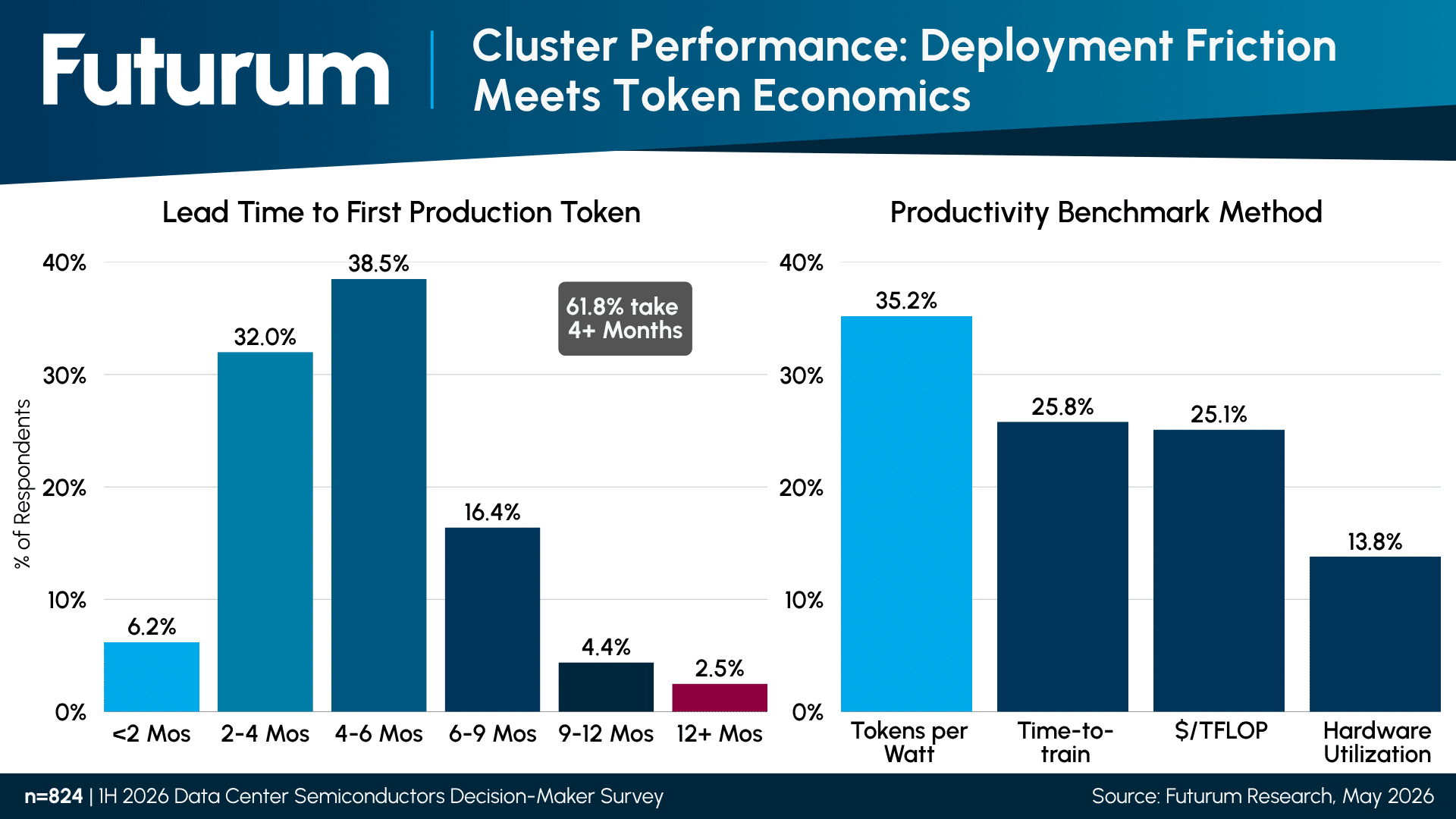
The “1H 2026 Data Center Semiconductor Decision Maker Survey Report”, a survey of 824 global data center semiconductor decision makers across enterprise end users, AI consumers, and data center operators fielded in Q1 2026, finds that 61.8% of compute decision makers take four or more months from purchase to first production token with a new AI accelerator cluster (4 to 6 months at 38.5%, 6 to 9 months at 16.4%, 9 to 12 months at 4.4%, and 12 or more months at 2.5%). Only 6.2% can stand up clusters in under two months. Separately, 35.2% now use tokens per watt as their primary AI infrastructure productivity benchmark, ahead of time-to-train at 25.8%, $/TFLOP at 25.1%, and hardware utilization at 13.8%.
Figure 1: Cluster Performance: Deployment Friction Meets Token Economics
“The challenge with new accelerators is not buying them, it is bringing them up. First production token arrives only after teams mature the software stack, validate kernels, and integrate the silicon into existing orchestration. That work is where AI infrastructure budgets quietly overrun. When 61.8% of buyers take four months or longer to get there, the binding constraint is engineering effort. Vendors that treat bring-up as a first-class problem, hardening compilers, libraries, and support around real workloads, hold a defensible position.”— Brendan Burke, Research Director, Semiconductors, Supply Chain, and Emerging Tech, The Futurum Group
The 1H 2026 survey reveals several structural shifts in cluster performance and token economics:
- Token volumes are operationally mature. 54.7% of decision makers generate 51 trillion or more tokens annually (33.1% at 51T to 500T, 19.1% at 501T to 5 quadrillion, and 2.5% above 5 quadrillion). Only 6.2% do not track token volume. Token volume is now a key productivity metric.
- Throughput targets exceed 500,000 tokens/sec/MW for 60.3%. 23.2% target 501K to 1M tokens/sec/MW, 21.8% target 1M to 2M, 10.9% target 2M to 4M, and 4.4% exceed 4M. Only 7.2% do not track throughput. High throughput is becoming non-negotiable for agentic speed.
- Hardware utilization has lost its lead as the top metric for AI infrastructure productivity. At 13.8%, hardware utilization trails tokens per watt (35.2%), time-to-train (25.8%), and $/TFLOP (25.1%). The buyer has shifted to economics-per-token, with hardware uptime being only a leading indicator.
Subscribers can read more in the full report, “1H 2026 Data Center Semiconductor Decision Maker Survey Report”, on the Futurum Intelligence Platform. Non-subscribers, click here for more information.
About Futurum Intelligence for Market Leaders
Futurum Intelligence’s Data Center Semiconductors IQ service provides actionable insight from analysts, reports, and interactive visualization datasets, helping leaders drive their organizations through transformation and business growth. Subscribers can log in to the platform at https://app.futurumgroup.com/, and non-subscribers can find additional information on Futurum Intelligence.
Follow news and updates from Futurum on X and LinkedIn using #Futurum. Visit the Futurum Newsroom for more information and insights.
Other Insights From Futurum:
Microchip Technology Q4 FY 2026 Revenue Beats Consensus With Data Center Wins
EDA Vendors Race to Align With TSMC’s Angstrom-Era Roadmap at Technology Symposium
NVIDIA’s $4B Optics Bet Signals Photonics as AI’s Next Bottleneck
Author Information

Brendan is Research Director, Semiconductors, Supply Chain, and Emerging Tech. He advises clients on strategic initiatives and leads the Futurum Semiconductors Practice. He is an experienced tech industry analyst who has guided tech leaders in identifying market opportunities spanning edge processors, generative AI applications, and hyperscale data centers.
Before joining Futurum, Brendan consulted with global AI leaders and served as a Senior Analyst in Emerging Technology Research at PitchBook. At PitchBook, he developed market intelligence tools for AI, highlighted by one of the industry’s most comprehensive AI semiconductor market landscapes encompassing both public and private companies. He has advised Fortune 100 tech giants, growth-stage innovators, global investors, and leading market research firms. Before PitchBook, he led research teams in tech investment banking and market research.
Brendan is based in Seattle, Washington. He has a Bachelor of Arts Degree from Amherst College.

