Analyst(s): Mitch Ashley
Publication Date: July 29, 2026
On July 15, Atlassian let engineering teams assign work to Claude Code, Cursor, and GitHub Copilot directly in Jira, view all agents in one view, and route work to them with automation rules. The features matter less than what sits under them. Teamwork Graph, the 150-billion-object layer Atlassian has spent years building, now feeds all three at once, which is what turns a set of features into a single system.
What Is Covered in This Article:
- Atlassian added the ability to assign Jira work items to Claude Code, Cursor, and GitHub Copilot, a built-in Jira Coding Agent, agent session visibility, automation rules that route work to agents, and a DX report tracking AI spend per pull request.
- Teamwork Graph, opened as a programmable platform in May, feeds the work surface, the workflow automation, and the governance layer from one source of truth, which is what binds the three into a single system.
- This analysis maps Atlassian against the Futurum AI Stack and the Agent Control Plane Framework, the first vendor mapping across both models, tracing the arc from Rovo in 2024 through the DX acquisition to show where the fusion is real and where the open questions sit.
The News: Atlassian announced new Jira capabilities on July 15 to advance AI-native software development, framing Jira as the coordination layer for human and agent work across the full software development lifecycle. Teams can assign work items to Claude Code, Cursor, or GitHub Copilot, with Codex support coming soon, and a built-in Jira Coding Agent, included in every paid plan, converts work items into ready-to-review pull requests. Teamwork Graph provides the enterprise context feeding those agents.
The release also adds agent session visibility, showing what is stuck, waiting, or complete across agents, an automation rule builder that routes bug fixes and remediation work to agents, and a DX AI cost management report that maps token and spend data to engineering output. Most capabilities are available today to paid Jira Cloud customers at no additional cost. Jira Planner is in early access, and DX AI cost management is available to DX customers.
Atlassian Fuses the Agent Work Surface, Workflow, and Control Plane Into Jira
Analyst Take: Most vendors are claiming one layer of the Futurum AI Stack. Atlassian just bound three of them together. The July 15 launch puts the work surface where engineers hand tasks to agents, the workflow that routes those tasks, and the control plane that governs them into a single system. The features are real, but the fusion is the story.
Teamwork Graph Is the Reason the Fusion Holds
Three layers in one product is a packaging decision. Three-layer reading from one source of truth is a system. Teamwork Graph is what makes the difference, and it is the piece that turns this launch from a feature bundle into a strategic position.
The graph holds more than 150 billion objects and relationships across Jira, Confluence, Bitbucket, Loom, and 75-plus third-party tools. When a developer assigns work to Cursor, when an automation rule routes a bug fix to an agent, and when a governance check reviews what that agent did, all three read the same graph. The work surface, the workflow, and the control plane are not integrated after the fact. They share one context from the start.
Two design choices set the graph apart from how most vendors build. It read data across every Atlassian product from the start, where rivals typically wire one product at a time. It also builds its own data on the third-party tools a customer connects to, reaching outward while others map only their own products. Atlassian describes the graph as a multiyear effort, with serious work beginning roughly two years before the platform was announced. This was a deliberate bet that took years to mature.
Futurum called the graph Atlassian’s secret weapon in May, when the company opened it as a programmable platform. The July launch is what the secret weapon was for. Atlassian is betting that as frontier models commoditize, the durable advantage is the structured context every agent has to read before it can act. Own that context, and you sit underneath every agent an enterprise runs, whoever built it.
The obvious objection is lock-in. An enterprise with its knowledge modeled inside one vendor’s graph could fear that it cannot get the data back out. Atlassian answers that the data is exported at any time, so it is not trapped, and the value is not the data itself but how the graph puts it to work across Atlassian’s products. That is a fair answer on portability. It also quietly concedes the real switching cost: not the data, but the cross-product intelligence built on top of it.
A Four-Year Build, Not a Product Launch
The fusion did not happen on July 15. It is the payoff of a sequence that runs back to 2023, and reading the launch without that arc misses what Atlassian actually assembled.
Atlassian Intelligence arrived in late 2023 as an assistive AI across Jira, Confluence, and Jira Service Management. AI was a feature then. It assisted, but it did not act. Rovo changed the frame. Announced at Team ’24 in May 2024 and generally available that October, Rovo introduced enterprise search, chat, and the first prebuilt agents, all running on Teamwork Graph. Rovo Studio followed at Team ’25 in April 2025, letting teams build agents without code. By early 2026, agents could access Jira work items directly, with Agents in Jira reaching general availability at Team ’26 in May 2026.
Two 2025 acquisitions hardened the position unevenly. Atlassian closed The Browser Company in October 2025, a hedge against AI browsers becoming the surface every vendor has to route through in Futurum’s viewpoint. That scenario has not arrived, so the hedge sits unused, still alive but not yet load-bearing. DX, closed in November 2025, is the one that matters now. DX measures the operational reality of software delivery: throughput, review turnaround, change confidence, and deployment frequency. The graph knew what work existed. DX adds whether the work is paying off, evidence that agents never had before. It is also why the July cost-tracking feature shipped as a working capability while competitors are still promising theirs.
The same stretch saw Atlassian expand its Google Cloud partnership at Cloud Next in spring 2026, putting Gemini 3 Flash into select Rovo capabilities and running training and inference on Google Kubernetes Engine and Google’s AI Hypercomputer. That partnership proved bidirectional MCP integration in production, Rovo reachable inside Gemini Enterprise, and Google Workspace reachable inside Atlassian tools. Atlassian was open at the protocol layer months before the July launch.
May’s Team ’26 event introduced Teamwork Graph itself, the general availability of Forge Connectors, an open-beta CLI with more than 300 commands, and MCP Server tools built for any compatible client. Each step added a piece. July bound them.
Mapping Atlassian to the AI Stack
Atlassian is the first instance a vendor has been mapped across the AI Stack and the Agent Control Plane Framework by Futurum. The exercise does something a feature list cannot. It shows where a vendor has staked a durable position, where it is renting from a partner, and where it has said nothing at all. Table 1 traces every move from Atlassian Intelligence in 2023 to the July launch.
Table 1: Atlassian’s AI Moves Mapped to the AI Stack and ACPF
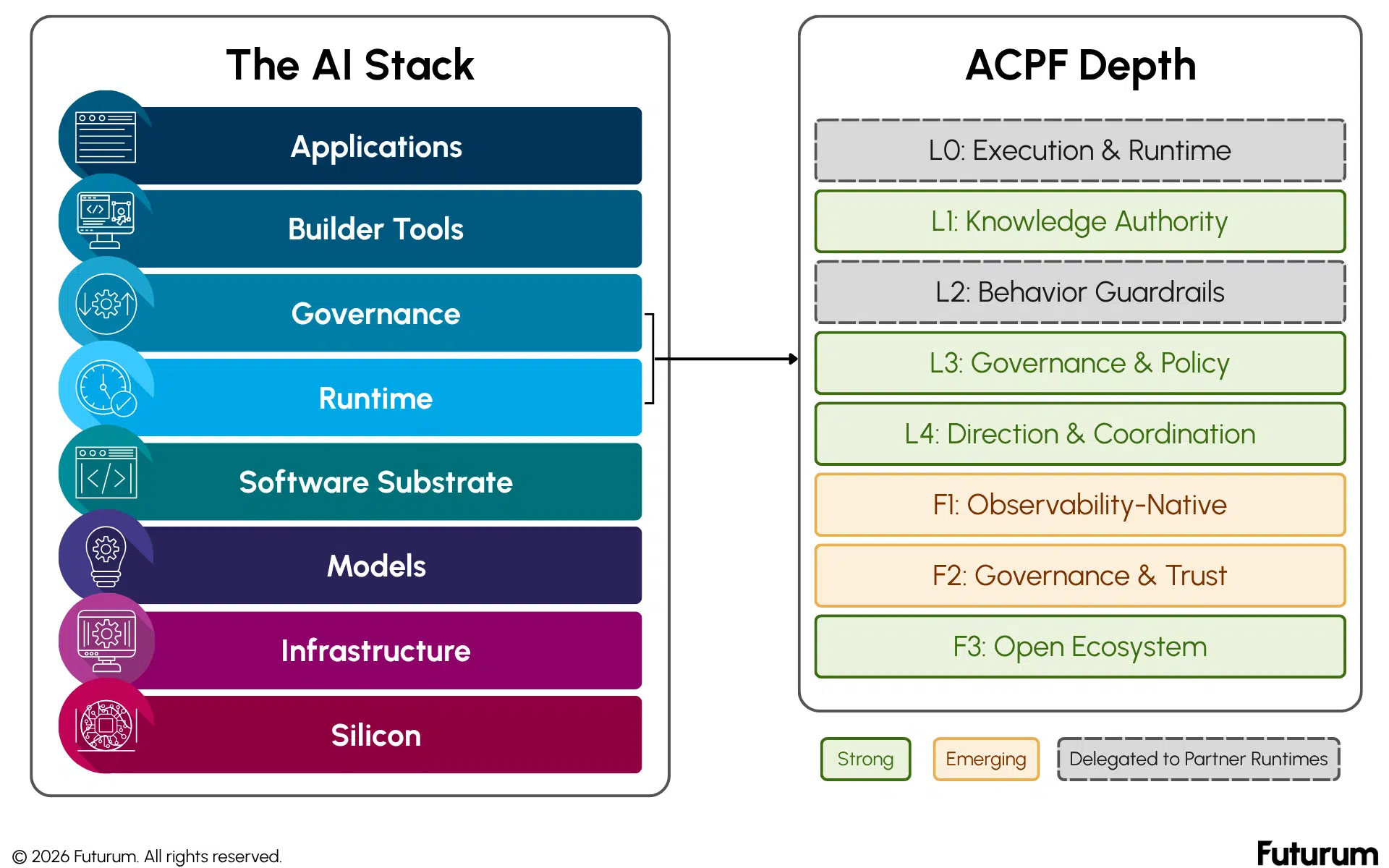
Figure 1: The Futurum AI Stack
The map reads cleanly. Atlassian owns the top of the stack, Apps and Builder tools, where engineers and agents meet. It has bound Governance and Runtime through the graph. It rents Models, Runtime infrastructure, and Software substrate from Google Cloud. It makes no claim on Infrastructure or Silicon, and it should not. The fusion sits exactly where Atlassian is strong, the work surface and the coordination layer, and stops where the partnership takes over.
How Deep the Control Plane Goes
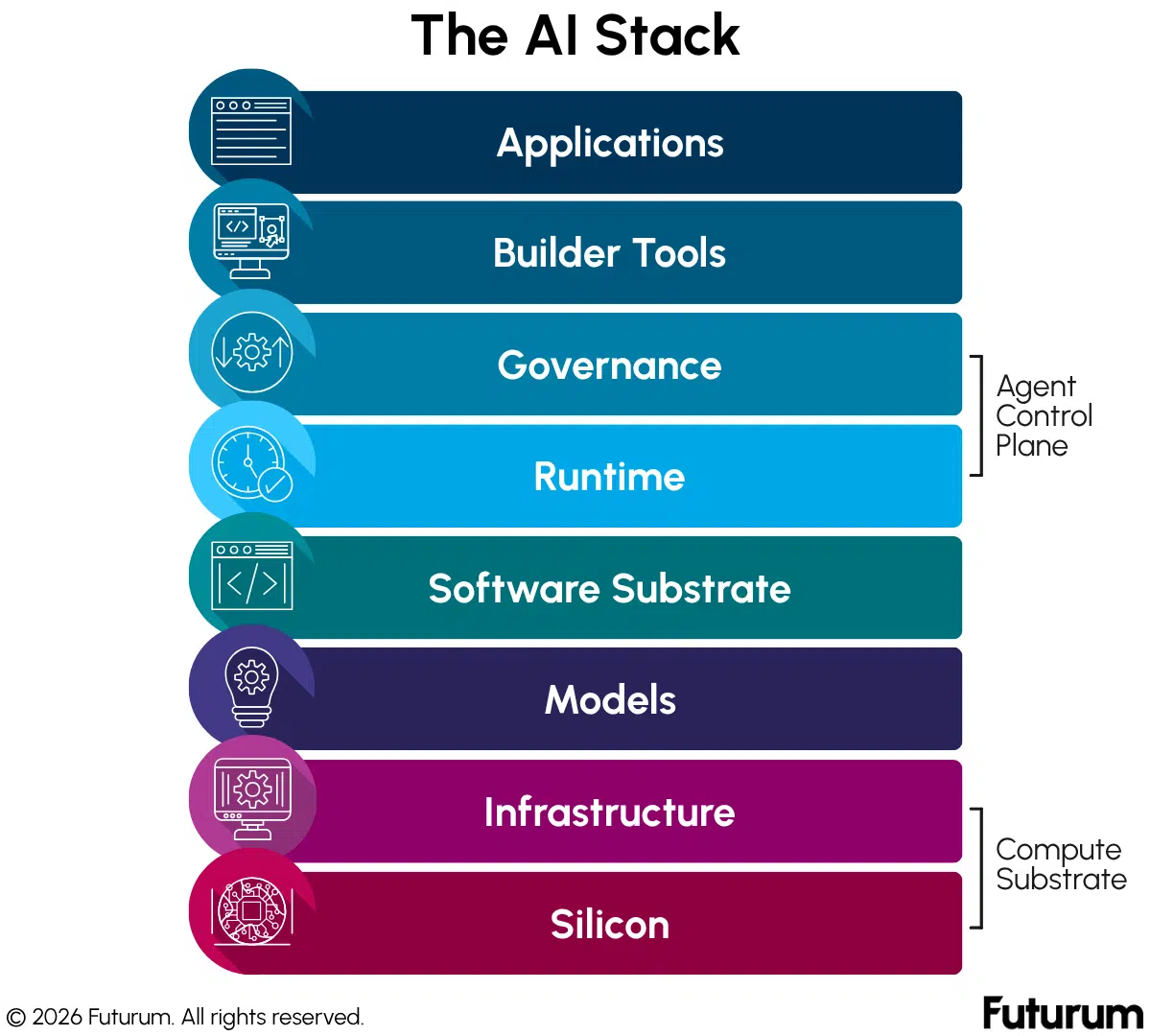
The AI Stack shows where Atlassian plays. The Agent Control Plane Framework shows how deep. The framework’s five layers and three foundations live inside the Governance and Runtime layers. Figure 2 maps the July release against them, and the shape is telling.
Figure 2: July 15 Announcement Mapped to the AI Stack and ACPF Depth
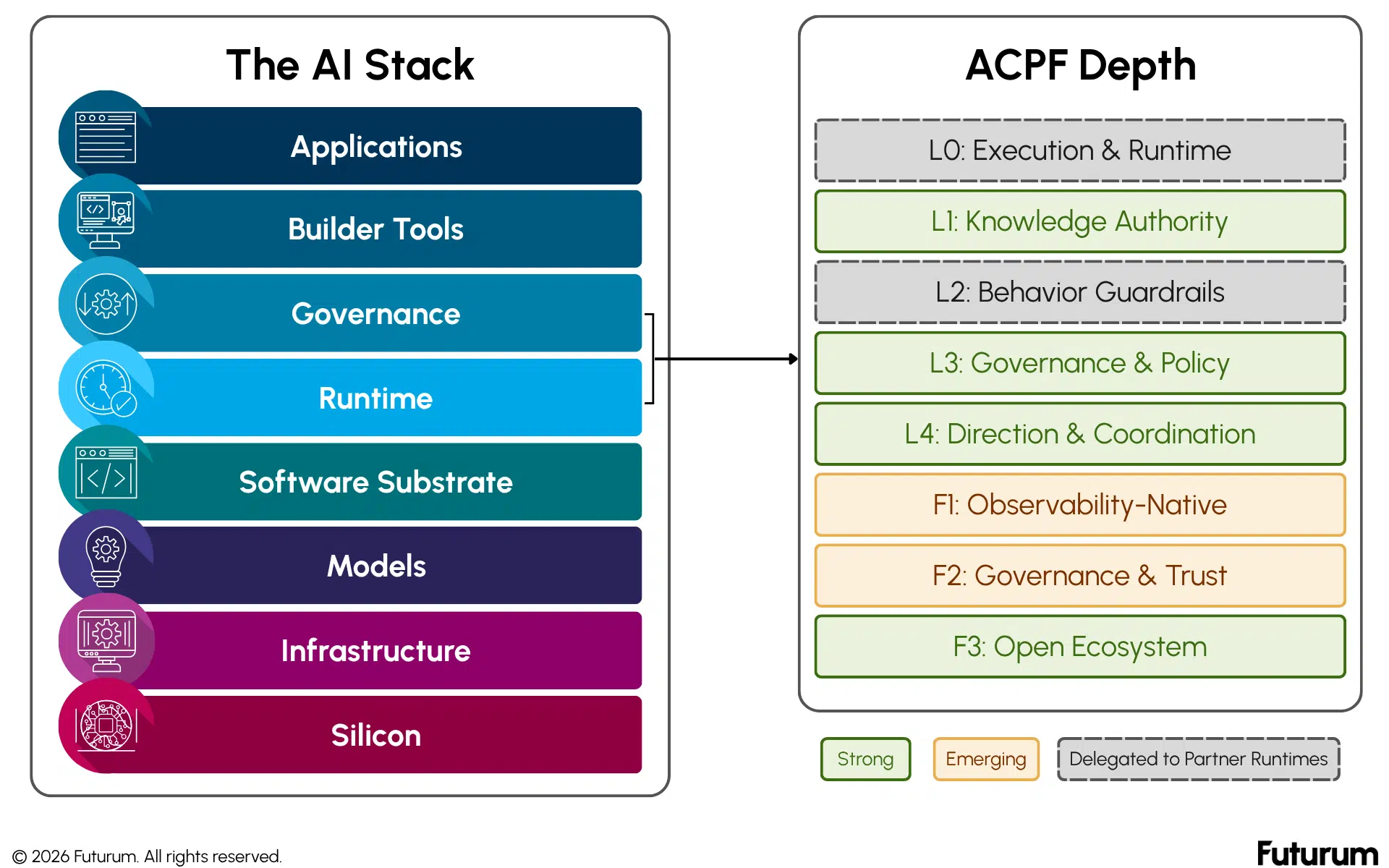
Knowledge authority, ACPF Layer 1, is Atlassian’s strongest layer. The graph inherits the identity, access, and audit boundaries that the company spent years operationalizing. That control is real and already in production. Coordination at Layer 4 and governance at Layer 3 are strong, too. The open ecosystem at F3 is a deliberate strength, since the graph CLI and MCP servers allow any agent, inside or outside Atlassian, to read the same context.
Atlassian delegates execution at Layer 0 to external runtimes like Claude Code, Cursor, and Copilot, while using Jira workflows and scoped permissions as its primary behavior guardrails at Layer 2. Agents can be invoked at defined workflow transitions and through automation rules, and their updates to Jira work items are recorded in issue history, real operational constraints, but not a formal, published AI safety standard.
Observability at F1 and trust at F2 are the emerging layers. Session visibility, org-wide agent lists, and cost-per-output tracking are real but shallow, closer to a dashboard than to production telemetry. Trust is present inside Atlassian through permissioning and auditability, and thin across vendors, where certifying a third-party agent still means a Marketplace listing or a contract. The DX acquisition is how F1 deepens. DX measures delivery performance, throughput, change confidence, and review turnaround. Feed that signal into the graph, and agents gain evidence about their own output, a feedback loop that the task-level context alone cannot provide.
Identity Is the Part Atlassian Already Solved
The layer most vendors seek is the one Atlassian moved on early. At its Barcelona conference in October 2024, Atlassian said agents would be assigned identities the same way human users are, and treated as team members rather than background automations. ServiceNow, Microsoft, and Salesforce have since made similar moves, but Atlassian staked its claim early. The July launch is where that framing becomes operational.
An agent appears as an assignee, gets @mentioned, and sits inside Jira workflow states with the same fields and patterns a human teammate uses. Rovo Studio adds agent accounts with scoped permissions, giving each agent a managed identity that persists like a user account. Identity answers who the agent is. Workflow placement answers where it is allowed to act. Binding the two means every agent is recognizable, permissioned, and traceable across planning, execution, and review.
This is the governance layer competitors treat as a roadmap item, shipped as a working capability. It also closes most identity questions within Atlassian’s boundary. The remaining edge is cross-vendor. When a workflow spans Rovo and an external orchestrator like Gemini Enterprise, we must look to Atlassian and Google for guidance on how those agent and workflow identities are governed. That is one of the genuine open questions left.
What This Means for Buyers
A CIO evaluating this is not buying features. The buyer is committing to Atlassian’s graph as the source of truth that every agent reads before acting, a deeper commitment than a tool selection and stickier. The upside is a single governed context across every agent the organization runs. The risk is that the boundary stops at Atlassian’s edge, and cross-vendor governance needs become the buyer’s problem to solve.
The survey data shows a buyer caught between what hurts and what they shop for, per the 2H 2026 Software Lifecycle Engineering Decision Maker data. Governance ranks third among factors limiting expanded AI use, named a top-three constraint by 42.4% of respondents, behind only token and compute cost at 43.7% and code quality at 43.4%. Yet AI governance support ranks dead last as a purchase criterion, 13th of 13, with just 4.3% naming it. Buyers feel the governance pain acutely. They are not yet naming it at the point of sale.
That gap is not permanent, and betting it stays open is the wrong read. 75% of organizations have already experienced a production incident in which AI-generated code, AI agents, or AI tooling was a contributing factor. Buyers already purchase for data sovereignty, risk reduction, and regulatory compliance, the top criteria, all of which carry governance within them. The demand is latent and real. As more agents reach production and more incidents land, the naming catches up to the pain, and governance moves from an implicit buy to an explicit one. Vendors who frame governance as embedded risk reduction convert that latent need into a pipeline. Vendors who wait for buyers to ask for governance by name will be late.
This is the window where Atlassian’s graph matures. The identity and governance work is largely built before the market starts demanding it at the point of sale. When the naming catches up, Atlassian is positioned to answer, provided it closes the cross-vendor edge before a competitor does.
What to Watch:
- Whether Atlassian and its partners resolve cross-vendor identity, the one open edge, by naming whose identity model governs when a workflow spans Rovo and an outside orchestrator like Gemini Enterprise.
- Whether Atlassian feeds the DX delivery signal into Teamwork Graph to the observability-native gap and gives agents evidence about their own output, moving the framework’s weakest strong-candidate layer to strong.
- How Microsoft, ServiceNow, or Salesforce respond in binding their own context layer to a coordination surface, as Atlassian just did, or compete based upon layer integration alone.
- Whether the next Atlassian benchmark brings independently verifiable data, given the 44% accuracy and 48% token figures from the release, repeat the numbers used for Teamwork Graph in May.
For more information, see the press release or article on the vendor’s website.
Disclosure: Futurum is a research and advisory firm that engages or has engaged in research, analysis, and advisory services with many technology companies, including those mentioned in this article. The author does not hold any equity positions with any company mentioned in this article.
Analysis and opinions expressed herein are specific to the analyst individually and data and other information that might have been provided for validation, not those of Futurum as a whole.
Other Insights From Futurum:
Selling Agent Provenance to the CIO: Entire Changes Who Signs
Microsoft Build 2026 – The Platform, Integration Plane, and Developer Surface
Google I/O: Did Google Just Ship the Full AI Stack?
Author Information

Mitch Ashley is VP and Practice Lead for the CIO & Technology Buyers and Software Lifecycle Engineering practices at The Futurum Group. A multi-time CIO and CTO with 30+ years leading technical organizations, Mitch built and operated production systems spanning cybersecurity for the U.S. Department of Defense, PKI services for the broadband and 5G industries, SaaS platforms, large-scale telecom and banking systems, and a national broadband network. His work with AI began early, developing expert systems that diagnosed and repaired complex mainframe environments. That operator foundation grounds his analysis in operational consequence, covering the technology buyer's world of software engineering, cybersecurity, DevOps, cloud, and AI.