
Disclosure: This report was commissioned by Oracle and conducted independently by The Futurum Group.
Corporate boards have issued a clear mandate: operationalize autonomous, agentic artificial intelligence immediately. Yet, this ambition keeps colliding with a rigid architectural ceiling. Over the last decade, polyglot persistence and brittle architectures have dominated data strategy, encouraging organizations to deliberately silo enterprise data and supportive infrastructure. IT teams deployed purpose-built document stores for unstructured data, standalone vector engines for semantic context, relational databases for transaction processing, and warehouses for strict financial reporting. Today, this fractured landscape demands incredibly complex integration plumbing simply to keep the lights on. To illustrate, when an agentic system burns its compute cycles as integration glue rather than executing core reasoning tasks, costs go up and additional network latency and synchronization lags inevitably break the workflow. In short, companies cannot bolt a modern autonomous capability layer onto a shattered infrastructure foundation.
Moving from experimental copilot chatbots to true agentic AI, where systems can reason, plan, coordinate, and independently execute multi-step business processes, exposes these foundational cracks. An AI agent needs simultaneous access to unstructured user profiles, rigid inventory tables, and semantic vector embeddings to accurately map the current state of the business. Forcing that agent to traverse distinct network hops to stitch this context together introduces a latency penalty that destroys its effectiveness and potentially interrupt agents’ actions midstream. Furthermore, autonomous agents demand persistent memory to comprehend ongoing context, a feature entirely absent from traditional stateless models (see Figure 1).
Our data warehouse/lake is too slow for real-time agent interactions
We lack a transactional (OLTP) layer that agents can write to directly (e.g., updating a customer record)
We cannot fit enough relevant history into the model's context
Agents cannot easily trigger external API actions (e.g., updating a CRM)
While many organizations have built agents that can "read" data, nearly a quarter of the market is hitting a brick wall when trying to "write" actions — a limitation Oracle's converged transactional-vector engine is designed to obliterate.
n = 818 Enterprise IT Decision Makers
Source: Futurum Research. Data Intelligence, Analytics, and Infrastructure Decision Maker Survey Report, 1H 2026.
When AI projects fail, blame usually falls on the algorithms or the vision. In reality, these are infrastructural and architectural collapses. To relieve this precise tension, Oracle AI Database 26ai converges relational, document, graph, vector, and other forms of data processing into a single, high-performance engine. In this way, Oracle can provide a pragmatic, structurally sound alternative to the chaotic patchwork of point solutions currently flooding the market. Scaling agentic AI demands a different approach, a unified foundation capable of delivering high-speed data retrieval alongside absolute transactional integrity.
The central thesis driving this architectural requirement is straightforward: success in the agentic era hinges entirely on moving reasoning logic and persistent memory directly to where the data physically resides. Organizations must stop shuttling sensitive information around outside of secure boundaries to feed external, stateless models. Oracle AI Database 26ai establishes this unified paradigm, enabling agents to execute complex business workflows over a single version of the truth. When the database engine natively handles multi-modal reasoning, enterprises completely eliminate typical integration overhead, clearing the path for mission-critical autonomous applications to operate securely at a global scale.
To truly grasp the necessity of a converged architecture, companies should unpack the architectural missteps defining today’s market. The industry-standard approach to building AI applications relies heavily on fragmented, bolt-on engineering. Developers typically select a specialized NoSQL document store for the application state, spin up a separate vector database for semantic similarity searches, and wire it all together with an external orchestrator framework. This best-of-breed philosophy often yields a rapid proof of concept while masking a mountain of technical debt that inevitably comes due during Day-2 operations.
This fragmentation exacts a severe operational toll on the enterprise. Continuously moving data between specialized silos racks up excessive egress fees, pipeline maintenance costs, as well as licensing complexity and bloat. More critically, it breeds severe security vulnerabilities. Administrators find themselves forced to replicate and manage separate access control models across disjointed platforms. Lock down the relational store while leaving the adjacent vector database exposed, and even the best retrieval-augmented generation (RAG) pipeline instantly morphs into a gaping data leak.
Cost and security issues aside, this disjointed architecture introduces a fatal technical flaw: state-vector dissonance. In environments where operational data resides in one database and vector embeddings reside in another, background processes handle synchronization asynchronously. When an agent attempts to reason over this setup, it reasons using outdated memories. If a product goes out of stock or a customer’s credit limit drops, the delayed update to the external vector index forces the agent to recommend actions based on an expired reality. For an autonomous system making financial or logistical decisions in real time, this kind of synchronization latency spells disaster.
Many modern data solutions offer the illusion of simplicity, marketing their standalone vector stores or specialized document databases as frictionless components. Under the hood, these tools force data engineering teams to build, monitor, and maintain fragile extraction, transformation, and loading pipelines simply to keep these disparate systems remotely aligned. According to Futurum Research’s 1H 2026 Data Intelligence, Analytics, and Infrastructure Decision Maker Survey, poor data quality and availability account for many AI project failures, but the complexity of model deployment and MLOps drives even more disruption (see Figure 2). This spells out one simple message: broken data logistics represent the primary barrier to production success.
This leads directly to a last-mile disconnect. Fragmented solutions fail completely at the exact point of operationalization. An AI agent might successfully analyze a trend and recommend a stock purchase, a supply chain reroute, or a patient treatment adjustment. Without a transactional engine offering ACID (Atomicity, Consistency, Isolation, Durability) guarantees, the agent cannot safely execute that move. Companies cannot trust an autonomous system to transfer capital or update healthcare records within an environment built on eventual consistency. By stranding AI insights in isolated dashboards and decoupled orchestration layers, the status quo forces organizations to maintain a manual validation step for every critical action, entirely negating the promise of agentic autonomy.
AI failure modes are becoming architectural rather than experimental. The friction of integration and deployment complexity now far outweighs raw data quality as the primary bottleneck for operationalizing agentic AI, highlighting the immediate need for a converged infrastructure.
n = 818 Enterprise IT Decision Makers
Oracle AI Database 26ai abandons the flawed polyglot persistence model in favor of a deeply optimized converged engine, aligning with a broader market shift toward integrated, multi-model architectures (see Figure 3). Oracle’s databases have long handled multi-modal logic natively, but they’ve recently extended their leadership in this area with the addition of AI Vectors as a native data type and both JSON Relational Duality and Graph Views, which enable a single copy of data to be used natively in document, relational, and graph paradigms. Oracle’s extension of its converged approach directly targets the structural weaknesses of the fragmented stack, positioning the database as the primary control point for enterprise automation.
We use vector capabilities within our existing multi-model databases (e.g., PostgreSQL/pgvector, Oracle, MongoDB)
We use purpose-built vector databases (e.g., Pinecone, Weaviate) alongside our core data
The architectural honeymoon for specialized vector stores is ending. As the "integration tax," synchronization lags, and security gaps of standalone tools become apparent, a growing plurality of the market (33.4%) is pivoting toward integrated, multi-modal databases, such as Oracle AI Database, to simplify their stack.
n = 818 Enterprise IT Decision Makers
Source: Futurum Research. Data Intelligence, Analytics, and Infrastructure Decision Maker Survey Report, 1H 2026.
The most prominent mechanism neutralizing the fragmented penalty is Oracle’s JSON-Relational Duality Views architecture. Historically, software developers battled the object-relational impedance mismatch by relying on fragile Object-Relational Mapping tools or surrendering ACID compliance entirely to adopt NoSQL document stores. Oracle resolves this structural conflict by allowing the same bytes of data to be accessed simultaneously as both flexible JSON documents and highly structured relational tables. This magic happens without any underlying data duplication. A developer can write a nested JSON purchase order via a standard REST API, and an analyst can instantly query the individual line items of that exact same record using complex SQL joins. The database maintains optimistic concurrency control internally, seamlessly managing the state without deploying intrusive locking mechanisms that throttle throughput.
Oracle also completely rewires retrieval-augmented generation through in-kernel vector processing. Rather than slapping a separate vector search engine onto the side of an operational database, Oracle embeds vector math directly into the deepest levels of the database kernel. Vector embeddings physically sit, index, and query alongside operational JSON documents and relational transactions. Update a record, and the associated vector index updates within the exact same atomic transaction. State-vector dissonance vanishes entirely. An AI agent can execute a hybrid query – filtering by semantic similarity while rigorously enforcing relational constraints such as real-time inventory counts – in a single, highly optimized database pass.
To elevate agents from simple, stateless functions into persistent enterprise entities, the platform introduces another unique trick – Oracle Unified Agent Memory. Typical agentic deployments lean on external orchestration frameworks to repeatedly shove conversational memory into the prompt context window of a large language model. This process runs terribly inefficiently, burns through costly tokens, and opens up massive security holes. Unified Agent Memory provides a stateful, persistent memory layer physically within the database engine. Autonomous agents can seamlessly retrieve long-term context across complex, multi-step reasoning cycles over all major data types without losing transactional lineage or broadcasting sensitive conversational history across vulnerable networks.
Oracle further extends performance and security with in-database agent execution. Using the Oracle AI Database Private Agent Factory, organizations can create and deploy data-centric agents as portable containers running natively next to the data itself. This architectural choice obliterates network roundtrips by processing heavy data-retrieval and filtering loops locally on the database server. It enforces a strict “compute-versus-disclose” privilege separation. The created agents and those imported using the Open Agent Specification can access and reason over raw, sensitive data internally, returning only the final, synthesized answer to the end-user. Intermediate sensitive data points never travel across the application tier, radically shrinking the attack surface.
Unifying these capabilities into a single converged engine allows enterprise architects to apply a cohesive security policy and governance framework across the entire ecosystem. Using Oracle Deep Data Security capabilities, administrators define highly granular access controls once, and the database enforces those rules with absolute consistency, whether a user queries the data via SQL, accesses it programmatically as a JSON document, retrieves it through a semantic vector search, or via an agent acting on their behalf. This unified policy enforcement eradicates the governance gaps inherent to disjointed, heterogeneous, and siloed architectures.
Enterprise technology never exists in a vacuum. It must bridge legacy system investments with emerging open standards. Oracle AI Database 26ai avoids erecting a new proprietary data silo by engineering native, high-performance support for industry standards and external data formats. The platform demonstrates that organizations can achieve deep integration without sacrificing the operational advantages of a converged architecture. Oracle’s “Vectors on Ice” capability showcases this interoperability, providing native support for the Apache Iceberg open table format and extending access to data lakes. As of March 2026, customers can make use of several mission-critical features introduced within version 3 of this popular standard. For example, the platform supports deletion vectors for optimized writes and row lineage in Iceberg. Modern enterprises frequently maintain petabytes of unstructured and semi-structured data in data lakes deployed in object storage scattered across various cloud providers. Dragging this massive volume of data into a centralized relational database for AI processing would trigger astronomical egress costs and unacceptable transfer delays. Oracle’s architecture leaves the source data exactly where it resides in the object store. The database builds and manages high-performance indexes internally while pointing directly to the external Iceberg tables. Users can run sophisticated vector searches and complex analytics on this external data, leveraging the full muscle of the converged database optimizer. Localized processing combined with external storage maintains high performance without forcing the centralization or duplication of physical assets.
To close the gap between open-source application development and enterprise infrastructure, Oracle has embraced the Model Context Protocol (MCP). The native MCP implementation empowers any agentic harness or popular third-party agentic framework to interface directly with the Autonomous AI Database. By acting as a native MCP server, the database exposes its converged capabilities – including complex SQL execution, semantic vector search, and JSON document retrieval – to external agents through a highly standardized, secure interface. Software developers never have to abandon their preferred open-source orchestration tools or maintain a watchful eye over data access API call consistency. They simply aim those existing tools at a fundamentally superior data foundation, dramatically reducing deployment friction and simplifying the onboarding of new AI workloads.
Oracle now also offers an MCP managed service, which extends the construct beyond the single user to meet enterprise- level needs. This service provides a cloud-native, secure way to connect AI agents and assistants to any Oracle Database running in the cloud. It gives business analysts, support teams, operations staff, application owners, other enterprise users, and agentic processes a way to ask questions of validated data without installing local tooling, sharing database credentials, or routing around established access controls.
Oracle also rewrites the operational reality of managing distributed data via the Autonomous AI Database Catalog. Acting as a true “catalog of catalogs,” this mechanism delivers plug-and-play SQL access to metadata spanning diverse, fiercely competitive ecosystems, including AWS Glue, Snowflake Horizon, and Databricks Unity. When an autonomous agent needs context that stretches across a legacy on-premises ERP system and a cloud-based data lakehouse, the catalog bridges these historically isolated domains. It dynamically translates metadata and schema information, empowering the converged engine to execute federated queries seamlessly across the entire data estate.
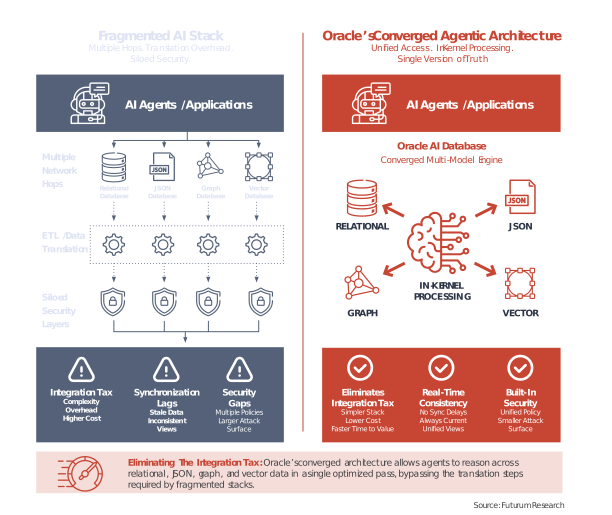
This comprehensive approach neutralizes the integration tax. Bridging analytics and operational workflows carries an immense impact. AI insights combining real-time transactional data with warehoused historical trends plug directly and effortlessly into the core business applications running the enterprise. The system maintains high performance during these complex federated tasks by intelligently caching frequently accessed Iceberg tables and by leveraging advanced optimizer logic to push query filters down to the source systems whenever possible. Processing complex workloads through this unified layer enables Oracle to completely bypass the fragile extraction, translation, and loading steps required by fragmented technology stacks (see Figure 4).
Source: Futurum Group
Scaling agentic AI globally forces enterprises to confront intense physical realities: regulatory compliance, the sheer physicsv of scale, and unyielding mission-critical reliability requirements (see Figure 5). Oracle AI Database 26ai establishes a stringent baseline for continuous availability and granular access control, ensuring the infrastructure can readily sustain the unpredictable concurrency demands of autonomous agents.
Less Focus on General AI Experimentation
Greater Focus on Outcomes and Reliability
"Building AI capabilities"
as an objective
Objectives tied to "measurable
outcomes and SLA attainment"
The Execution Era has arrived. Corporate mandates are shifting away from general AI experimentation toward the hard realities of uptime and reliability, perfectly aligning with Oracle's move toward Maximum Availability Architecture (MAA) Platinum and Diamond-tier mission-critical infrastructure.
n = 818 Enterprise IT Decision Makers
Oracle has formalized its highest availability architecture into two distinct mission-critical tiers, acknowledging that standard high availability on its own simply cannot handle modern loads, with an updated Platinum-tier and adding a new Diamond- tier for ultra-critical applications. This updated program targets high-throughput, multi-node clusters deployed on Oracle Exadata infrastructure. It utilizes Oracle Active Data Guard and Real Application Clusters (RAC) Fast Restart Recovery to deliver disaster failover times typically under 30 seconds, accelerating OLTP recovery by an order of magnitude. Crucially, this tier includes Oracle True Cache, which offloads read-heavy operations to consistent, in-memory caches. These diskless cache nodes automatically synchronize with the primary database, guaranteeing high performance while sparing developers from writing convoluted application-level caching logic.
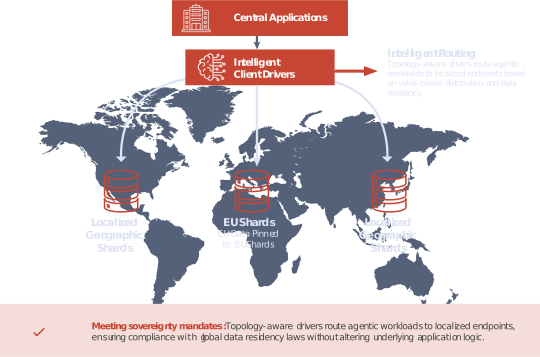
For workloads where even a few seconds of downtime trigger catastrophic business failure, Oracle offers the Diamond- tier. This architecture leverages synchronous replication with Oracle GoldenGate 26ai or Raft-based consensus protocols in Oracle Globally Distributed AI Database to achieve active-active distributed clustering. This configuration boasts zero data loss recovery point objectives (RPOs) and failover times typically under three seconds. With Globally Distributed AI Database, managing consensus at the global architectural level, rather than praying the application tier correctly handles retry logic, provides structural integrity during complex failures. Furthermore, this globally distributed model hands architects granular control over data sovereignty, enabling localized workload routing aligned with regulatory requirements (see Figure 6). Teams can use value-based distribution to pin specific regional assets to localized shards, satisfying strict regulations such
as GDPR or HIPAA without touching a single line of application code.
Scale without profound security operates as an enormous liability. As autonomous agents independently query massive, enterprise-wide datasets, traditional application-level security proxies prove dangerously inadequate. Compromise the application tier, and the agent suddenly wields unrestricted access to the underlying data store. Oracle counters this vulnerability with Deep Data Security, ripping fine-grained authorization out of the application and housing it directly in the database kernel. Administrators define declarative row-, column, and cell-level access controls that are tightly tied to end- user identity and organizational context. If a user lacks clearance for specific financial records, an AI agent acting on their behalf cannot retrieve that data, no matter how cleverly the user engineers a prompt injection attack. The database simply returns null values for restricted rows, preventing data leakage at the source and enabling compliance with stringent privacy
mandates.
Oracle also proactively targets the looming cryptographic threat of “harvest now, decrypt later” quantum attacks through comprehensive Post-Quantum Cryptography readiness. The platform integrates NIST-approved quantum-resistant hybrid key exchange (ML-KEM), deploying TLS 1.3 alongside AES-256 encryption. Baking quantum-safe public-key algorithms for authentication into the foundation today shields encrypted data at rest and in transit from tomorrow’s decryption capabilities.
Finally, Oracle conquers the raw physics of scale using Exadata Smart Scan technology. Traditional shared-nothing architectures choke at petabyte scale because they must drag massive datasets across the network to the compute layer for filtering. Smart Scan, however, completely decouples this process, pushing query processing and vector math directly down to Exadata’s intelligent storage layer. The database filters data and runs AI algorithms on it exactly where the data rests, sending only highly refined results back up to the compute tier and preventing network saturation during dense vector searches.
Source: Futurum Group
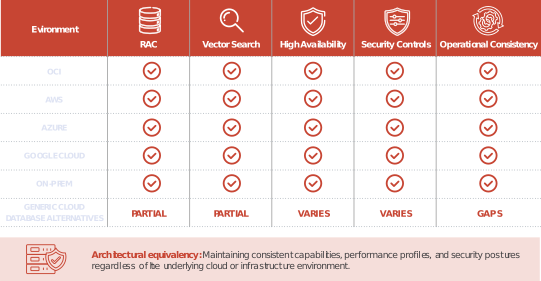
Infrastructure flexibility and the rigorous reduction of operational overhead define the long-term viability of Day-2 operations. Oracle delivers architectural equivalency across its diverse deployment models. The hardware and software profile of the Oracle AI Database 26ai remains identical whether deployed on-premises, utilized via Exadata Cloud@ Customer, or fully managed natively in Oracle Cloud Infrastructure (OCI).
Most dramatically, through aggressive multicloud partnerships, this identical Exadata-backed architecture runs physically on OCI inside AWS, Microsoft Azure, and Google Cloud data centers. Organizations maintain consistent capabilities, performance profiles, and security postures without bowing to the varying resource constraints of different hyperscalers (see Figure 7). An agentic application deployed in AWS accesses Oracle Database services running on Exadata hardware within the exact same physical AWS availability zone, enabling sub-millisecond latency.
The deliberate decoupling of resources inside Oracle Exadata fundamentally powers this equivalency. Cleanly separating the storage pool from the compute processing layer allows enterprises to dynamically scale compute nodes to absorb sudden spikes in AI agent activity. Unlike generic shared-nothing architectures that tightly bind storage and compute, Oracle executes dynamic scaling without triggering disruptive cluster-wide rebalancing storms or requiring physical data block migrations across the network. Computing power expands elastically while the storage tier remains perfectly stable, guaranteeing zero downtime and zero performance degradation during growth.
To tame this complex global footprint, Oracle leverages Autonomous Lifecycle Management. Instead of treating autonomy as marketing fluff, Oracle embeds programmatic automation deep within the system to actively eradicate human error. The platform uses advanced auto-indexing to dynamically create, test, and drop indexes invisibly in the background based on continuous, real-time workload analysis. Paired with auto-tuning and zero-downtime patching, the database effectively self-heals and self-optimizes. Automating these tedious processes liberates data architects and database administrators from menial bit-shoveling, clearing their schedules to focus entirely on strategic data governance and agentic workflow design.
Source: Futurum Group
The future of enterprise IT demands profound structural integrity at the data foundation, far outweighing the sheer novelty of any specific algorithm or large language model. Organizations cannot afford to maintain a brittle, fragmented environment where agentic workloads constantly traverse operational silos just to cobble together basic context. Strangle autonomous systems with high latency, rampant data duplication, and decoupled security postures, and they will absolutely fail to deliver the ROI required by modern business operations.
Operationalizing autonomous AI demands systems capable of executing highly complex logic with absolute safety, massive physical scale, and seamless cross-platform interoperability. By converging disjointed core capabilities – relational rigor, document flexibility, graph processing, and deeply embedded in-kernel vector intelligence – into a single, high-performance and secure engine, Oracle engineers a definitive structural remedy to integration complexity. Extending this strict enterprise rigor directly to open standards, multi-cloud environments, and localized deployments ensures that advanced AI initiatives never hit a bottleneck created by basic data logistics.
In today’s rapidly expanding market for agentic outcomes, selecting a sound data foundation is the primary differentiator separating true leaders from organizations paralyzed by technical debt. For enterprises scaling mission-critical, autonomous applications globally, Oracle’s architecture prioritizing deployment consistency, operational colocation, and unified governance offers the most pragmatic, low-risk path forward.
Data Intelligence, Analytics, & Infrastructure Practice Area, Led by Brad Shimmin
Futurum Research
Contact us if you would like to discuss this report and The Futurum Group will respond promptly.
This paper can be cited by accredited press and analysts, but must be cited in context, displaying author’s name, author’s title, and “The Futurum Group.” Non-press and non-analysts must receive prior written permission by The Futurum Group for any citations.
This document, including any supporting materials, is owned by The Futurum Group. This publication may not be reproduced, distributed, or shared in any form without the prior written permission of The Futurum Group
The Futurum Group provides research, analysis, advising, and consulting to many high-tech companies, including those mentioned in this paper. No employees at the firm hold any equity positions with any companies cited in this document. This Competitive Assessment report was commissioned by Oracle.
The Futurum Group is an independent research, analysis, and advisory firm, focused on digital innovation and market-disrupting technologies and trends. Every day, our analysts, researchers, and advisors help business leaders from around the world anticipate tectonic shifts in their industries and leverage disruptive innovation to either gain or maintain a competitive advantage in their markets.
The Futurum Group LLC
futurumgroup.com
(833) 722-5337
The vision behind everything in Futurum’s Custom Research practice is this: research should show you what is happening, what comes next, and what to do about it. It should be personal to each audience, easy for people to grasp, and structured so LLMs can reason over it accurately. And it should be fast and turnkey; you want answers now, not another project to carry for quarters.
Whether you are defining business, channel, or go-to-market strategy; evaluating vendors or justifying ROI; or commissioning research to fill an emerging market need, we have your back, with a program that answers your questions with the objectivity and credibility to drive real decisions.
To do it, we bring unmatched data to bear: Futurum research, surveys, and market projections; validated market feeds; ETR’s 15 years of insight from 10,000 technology decision-makers; G2’s buyer and user data; and what our analysts hear every day. Add leading primary collection, from AI-moderated voice interviews to surveys and analyst-led interviews, all turnkey, and every project comes out credible, nuanced, and actionable.
And we don’t just drop the results in your lap. For internal work, we provide analyst-led sessions, interactive dashboards, and a range of formats. For market-facing work, Futurum delivers turnkey activation and amplification that actually gets seen, by people and by LLMs, through our media and share of voice. This is research that moves decisions and markets.
We will meet you wherever you are, from a fast-turn brief to a multi-year program, and shape the work to your goals, timeline, and budget. The right program for your moment.
If any of this is useful, I would love to talk.

VP, Custom Research · The Futurum Group
Get important insights straight to your inbox, receive first looks at eBooks, exclusive event invitations, custom content, and more. We promise not to spam you or sell your name to anyone. You can always unsubscribe at any time.