
Austin, Texas, USA, March 23, 2026
With AI-infused change on the horizon, SOC teams navigate challenges in integration, staffing, and risk management.
New research from Futurum Intelligence reveals that security operations centers (SOCs) are facing mounting pressure from an evolving threat landscape, exacerbated by internal challenges related to staffing and operational integration. The findings indicate that while integrating risk metrics remains a structural priority, keeping pace with advanced attacks and managing analyst burnout are the foremost concerns for security leaders.
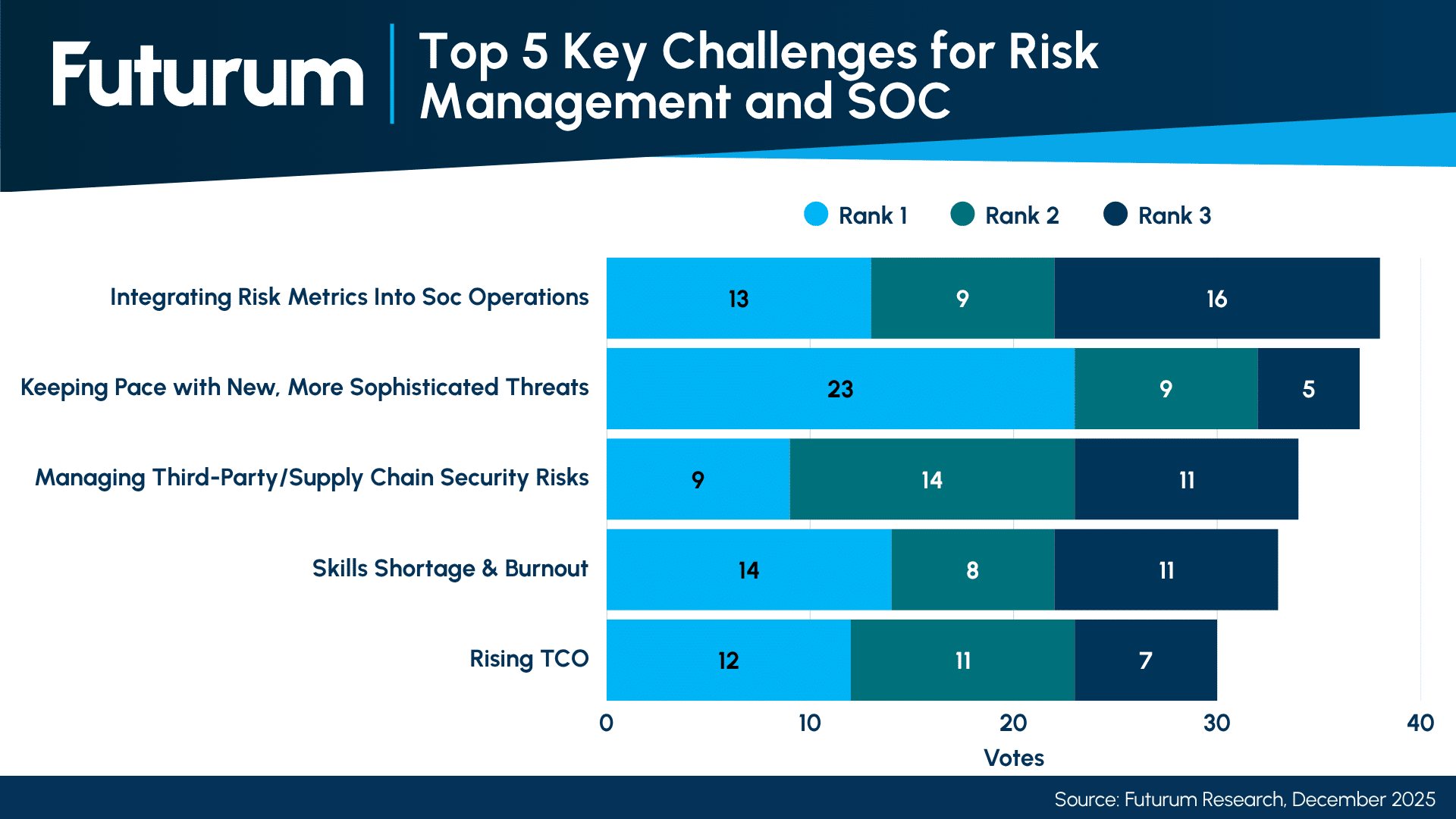
When asked to rank their organization’s key challenges with respect to risk management and the SOC, respondents provided the following prioritization:
Figure 1: Top 5 Key Challenges for Risk Management and SOC
The Complexity of Threat Evolution
The data highlights that addressing new, more sophisticated threats is the most pressing issue, capturing the highest number of primary selections. This underscores the reality that adversaries are innovating rapidly, particularly with the increasing use of AI, forcing organizations into a reactive posture and making it difficult to maintain a stable defense.
“The data clearly illustrates a compounding problem within the modern SOC,” states Fernando Montenegro, Vice President and Practice Lead at Futurum. “Security teams are locked in an arms race with sophisticated actors, and the friction between maintaining robust protection and achieving operational efficiency has never been higher. When the primary challenge is simply keeping pace, it leaves little room for strategic advancement. Unfortunately, adversaries are likely to make this worse as they quickly adopt AI capabilities to launch attack campaigns with more velocity and sophistication.”
The Human Element and Operational Friction
Beyond external threats, internal operational topics heavily impact SOC effectiveness. The skills shortage and resulting burnout were identified as the second-highest primary challenge. Still, the integration of risk metrics into SOC operations was the greatest overall concern. Budgetary and external network concerns also persist, with rising total cost of ownership (TCO) and the management of third-party risks presenting significant hurdles.
“We cannot look at threat sophistication in a vacuum; it is directly tied to the human element,” Montenegro adds. “When teams are understaffed and burning out, their ability to contextualize and integrate more sophisticated insights drops significantly. Solving this requires more than just budget; it demands intelligent automation that reduces cognitive load and allows analysts to focus on true risk mitigation rather than constant alert triage.”
About Futurum Intelligence for Market Leaders
Futurum Intelligence’s Cybersecurity and Resilience IQ service provides actionable insight from analysts, reports, and interactive visualization datasets, helping leaders drive their organizations through transformation and business growth. Subscribers can log into the platform at https://app.futurumgroup.com/, and non-subscribers can find additional information at Futurum Intelligence.
Follow news and updates from Futurum on X and LinkedIn using #Futurum. Visit the Futurum Newsroom for more information and insights.
Declaration of generative AI and AI-assisted technologies in the writing process: This content has been generated with the support of artificial intelligence technologies. Due to the fast pace of content creation and the continuous evolution of data and information, The Futurum Group and its analysts strive to ensure the accuracy and factual integrity of the information presented. However, the opinions and interpretations expressed in this content reflect those of the individual author/analyst. The Futurum Group makes no guarantees regarding the completeness, accuracy, or reliability of any information contained herein. Readers are encouraged to verify facts independently and consult relevant sources for further clarification.
Disclosure: Futurum is a research and advisory firm that engages or has engaged in research, analysis, and advisory services with many technology companies, including those mentioned in this article. The author does not hold any equity positions with any company mentioned in this article.
Analysis and opinions expressed herein are specific to the analyst individually and data and other information that might have been provided for validation, not those of Futurum as a whole.
Read the full Futurum Group Disclosure.
Other Insights From Futurum:
Futurum Research: Cybersecurity Buyers Prioritize Integration Over Cost Savings
Futurum Research: AI Workloads and Hybrid Work Redefine Network Architecture
Futurum Research: Cybersecurity Sentiment Points to Resilience and Growth
Sovereign AI: What Nations Want (And What They’ll Actually Get) – Report Summary
Author Information

Fernando Montenegro serves as the Vice President & Practice Lead for Cybersecurity & Resilience at The Futurum Group. In this role, he leads the development and execution of the Cybersecurity research agenda, working closely with the team to drive the practice's growth. His research focuses on addressing critical topics in modern cybersecurity. These include the multifaceted role of AI in cybersecurity, strategies for managing an ever-expanding attack surface, and the evolution of cybersecurity architectures toward more platform-oriented solutions.
Before joining The Futurum Group, Fernando held senior industry analyst roles at Omdia, S&P Global, and 451 Research. His career also includes diverse roles in customer support, security, IT operations, professional services, and sales engineering. He has worked with pioneering Internet Service Providers, established security vendors, and startups across North and South America.
Fernando holds a Bachelor’s degree in Computer Science from Universidade Federal do Rio Grande do Sul in Brazil and various industry certifications. Although he is originally from Brazil, he has been based in Toronto, Canada, for many years.

