Analyst(s): Keith Kirkpatrick
Publication Date: March 13, 2026
The Enterprise Connect 2026 event highlighted a major shift in enterprise communications towards AI-driven engagement platforms, with artificial intelligence becoming the core architectural layer for modern communications. Key themes included the emergence of Agentic AI, a focus on outcome-based customer experience metrics, and the ongoing convergence of UCaaS, CCaaS, and collaboration, which is reshaping the competitive landscape, with hyperscalers and data ownership becoming central battlegrounds.
What is Covered in This Article:
- A recap of the major themes and vendor moves from the event.
- An overview of key vendor announcements from the event.
- An analysis of how the vendor announcements and themes may impact end customers seeking CX engagement vendors.
- An assessment of how the major announcements from vendors impact the overall vendor landscape.
The Event — Major Themes & Vendor Moves: Enterprise Connect 2026, held March 10-12 in Las Vegas, brought together enterprise IT leaders and vendors focused on transforming collaboration, contact centers, and unified communications through AI-driven automation and orchestration. The event highlighted the rapid shift toward AI-native enterprise communications platforms, with nearly every keynote, product announcement, and panel discussion framing artificial intelligence as the core architectural layer for modern communications rather than an add-on feature.
Some of the notable announcements and strategies emphasized at the event included:
Amazon Web Services/Amazon Connect: AI agents will increasingly handle customer interactions directly rather than simply assisting human agents, with updates to Amazon Connect highlighting generative AI capabilities such as email summarization, improved predictive personalization/AI-assisted management, and expanded workflow automation. Strategically, the company is positioning Amazon Connect as an AI-native CX platform tightly integrated with its broader AI ecosystem, including Amazon Bedrock, AWS Lambda, and its Nova models, reframing customer experience not as a telephony-centric contact center but as another AI workload running on cloud infrastructure. AWS leadership also suggested that traditional contact center KPIs, such as call deflection, may be fundamentally misaligned with an AI-driven service model, where the goal shifts from minimizing interactions to resolving customer needs more effectively through automated intelligence.
Avaya: Avaya highlighted the continued development of its Avaya Infinity platform, which unifies contact center, digital channels, workforce engagement, and analytics into a single architecture. Avaya’s era positioning is about hybrid, governed AI orchestration across on-prem, private-cloud, and cloud environments.
Cisco / Webex: Cisco highlighted its AI capabilities across Webex, including real-time meeting intelligence, automation, and enhanced contact center capabilities. Cisco’s strategy is to embed AI across collaboration, communications, and customer engagement rather than position CCaaS as a standalone category, particularly for large enterprises that have already invested in their infrastructure.
Five9: Five9 highlighted the evolution of its Five9 Fusion into a broader partner and orchestration framework connecting AI agents, data, and business systems. The company continues to position itself as a pure-play CCaaS provider focused on AI-driven service operations, emphasizing operational efficiency and improved customer outcomes.
Genesys: Genesys used Enterprise Connect to emphasize the evolution of its platform toward journey orchestration and predictive customer engagement, incorporating analytics, AI copilots for agents and supervisors, experience orchestration, agentic AI, A2A orchestration, and deeper automation across the customer lifecycle. Genesys’ differentiation narrative centers on experience orchestration and domain expertise in customer engagement workflows, which enables the company to position itself as the specialist CX platform that understands customer journeys better than general cloud providers.
Mitel: Focused on hybrid deployment models and AI capabilities for organizations transitioning from legacy telephony systems. The strategy targets enterprises that cannot fully move to cloud-native communications platforms, offering a gradual path to AI-enabled CX.
RingCentral: RingCentral launched AIR Pro, a voice-first AI agent platform for automating customer interactions across voice and digital channels, and showcased agentic voice AI, RingCX, AIR Pro, and conversation intelligence as part of a broader agentic AI portfolio. The strategy reinforces
RingCentral’s push to strengthen its enterprise collaboration platform with AI-powered capabilities.
Salesforce: Salesforce has unveiled its Agentic Contact Center that embeds AI, omnichannel engagement, and CRM into a unified platform. This new product launch has the potential to upend traditional enterprise contact center sourcing, challenging the assumptions behind multi-vendor stacks and BPO outsourcing. Competitors who previously partnered with Salesforce may now find themselves competing with the platform giant.
Zoom Communications: Zoom expanded its AI Companion and agentic capabilities to automate workflows across meetings, chat, phone, and customer interactions. Rather than positioning itself purely as a UCaaS vendor, Zoom framed its platform as an orchestration layer for human and AI work. The idea is that communications events (meetings, calls, chats) become triggers for AI-driven business processes.
Enterprise Connect 2026 — How Will AI’s Emergence Impact CCaaS Vendors?
Analyst Take: Enterprise Connect 2026 underscored a major transition underway in enterprise communications: the shift from standalone communications tools to AI-driven engagement platforms. Across the conference, unified communications, collaboration, and contact center technologies were increasingly positioned as intelligent enterprise platforms that combine AI, workflow orchestration, and enterprise data. Rather than operating as separate systems, these platforms are evolving to enable seamless interaction between AI agents, human employees, and enterprise applications, blurring traditional boundaries between UCaaS, CCaaS, and broader enterprise software ecosystems.
Agentic AI as a Dominant Theme
Agentic AI emerged as the dominant technology theme at the event. Vendors described a future in which autonomous or semi-autonomous AI agents interpret user intent, retrieve contextual data, and trigger actions across enterprise systems to complete business tasks. This represents a shift beyond conversational AI that simply generates responses toward systems capable of executing business processes and driving measurable operational outcomes.
Customer Experience Innovation Comes into Focus
Customer experience innovation remained a central focus of the conference. Vendors such as Amazon and Zoom introduced capabilities aimed at making CX operations more predictive and automated, including predictive personalization, automated testing of customer journeys, advanced analytics, and AI-assisted management tools. At the same time, industry conversations increasingly questioned traditional contact center metrics, such as call deflection and average handle time, and emphasized outcome-based measures, including resolution quality, customer satisfaction, and long-term relationship value.
Continuing Convergence Across UCaaS, CCaaS, and Collaboration Environments
Another prominent theme was platform convergence across UCaaS, CCaaS, and collaboration environments. Vendors are increasingly positioning their offerings as unified engagement platforms capable of orchestrating communications, workflows, and customer interactions across the enterprise. Collaboration platforms in particular are being reframed as workflow orchestration environments that coordinate business processes, communications events, and CX operations. As enterprises move from experimentation to operational AI deployment, discussions also increasingly emphasize governance, security, and trust.
One of the most significant implications of these developments is that the traditional CCaaS category may gradually dissolve into broader AI engagement platforms. Instead of deploying standalone contact center systems, enterprises increasingly seek platforms that combine communications, workflow automation, AI agents, and deep integration with enterprise data. Over the next five to seven years, the contact center is likely to become just one component within a broader engagement architecture that orchestrates interactions across customers, employees, and automated systems.
At the same time, hyperscalers are emerging as major CX platform providers, reshaping the competitive landscape. Companies such as Amazon Web Services and Microsoft are embedding contact center and customer engagement capabilities directly into their broader cloud and AI platforms. This dynamic forces traditional CX vendors to compete not only with other CCaaS providers but also with infrastructure platforms, AI model providers, and large enterprise software vendors, such as Salesforce, which also announced its foray into the contact center world.
AI Agents to Handle More Customer Interactions
Historically, contact center platforms were built around a world where human agents handled nearly every interaction. Traditional CCaaS systems from vendors such as Genesys, Five9, and Talkdesk focused primarily on capabilities like call routing, queue management, workforce optimization, and telephony infrastructure, with AI largely limited to agent assistance or basic call deflection. As AI agents begin resolving a larger share of interactions, however, the contact center is evolving from a system that routes calls to people into a decision engine that orchestrates automated workflows.
Emerging architectures will emphasize AI models, customer data platforms, and workflow orchestration layers, with voice and messaging acting primarily as interface channels. In this environment, hyperscalers such as Amazon Web Services and Microsoft are gaining influence because they control the underlying cloud infrastructure and AI services that power these systems.
Vendors describe a model in which autonomous systems handle routine inquiries while human agents focus on complex issues, exception handling, and oversight of AI-driven workflows. In this environment, communications platforms are evolving from tools that facilitate conversations into event-driven workflow engines, where calls, meetings, and messages automatically trigger actions such as CRM updates, task creation, or automated follow-up processes.
The New Battlegrounds: Data and Pricing Models
Data and economic models are also emerging as the next battleground for competition. Customer data is becoming one of the most valuable strategic assets in the future CX landscape. For AI agents to autonomously resolve issues, they must access rich contextual data, including purchase history, prior support interactions, product usage information, billing data, and broader account context. Much of this information resides in CRM platforms such as Salesforce or in enterprise ecosystems such as Microsoft Dynamics 365, giving vendors that control the customer data model significant strategic leverage.
As AI capabilities become more widely available, differentiation will increasingly depend on access to rich customer data and contextual insight—favoring vendors that control customer data platforms or CRM systems such as Salesforce and Microsoft.
At the same time, vendors are exploring new pricing structures that move beyond seat-based subscriptions toward consumption-based or outcome-based models, including usage-based AI pricing and per-resolution service models.
What to Watch:
- Watch to see how vendors and customers use next-generation AI agents to increasingly process refunds, update orders, modify subscriptions, schedule service visits, or trigger logistics workflows.
- As voice, messaging, and chat capabilities become commoditized through APIs and cloud communications services, pay attention to how vendors differentiate by highlighting how their platforms orchestrate AI agents, enterprise workflows, customer data, and human supervision into a unified system for resolving customer problems.
- Observe how traditional CCaaS vendors evolve to enable actions to be executed across enterprise systems rather than simply facilitating conversations.
- As CX and contact centers become increasingly embedded with AI, watch how pricing models evolve from seat licenses to other models.
You can read more about Enterprise Connect at the event website.
Disclosure: Futurum is a research and advisory firm that engages or has engaged in research, analysis, and advisory services with many technology companies, including those mentioned in this article. The author does not hold any equity positions with any company mentioned in this article.
Analysis and opinions expressed herein are specific to the analyst individually and data and other information that might have been provided for validation, not those of Futurum as a whole.
Other Insights from Futurum:
Contact Center as a Service (CCaaS) Platforms – Futurum Signal
Will Salesforce’s Agentic Contact Center Force a Rethink of CCaaS Sourcing?
CCaaS Software Market Dominated by Genesys, Cisco, Five9, and RingCentral
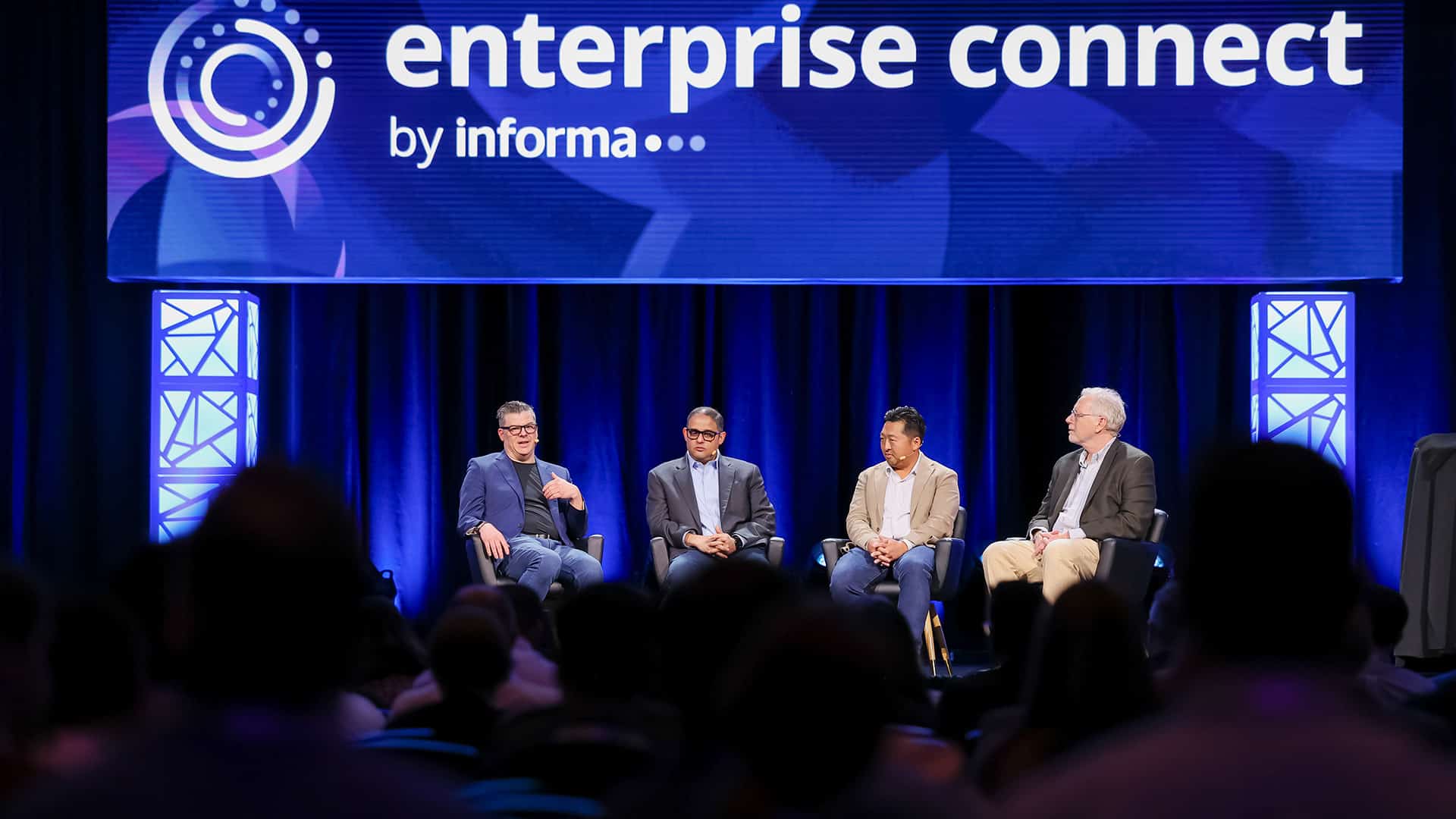
Image Credit: Informa
Author Information

Keith Kirkpatrick is VP & Research Director, Enterprise Software & Digital Workflows for The Futurum Group. Keith has over 25 years of experience in research, marketing, and consulting-based fields.
He has authored in-depth reports and market forecast studies covering artificial intelligence, biometrics, data analytics, robotics, high performance computing, and quantum computing, with a specific focus on the use of these technologies within large enterprise organizations and SMBs. He has also established strong working relationships with the international technology vendor community and is a frequent speaker at industry conferences and events.
In his career as a financial and technology journalist he has written for national and trade publications, including BusinessWeek, CNBC.com, Investment Dealers’ Digest, The Red Herring, The Communications of the ACM, and Mobile Computing & Communications, among others.
He is a member of the Association of Independent Information Professionals (AIIP).
Keith holds dual Bachelor of Arts degrees in Magazine Journalism and Sociology from Syracuse University.