
Analyst(s): Olivier Blanchard
Publication Date: March 3, 2026
POCO is set to launch its X8 Pro and X8 Pro Max in India, aiming to redefine mid-range expectations with flagship-killer specifications, including 1.5K OLED displays and disruptive battery capacities up to 9,000 mAh. This strategic move, powered by MediaTek’s latest Dimensity 8500 and 9500s silicon, solidifies MediaTek’s position in the performance-heavy Indian market and challenges competitors’ standards for battery and durability.
What is Covered in This Article:
- POCO X8 Pro/Max launch
- New MediaTek Dimensity silicon
- High-capacity 9,000mAh batteries
- Premium durability and display specs
The News: Reports indicate that POCO, the Xiaomi subsidiary, is preparing to launch the POCO X8 Pro and potentially a POCO X8 Pro Max in the Indian market as early as March 2026. The upcoming devices are expected to be rebranded versions of the Redmi Turbo 5 series recently launched in China. Key leaked specifications suggest a focus on high-capacity batteries, 1.5K OLED displays, and new MediaTek Dimensity silicon.
POCO and MediaTek Aim to Redefine Mid-Tier Performance Expectations in the Mobile Segment
Analyst Take: The launch of the X8 Pro series signals POCO’s continued strategy of bringing high-performance “flagship killer” specifications to the mid-range segment through Xiaomi’s ecosystem rebranding.
The timing of the March launch is critical as it follows the initial Q1 flagship cycles from premium competitors. And by offering a 1.5K OLED display and top-tier IP ratings in a Pro-tier device, POCO is effectively raising the floor for what consumers expect in the mid- to high-end price bracket. The shift to MediaTek’s latest 8000 and 9000-series chips further validates MediaTek’s growing dominance in the high-performance value segment, challenging the traditional silicon hierarchy in the region.
Product Specifications & Features
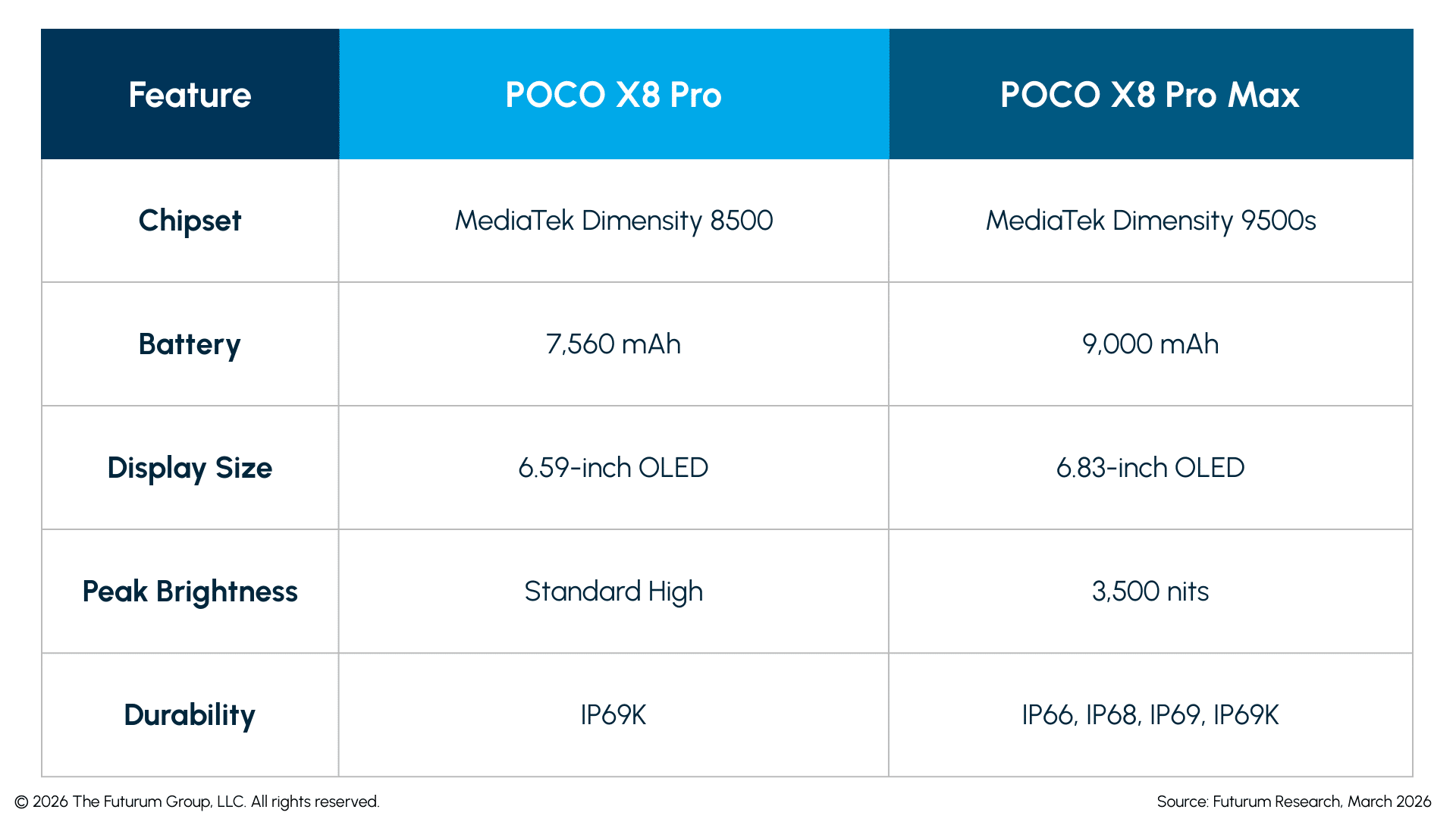
Based on recent Geekbench listings and regional rebranding patterns, the anticipated specifications for the new series include:
- POCO X8 Pro:
- Processor: MediaTek Dimensity 8500.
- Display: 6.59-inch 1.5K OLED with a 120Hz refresh rate.
- Battery: 7,560mAh with 100W fast charging.
- Camera: 50MP main sensor, 8MP ultra-wide, and 20MP selfie camera.
- Durability: IP69K rating for dust- and water-resistance.
- POCO X8 Pro Max:
- Processor: MediaTek Dimensity 9500s.
- Display: 6.83-inch 1.5K OLED, 3,500 nits peak brightness, and Dolby Vision support.
- Battery: Massive 9,000mAh capacity with 100W charging.
- Durability: Multiple ratings, including IP66, IP68, and IP69K.
Disruptive Power Management & Battery Tech
One of the most striking features is the jump to 7,560 mAh and 9,000 mAh batteries. By nearly doubling the industry standard of 5,000mAh, POCO is effectively bulldozing over battery anxiety at this price point.
Additionally, maintaining a “Pro” aesthetic while housing a 9,000 mAh cell suggests significant advancements in silicon-carbon battery density, enabling larger capacities without a massive increase in device thickness. If this strategy is successful, it could 1) help blur the lines between phones in this price tier and those above it, and 2) provide MediaTek with yet another market differentiator/advantage.
The transition to the Dimensity 8500 and 9500s also represents a critical win for MediaTek in the performance-heavy Indian market. On the one hand, this move suggests that MediaTek’s high-end chips are increasingly viewed as equivalent to their Snapdragon counterparts, particularly for gaming-centric devices.
Note that the use of the “s” variant in the Pro Max model likely indicates a custom-tuned or high-efficiency version of the flagship 9000-series, designed to maximize the longevity of the 9,000mAh battery.
The “Premiumization” of the Mid-Range
POCO is no longer just competing on price; they are also competing on durability and display quality:
- IP69K Rating: Usually reserved for specialized rugged phones, the inclusion of IP69K (high-pressure steam jet resistance) in a mainstream consumer device sets a new durability benchmark for the sub-₹40,000 segment.
- Visual Fidelity: The standard 1.5K OLED with 3,500 nits brightness ensures that the “viewing experience” matches the internal processing power, making these devices viable alternatives to flagships costing twice as much.
Table 1: Competitive Comparison: X8 Pro vs. X8 Pro Max
Strategy & Market Impact
The launch of the POCO X8 Pro and POCO X8 Pro Max highlights a strategic shift in the mid-premium smartphone segment. By leveraging ultra-high-capacity batteries and the latest MediaTek silicon, POCO is moving beyond simple “value” to “spec-dominance” in the Indian market. The POCO X8 Pro series is designed to dominate the “Performance/Endurance” niche. By launching with Android 16-based HyperOS 3, POCO is also ensuring that the hardware is matched by the most current software lifecycle available in early 2026. This launch is likely to force competitors like Samsung and OnePlus to reconsider their battery and durability standards in their respective “A” and “Nord” series.
By integrating MediaTek’s Dimensity 8500 and 9500, POCO is positioning itself to compete directly with other performance-centric brands in India. The inclusion of exceptionally large batteries (up to 9,000mAh) and the latest Android 16-based HyperOS 3 suggests a pivot toward extreme endurance and long-term software relevance, which are high-priority factors for the Indian consumer base.
Read more about the launch timeline on Gadgets 360.
Declaration of generative AI and AI-assisted technologies in the writing process: This content has been generated with the support of artificial intelligence technologies. Due to the fast pace of content creation and the continuous evolution of data and information, The Futurum Group and its analysts strive to ensure the accuracy and factual integrity of the information presented. However, the opinions and interpretations expressed in this content reflect those of the individual author/analyst. The Futurum Group makes no guarantees regarding the completeness, accuracy, or reliability of any information contained herein. Readers are encouraged to verify facts independently and consult relevant sources for further clarification.
Disclosure: Futurum is a research and advisory firm that engages or has engaged in research, analysis, and advisory services with many technology companies, including those mentioned in this article. The author does not hold any equity positions with any company mentioned in this article.
Analysis and opinions expressed herein are specific to the analyst individually and data and other information that might have been provided for validation, not those of Futurum as a whole.
Other Insights from Futurum:
Google Debuts Pixel 10A Amidst Minimal Hardware Evolution
Voice-First AI Interfaces Are Quickly Expanding Beyond The Smart Speaker Segment
Panther Lake – The AI PC Processor the Enterprise Has Been Waiting For
Author Information

Olivier Blanchard is Research Director, Intelligent Devices. He covers edge semiconductors and intelligent AI-capable devices for Futurum. In addition to having co-authored several books about digital transformation and AI with Futurum Group CEO Daniel Newman, Blanchard brings considerable experience demystifying new and emerging technologies, advising clients on how best to future-proof their organizations, and helping maximize the positive impacts of technology disruption while mitigating their potentially negative effects. Follow his extended analysis on X and LinkedIn.