Analyst(s): Brendan Burke
Publication Date: February 26, 2026
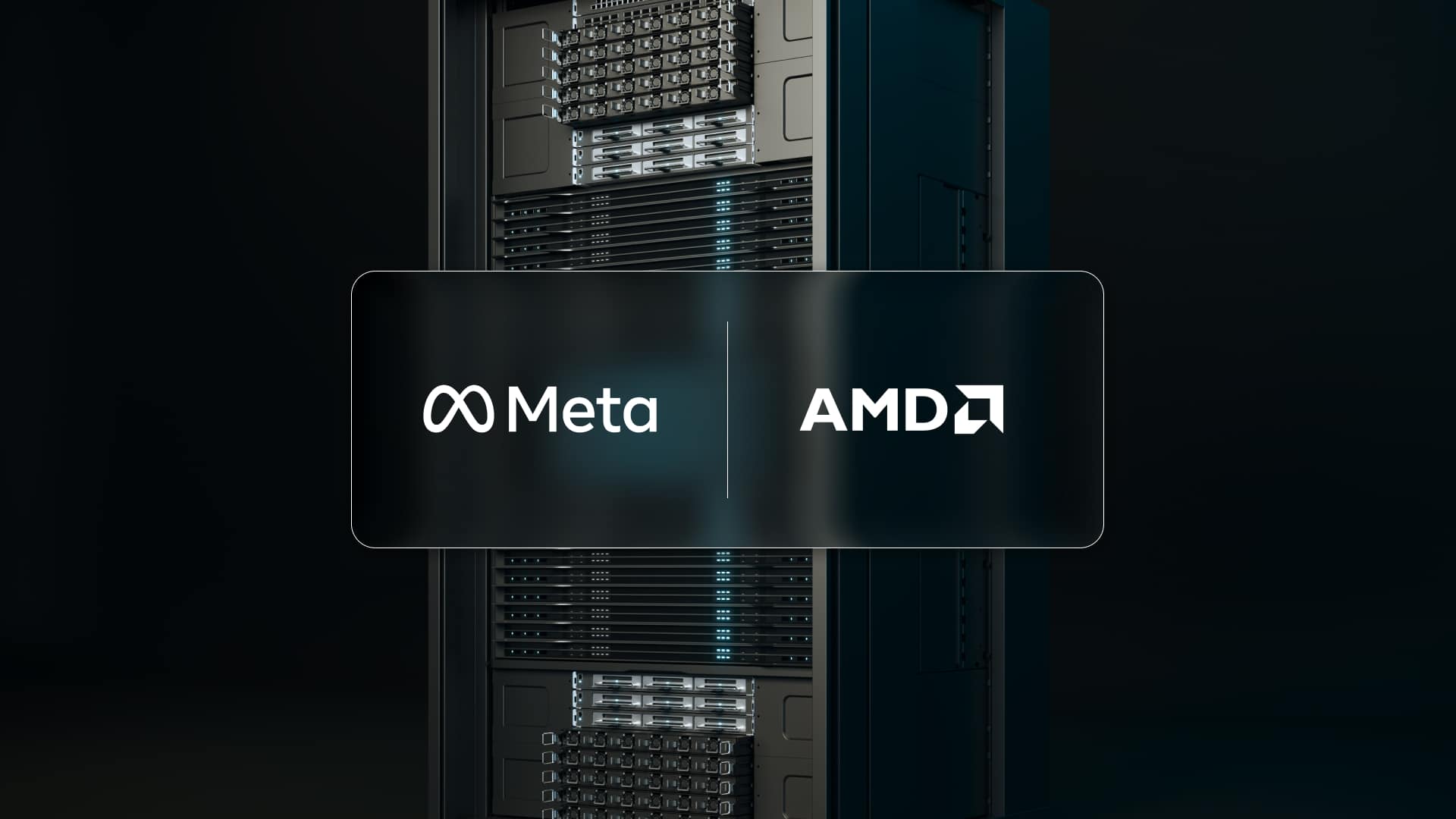
Meta and AMD announced a multi-year agreement to deploy up to 6 gigawatts of AMD Instinct GPUs across Meta’s AI infrastructure, anchored by a custom MI450-based processor and the jointly developed Helios rack-scale architecture. The deal, which includes a performance-based warrant for up to 160 million shares of AMD common stock, establishes a new template for how hyperscalers structure long-term compute partnerships.
What is Covered in This Article:
- Meta’s 6-gigawatt AMD Instinct GPU infrastructure agreement
- Inference-first workload positioning and Meta’s custom GPU rationale
- The performance-based equity warrant as a procurement innovation
- AMD’s strategic positioning as the rack-scale alternative
The News: AMD and Meta announced on February 24, 2026, a definitive multi-year, multi-generation agreement to deploy up to 6 gigawatts of AMD Instinct GPUs to power Meta’s next generation of AI infrastructure. The first deployment will use a custom AMD Instinct GPU based on the MI450 architecture, optimized for Meta’s workloads, with shipments supporting the initial 1-gigawatt deployment scheduled to begin in the second half of 2026. The systems will run on 6th Gen AMD EPYC processors, codenamed Venice, using ROCm software and built on the AMD Helios rack-scale architecture that was jointly developed through the Open Compute Project. As part of the agreement, AMD issued Meta a performance-based warrant for up to 160 million shares of AMD common stock, structured to vest as specific milestones associated with Instinct GPU shipments are achieved, with the first tranche vesting at the initial 1-gigawatt deployment and additional tranches scaling to 6 gigawatts. Meta also committed to deploying Venice and Verano, a next-generation EPYC processor designed with workload-specific optimizations.
“We’re excited to form a long-term partnership with AMD to deploy efficient inference compute and deliver personal superintelligence,” said Mark Zuckerberg, founder and CEO of Meta. “This is an important step for Meta as we diversify our compute.”
Will Meta’s Customization of AMD GPUs Empower Personal Agents?
Analyst Take: Meta’s AMD commitment transforms how hyperscalers diversify AI compute vendors and architect inference-optimized compute. The agreement establishes AMD as a credible second pillar in hyperscaler GPU procurement, moving the company from supplementary deployments of MI300 and MI350 series accelerators into a multi-generation, roadmap-aligned partnership that spans silicon, systems, and software.
Mark Zuckerberg’s explicit framing of the deal as an inference compute partnership, rather than a training infrastructure expansion, reveals Meta’s thesis that inference workloads at the scale required for personal superintelligence demand purpose-built economics that a single-vendor GPU strategy cannot deliver. The performance-based warrant structure further signals that both companies view this as a bet on execution rather than a guaranteed volume commitment, tying AMD’s equity upside directly to delivery milestones that Meta must validate through technical and commercial performance.
Inference-First Framing Reveals Where Meta Sees AMD’s Competitive Advantage
Zuckerberg’s deliberate use of the phrase “efficient inference compute” rather than general-purpose AI acceleration signals that Meta views AMD’s value proposition as workload-specific rather than as a direct substitute for NVIDIA across all AI infrastructure requirements. The custom MI450-based GPU optimized for Meta’s workloads suggests AMD is willing to co-design silicon for a single customer’s inference profile, a level of architectural collaboration that NVIDIA’s merchant GPU model does not typically accommodate at the silicon level. Our briefing with management indicates that latency is a primary concern that can be adjusted through instruction set customization and advanced packaging. This capability ties into the workload optimization that CEO Lisa Su has prioritized for AMD’s roadmap. We believe this customer-specific customization is a form of operating leverage that can support.
As Meta Superintelligence Labs progresses towards deploying personal agents across a global consumer base, Meta can distribute inference workloads across AMD GPUs, the internal Meta Training and Inference Accelerator (MTIA) chips, and NVIDIA GPUs based on workload-specific economics rather than defaulting to a single architecture. This portfolio-based approach treats GPU procurement as a multi-vendor optimization problem rather than a platform loyalty decision, fundamentally altering the buyer-seller dynamic that has defined hyperscaler GPU procurement since the emergence of large-scale AI training. The implication is that AMD’s path to sustained hyperscaler revenue runs through inference economics and co-design flexibility rather than through displacing NVIDIA on training benchmarks.
The Equity Warrant Structure Redefines Hyperscaler Procurement Risk-Sharing
AMD’s issuance of a performance-based warrant for up to 160 million shares of common stock introduces a procurement mechanism that has no direct precedent in semiconductor supply agreements of this scale, effectively converting a portion of Meta’s compute expenditure into equity upside contingent on AMD’s execution against delivery and stock price milestones. The structure aligns AMD’s financial incentives with Meta’s deployment timeline by tying warrant vesting to specific gigawatt shipment milestones, beginning with the first gigawatt and scaling through the full 6-gigawatt commitment, while further conditioning exercise on Meta achieving technical and commercial milestones. AMD CFO Jean Hu’s statement that the partnership is expected to be “accretive to our non-GAAP earnings per share” indicates AMD has modeled the dilutive impact of the warrant against the revenue scale of the agreement and concluded that volume economics outweigh per-share dilution at projected shipment levels.
For Meta, the warrant transforms a portion of infrastructure capital expenditure into a financial instrument that appreciates if AMD executes successfully, creating a hedge where Meta benefits economically from the very supplier performance it depends on operationally. This structure may establish a template for future hyperscaler procurement agreements where the buyer’s scale justifies equity-linked pricing mechanisms that traditional volume discount frameworks cannot accommodate. The broader significance is that semiconductor procurement at gigawatt scale is becoming a financial engineering exercise as much as a technology evaluation, with equity structures replacing conventional discount schedules as the primary mechanism for aligning buyer and supplier incentives.
Helios and Open Compute Alignment Position AMD as the Rack-Scale Alternative
The Helios rack-scale architecture, jointly developed by AMD and Meta through the Open Compute Project (OCP), provides AMD with a system-level integration advantage that extends beyond the GPU to impact TCO at data center scale. By co-developing the rack architecture through OCP rather than as a proprietary design, Meta and AMD have created an open reference platform that other hyperscalers and enterprises can adopt, potentially expanding Helios beyond a single-customer deployment into an industry standard for AMD-based AI infrastructure. The Venice and Verano EPYC CPU commitments embedded within the agreement ensure that AMD captures both GPU and CPU revenue per rack, creating a vertically integrated AMD compute stack where Instinct GPUs, EPYC processors, and ROCm software operate as a co-optimized system rather than as discrete components competing on individual specifications.
Meta’s willingness to co-develop rack architecture with AMD through an open standard rather than relying exclusively on NVIDIA’s proprietary system designs reflects a deliberate effort to create competitive alternatives that prevent infrastructure lock-in at the system level. The strategic consequence is that AMD now competes not only on GPU performance but on rack-scale total cost of ownership, a dimension where open architecture co-design with the buyer can offset NVIDIA’s software ecosystem advantages.
What to Watch:
- Success hinges on AMD’s execution in delivering the custom MI450 GPU on time and meeting performance and cost targets, avoiding delays in silicon, HBM, or ROCm software.
- NVIDIA’s response should be monitored for accelerated custom inference offerings, competitive Blackwell/Rubin GPU pricing, or the adoption of equity-linked procurement structures.
- The deal reinforces the CPU supercycle, validating the central role of EPYC CPUs in orchestration and caching for emerging agentic AI workloads.
- Software optimization remains a critical variable, requiring AMD’s ROCm and open-source ecosystem to close the performance gap with NVIDIA on inference-specific workloads.
- Other hyperscalers will evaluate whether the performance-based equity warrant sets a new precedent for vendor-buyer financial alignment in gigawatt-scale procurement negotiations.
Read the full press release on AMD’s Newsroom website.
Disclosure: Futurum is a research and advisory firm that engages or has engaged in research, analysis, and advisory services with many technology companies, including those mentioned in this article. The author does not hold any equity positions with any company mentioned in this article.
Analysis and opinions expressed herein are specific to the analyst individually and data and other information that might have been provided for validation, not those of Futurum as a whole.
Other Insights from Futurum:
Will NVIDIA’s Meta Deal Ignite a CPU Supercycle?
AMD Q4 FY 2025: Record Data Center And Client Momentum
At CES, NVIDIA Rubin and AMD “Helios” Made Memory the Future of AI
Author Information

Brendan is Research Director, Semiconductors, Supply Chain, and Emerging Tech. He advises clients on strategic initiatives and leads the Futurum Semiconductors Practice. He is an experienced tech industry analyst who has guided tech leaders in identifying market opportunities spanning edge processors, generative AI applications, and hyperscale data centers.
Before joining Futurum, Brendan consulted with global AI leaders and served as a Senior Analyst in Emerging Technology Research at PitchBook. At PitchBook, he developed market intelligence tools for AI, highlighted by one of the industry’s most comprehensive AI semiconductor market landscapes encompassing both public and private companies. He has advised Fortune 100 tech giants, growth-stage innovators, global investors, and leading market research firms. Before PitchBook, he led research teams in tech investment banking and market research.
Brendan is based in Seattle, Washington. He has a Bachelor of Arts Degree from Amherst College.