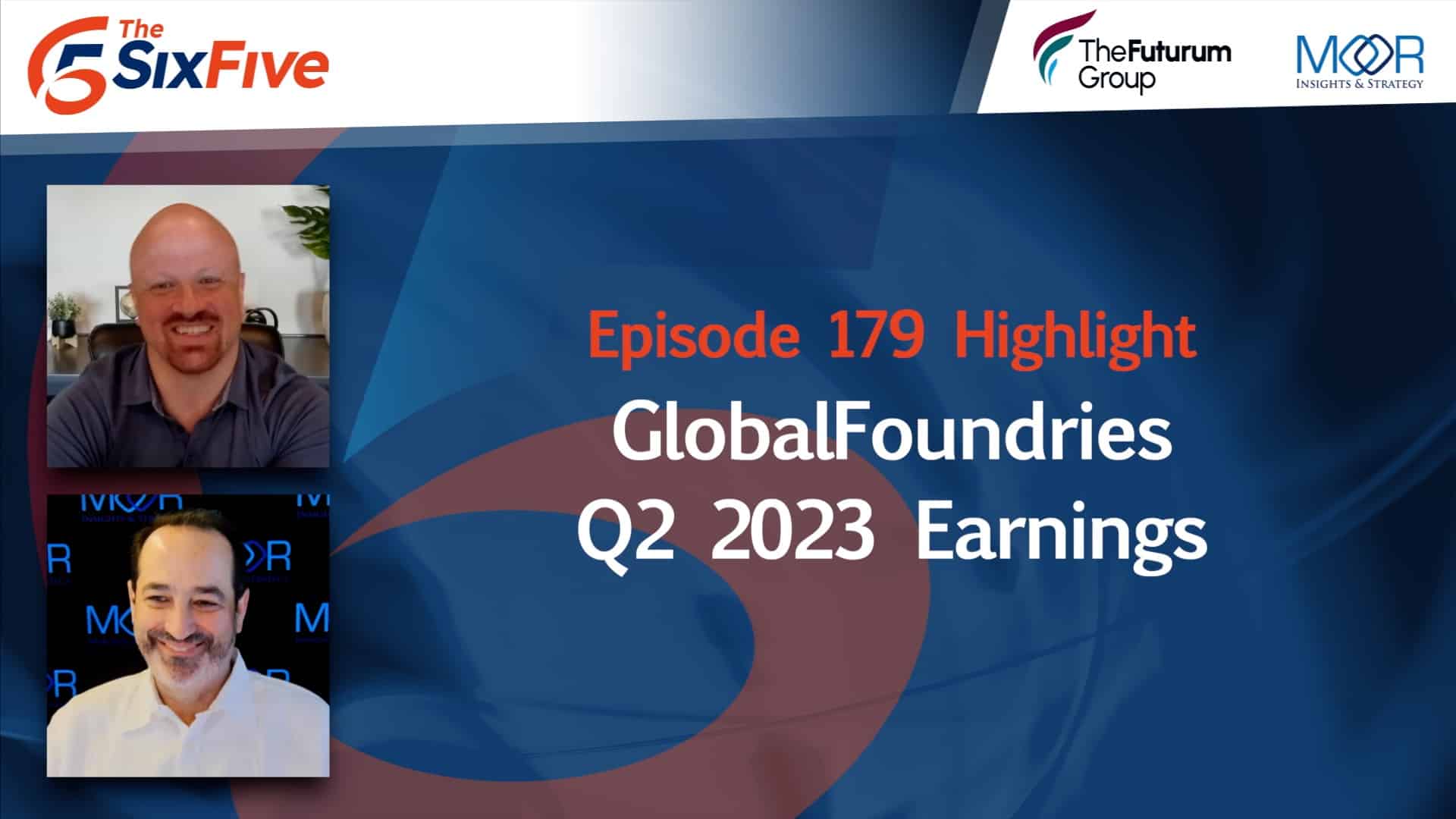
The Six Five team discusses GlobalFoundries Q2 2023 earnings release.
If you are interested in watching the full episode you can check it out here.
Disclaimer: The Six Five Webcast is for information and entertainment purposes only. Over the course of this webcast, we may talk about companies that are publicly traded and we may even reference that fact and their equity share price, but please do not take anything that we say as a recommendation about what you should do with your investment dollars. We are not investment advisors and we ask that you do not treat us as such.
Transcript:
Daniel Newman: The one earnings of the week, and it’s a big one because it does tell a pretty big story about the broader semiconductor market through the lens of the foundry side. So GlobalFoundries, Pat.
Patrick Moorhead: Yeah, so if you’re not familiar with GlobalFoundries, they’re a leading foundry that is global, okay? And they were global before it was cool. Back in 2009, they were a spinoff from AMD and I actually ran corporate marketing when we spun it off and created the corporation with Mubadala who was a huge investor. So boy have they come a long way, right? They’re one of the only foundries with a truly global footprint, but more importantly they do semiconductor foundry work. They’re very focused, right? They’re not a TSMC that is doing everything for everybody. I don’t want to call TSMC the “Walmart,” but they do have this top to bottom. GlobalFoundries is very focused on things like 5G, on power, and on automotive. They do a little bit of compute, a carryover from the AMD days, but not a whole lot.
They’re one of the leaders, if not the leader in silicon photonics. So how do they do? Well, they did pretty well, right? They hit on the higher end of their guide, which I think was really good. Now declines were in areas that quite frankly you would expect, right? What is down in the market? Smartphones. Yeah, smart mobile devices were down 19% year over year. Communications infrastructure, primarily comms infrastructure. 5G is down, data center is okay, but also down. But that was down pretty big. 38%. Personal computing, again, is a knit right now. It’s $52 million on $1.8 billion in revenue a quarter. It was down significantly. But on the bright side, automotive up 200% home and industrial IOT right now, industrial IOT, up home, it down knitted out to be a little bit of a push, but growth, right? About 3%.
So nothing that you wouldn’t expect. There was a lot of talk on the call about these long-term agreements. And when I read through the transcript, my takeaway was, “Hey, we’ve got long-term agreements,” but we’re not trying to make them onerous to the sides and squeeze them to the point where we’re having them. And this is my number– chew into 50% of the wafers that maybe weren’t delivered, right? Or that the customer didn’t need. But the key is that with these long-term agreements, the true view of the market is probably subdued a little bit, right? Because in these LTAs, for a long-term agreement, you have wafer agreements that you have to abide by. But anyways, solid work here. And I’m really interested to see competitively when Tower Semiconductor closes and Intel embraces that and what happens next.
Daniel Newman: Yeah, I think you hit it. This one can get pretty geeky, pretty quick because of the stuff they focus on. There is definitely some great stuff that was talked about that you didn’t necessarily dig into their Lockheed Martin partnership that was announced. They’re doing some interesting stuff on 3D or-
Patrick Moorhead: Hey, man, I had to leave you something, dude.
Daniel Newman: Thank you. Thank you. Thank you. I do appreciate that. But some 3D heterogeneous integrations. Look, Pat, this is probably the most interesting thing just to continue to talk about is we had this great run of tech for the last couple months and it’s sold off pretty hard in the last month. And again, we’re not a stock show, but the market is the market and these companies do very much emotionally react to the market in terms of how they do their business.
And so we had a lot of Q2 is the bottom, Q2 is the bottom. We heard from Pat. Lisa had made similar overtures. Jensen hasn’t had to make any comments like that, but GFS beat GlobalFoundries is beating. We saw Lattice had a good number. Are we out of the woods? Before I just dig, I mean just kind of the question here. How do you feel, are we beating expectations because we put the bar on the ground and now these companies are jumping over it and we set low expectations, these huge cuts in expectations, or have we turned a corner now? And even though some of the macro data is still a little rough, tech’s about to see another explosion.
Patrick Moorhead: Yeah. So I like to separate the market. You have to set memory aside, memory and storage. So memory and SSDs. Just because they’re so off and they’re so crushing. Well, the good news is GlobalFoundries doesn’t do any of that. So then you’re into RF, you’re into different impacts of what hits there. So I think though this shows the diversification of GlobalFoundries and also the impact of these long-term agreements that, by the way, and Tom brought this up on the call, CEO Tom Caulfield. Hey, remember when we couldn’t get chips, we couldn’t get that 1 cent chip to sell that $75,000 car. Heck, there are luxury cars that they couldn’t ship with a radio because they couldn’t get a MOSFET or some analog PMIC out there.
Hey, we’ve got a good question coming in from Jeff Rick. “Hey, one year post chips act impact.” Well, hey Jeff, the money hasn’t been distributed, the awarding hasn’t been done and quite frankly, doing what the government’s done, we’re sitting on our hands right now and companies are waiting to get that money. But some companies didn’t wait. Intel went in and made… Dan, what was it? 200 billion commitment globally, 100 billion commitment just in Columbus, Ohio with or without the CHIPS Act. And what Intel did to defray the risk is they did a couple JVs with some companies to be able to split the financing. So a risk return there. Great question. And we love the questions we get from our awesome audience.
Daniel Newman: We don’t always talk, because if we did, we’d have no time to talk about our topics. But I think since we were asking about the market that was really well-timed. I talked to a few different press outlets about that one year thing. And Pat, I got a slightly different view. Look, the government administration is just terrible at actually executing plans, whether it was Obamacare or the amount of years it took before any of that actually took hold or something as big as the CHIPS act. I think the expectation, at least for the chips part, the science part’s a little bit different because the science part’s a lot more small companies, universities, it’s innovators, it’s VCs, it’s accelerators, but the CHIPS Act is really big mega global companies with huge balance sheets that are going to largely be benefiting from that cash. And so, long and short here is that the science part will be delayed. The CHIPS Act part of it. I just think they know these companies can cover it and they’ll get around to it.
Author Information

Daniel is the CEO of The Futurum Group. Living his life at the intersection of people and technology, Daniel works with the world’s largest technology brands exploring Digital Transformation and how it is influencing the enterprise.
From the leading edge of AI to global technology policy, Daniel makes the connections between business, people and tech that are required for companies to benefit most from their technology investments. Daniel is a top 5 globally ranked industry analyst and his ideas are regularly cited or shared in television appearances by CNBC, Bloomberg, Wall Street Journal and hundreds of other sites around the world.
A 7x Best-Selling Author including his most recent book “Human/Machine.” Daniel is also a Forbes and MarketWatch (Dow Jones) contributor.
An MBA and Former Graduate Adjunct Faculty, Daniel is an Austin Texas transplant after 40 years in Chicago. His speaking takes him around the world each year as he shares his vision of the role technology will play in our future.