Taco Bell announced earlier this month that it opened the first of its “Taco Bell Defy” stores in Brooklyn Park, Minnesota, which incorporates automated and other innovative technologies designed to speed up and improve the customer’s experience. The goal of the concept is to create a two-minutes-or-less drive-through experience, thereby reducing customer frustration and establishing the restaurant as an efficient provider of fast food.
The decrease in the amount of time it takes to order and receive food is delivered using several technologies, including digital check-in screens for mobile order customers’ unique QR codes, a two-way audio and video technology service for customers to talk to team members on the second floor, and the use of a four-lane drive through and a second-level kitchen that can transport menu times straight from the kitchen to customers.
The Taco Bell Defy format also segments customer types to speed up service, by providing a dedicated areas for each type of customer. There are lanes for customers who preorder ahead of time on the Taco Bell app, a spot for delivery drivers to pull up and quickly grab orders made with third-party partners, and then a single traditional drive-thru lane.
“The guest comes in, they pull up to the arrival monitor and they scan their phone,” explains Jarret Persons, regional manager for Border Foods, to television station KARE11 in Minneapolis. “It checks in for orders prepared and assigns it to a lane. Once the order is assigned to the lane, we just verify the customer’s name, we lift up the top of the lift, put the food in, push the two buttons and it’s on its way,”
Indeed, the store eschews a human attendant for a proprietary lift designed by Minneapolis-based Vertical Works that lowers food from the second-story kitchen, located above the drive-through line, down to a customer’s car.
According to the company, the initial Taco Bell Defy boasts many features that could show up in future Taco Bell restaurants in the US, or as potential retrofits that could be made to several of Taco Bell Defy’s neighboring restaurants.
In this case, speed and efficiency are the key levers being used to impact and improve CX. However, the concept also incorporates a degree of personalization at the back end, largely via the Taco Bell mobile app, which permits a granular level of personalization for each order. For example, each item ordered can be customized with the customer’s choice of toppings, and favorite items can be saved for easy recall. The mobile app also allows customers to track their orders in real time, ensuring they do not arrive too early to pick up their food, as well as accurately time pickup based on their current location.
Customization and tracking can be further leveraged using the Taco Bell Defy format, as it is designed to improve two major impediments to good fast food service. For one, human workers are bound to make mistakes when trying to capture an order from a customer during peak times, combined with lots of background noise and other distractions that often accompany a drive-thru order. When orders are not correct, it often impacts the kitchen staff, which needs to add or modify orders, thereby increasing the waiting time for both the customer being served, as well as others in line.
By encouraging people to use the mobile app to order, accuracy and efficiency can be improved, resulting in better CX.
Ultimately, the Taco Bell Defy restaurant format is addressing CX in a very customer-centric way, allowing customers to prioritize the elements of service that are most important to them, and then physically designing the environment to accommodate them.
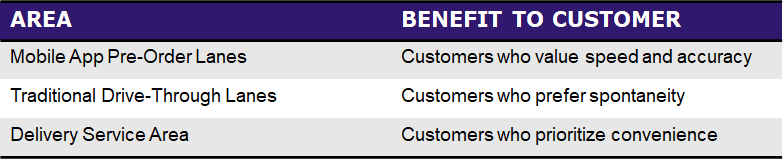
By creating dedicated physical spaces that take these priorities into account, it helps the company deliver their products to customers in the way that is most appealing to them. It also reduces the bottlenecks that often occur when there is a sole point of purchase, and provides flexibility if specific dayparts or events impact the demand through any of the channels.
Author Information

Keith Kirkpatrick is VP & Research Director, Enterprise Software & Digital Workflows for The Futurum Group. Keith has over 25 years of experience in research, marketing, and consulting-based fields.
He has authored in-depth reports and market forecast studies covering artificial intelligence, biometrics, data analytics, robotics, high performance computing, and quantum computing, with a specific focus on the use of these technologies within large enterprise organizations and SMBs. He has also established strong working relationships with the international technology vendor community and is a frequent speaker at industry conferences and events.
In his career as a financial and technology journalist he has written for national and trade publications, including BusinessWeek, CNBC.com, Investment Dealers’ Digest, The Red Herring, The Communications of the ACM, and Mobile Computing & Communications, among others.
He is a member of the Association of Independent Information Professionals (AIIP).
Keith holds dual Bachelor of Arts degrees in Magazine Journalism and Sociology from Syracuse University.