The so-called “Great Resignation” is continuing, with data from the U.S. Bureau of Labor Statistics indicating that the number of workers quitting jobs in November 2021 grew to 4.5 million, up from 4.2 million the previous month, and above the prior record of 4.4 million reached in September. And while the US Department of Labor said the number of job openings in the US decreased to 10.6 million in November 2021 from an upwardly revised 11 million in the previous month and below market expectations of 11.075 million, the level of openings remained near record highs with employers still having a difficult time finding workers.
US Job Openings

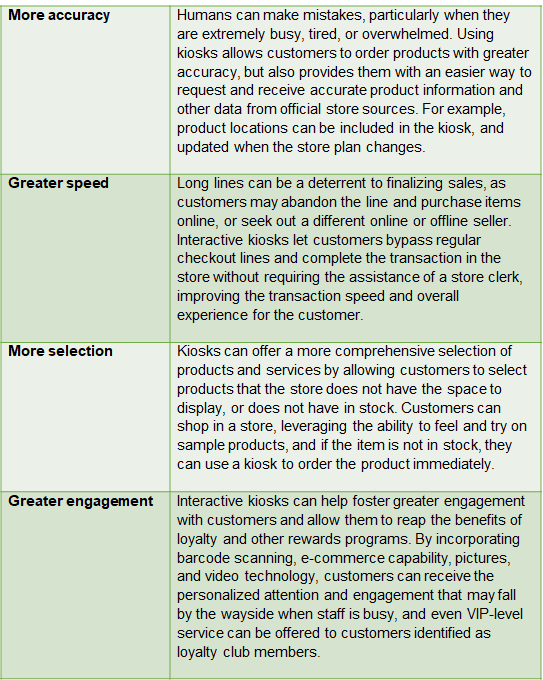
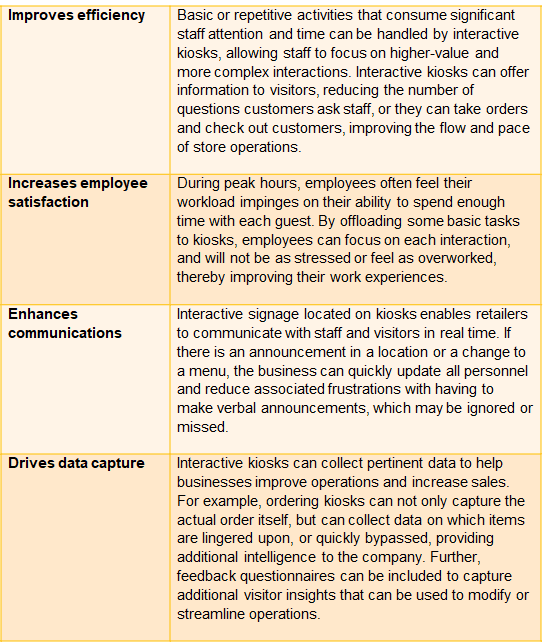
As a result, many industries are facing a significant shortage of in-person staff to handle sales, CX, and other customer-facing functions, which can have significant implications. A 2019 report published by Omnico found that 92% of US shoppers become frustrated when shopping in a store, with 86% annoyed by waiting for a refund, 52% angry about waiting to pay, and 49% ready to boil over if they are unable to find what they want. Kiosks, which have been used for years in airport terminals, fast food restaurants, and healthcare settings, can be used to improve CX by offloading the time-consuming and repetitive tasks that would prevent human workers from addressing more complex issues, or taking the time to create better experiences with customers. Although kiosks cannot and likely should not replace all human workers, they can provide significant benefits to both customers and employees, as detailed below, while somewhat lessening the demand for frontline staff.
Kiosk Customer Benefits
Kiosk Retailer Benefits
Best Practices for Deploying Kiosks
Placing kiosks in a retail environment will not generate return on investment (ROI). Instead, several factors will determine the extent to which kiosks can improve CX, as well as improve the organization’s operational efficiency. Kiosks deployed in retail environments should have the following features:
- Multifunction: Single-function kiosks, such as those that only support price checking, can take up valuable retail floor space, and can frustrate customers who want to handle several tasks, including looking up product information, checking in-stock status, printing out coupons, or checking loyalty card points. Multifunction kiosks can not only reduce the number of questions or tasks that need to be handled by store associates, but can ensure that customers get all of their tasks handled at a single location, thereby increasing efficiency and their overall experience.
- Easy to navigate: Customers have become accustomed to the simple-to-use iOS and Android software found on their smartphones and other devices. In-store kiosks should similarly be simple to navigate, with clear directions provided via on-screen text or via voice prompts, a logical progression of steps to accomplish a task, and, in all cases, the ability to quickly ring for a human associate to help if they run into a problem. On the back end, kiosks should be equipped with sensors that can detect a malfunction with the kiosk, which sends an immediate notification to the store manager, so that the kiosk can be quickly reset and put back into service.
- Functionally aligned with store goals: Kiosks should be set up to support the core goals of the store. If the store is trying to encourage more customer engagement, the kiosks should incorporate tools and offers that drive engagement, such as promoting loyalty programs, providing deeper product or service information, or offering other content or services that go beyond supporting in-store transactions. Kiosks can be an efficient modality through which customer engagement can be promoted and supported, without requiring store associates.
- Refreshable: Kiosks with static content or features are ultimately a waste of valuable floor space. If customers do not find new content, features, or tools over time, kiosks will lose their value as engagement centers. In addition to adding new promotions on a weekly or monthly basis, kiosks should have new content tied to products, services, or customer programs added on a regular basis, so that customers become used to finding and using these tools while in the stores. As the usage of a kiosk as a center of information or engagement increases, stores are likely to see a greater ROI.
Author Information

Keith Kirkpatrick is VP & Research Director, Enterprise Software & Digital Workflows for The Futurum Group. Keith has over 25 years of experience in research, marketing, and consulting-based fields.
He has authored in-depth reports and market forecast studies covering artificial intelligence, biometrics, data analytics, robotics, high performance computing, and quantum computing, with a specific focus on the use of these technologies within large enterprise organizations and SMBs. He has also established strong working relationships with the international technology vendor community and is a frequent speaker at industry conferences and events.
In his career as a financial and technology journalist he has written for national and trade publications, including BusinessWeek, CNBC.com, Investment Dealers’ Digest, The Red Herring, The Communications of the ACM, and Mobile Computing & Communications, among others.
He is a member of the Association of Independent Information Professionals (AIIP).
Keith holds dual Bachelor of Arts degrees in Magazine Journalism and Sociology from Syracuse University.