
Analyst(s): Mitch Ashley
Publication Date: May 28, 2025
Early adoption of AI innovations in software development is a leading indicator to inform and shape tech vendors’ agentic AI strategies.
Key Points:
- Mirroring past tech waves such as cloud and Agile, AI’s rapid integration into software development signals transformative changes extending beyond IT into broader business strategies.
- Software development’s relentless pace of AI innovation establishes it as the primary proving ground for advanced AI and emerging agentic capabilities.
- The complex SDLC, coupled with developers acting as innovation catalysts, uniquely positions software development to accelerate the evolution of agentic AI.
Overview:
The software industry is experiencing rapid and continuous innovations in generative AI models, agents with agentic capabilities, and open standards, which are quickly advancing us toward AI-native software development and DevOps. While AI is expected to be the most widespread, impactful, and disruptive technology, it is not the first wave of software development to see significant adoption.
The migration of applications and development to the cloud, along with the shift towards DevOps, Agile, and Lean methodologies, is transforming software from a supporting tool into a central component of business strategies and innovation. These changes extend far beyond the boundaries of development teams and IT departments.
With a disruptive technology like AI, software development is the live sandbox for the future of AI applied to the software development life cycle and other parts of the business. The accelerating pace of innovation, particularly in creating agentic AI systems that tackle the SDLC, provides valuable foresight for all tech vendors as their products and companies plan, execute, and adapt as customers shift to using AI as a central part of their work.
Figure 1: Organizations Using AI/ML/Generative AI Tools to Aid or Augment Software Development, Testing, or DevOps
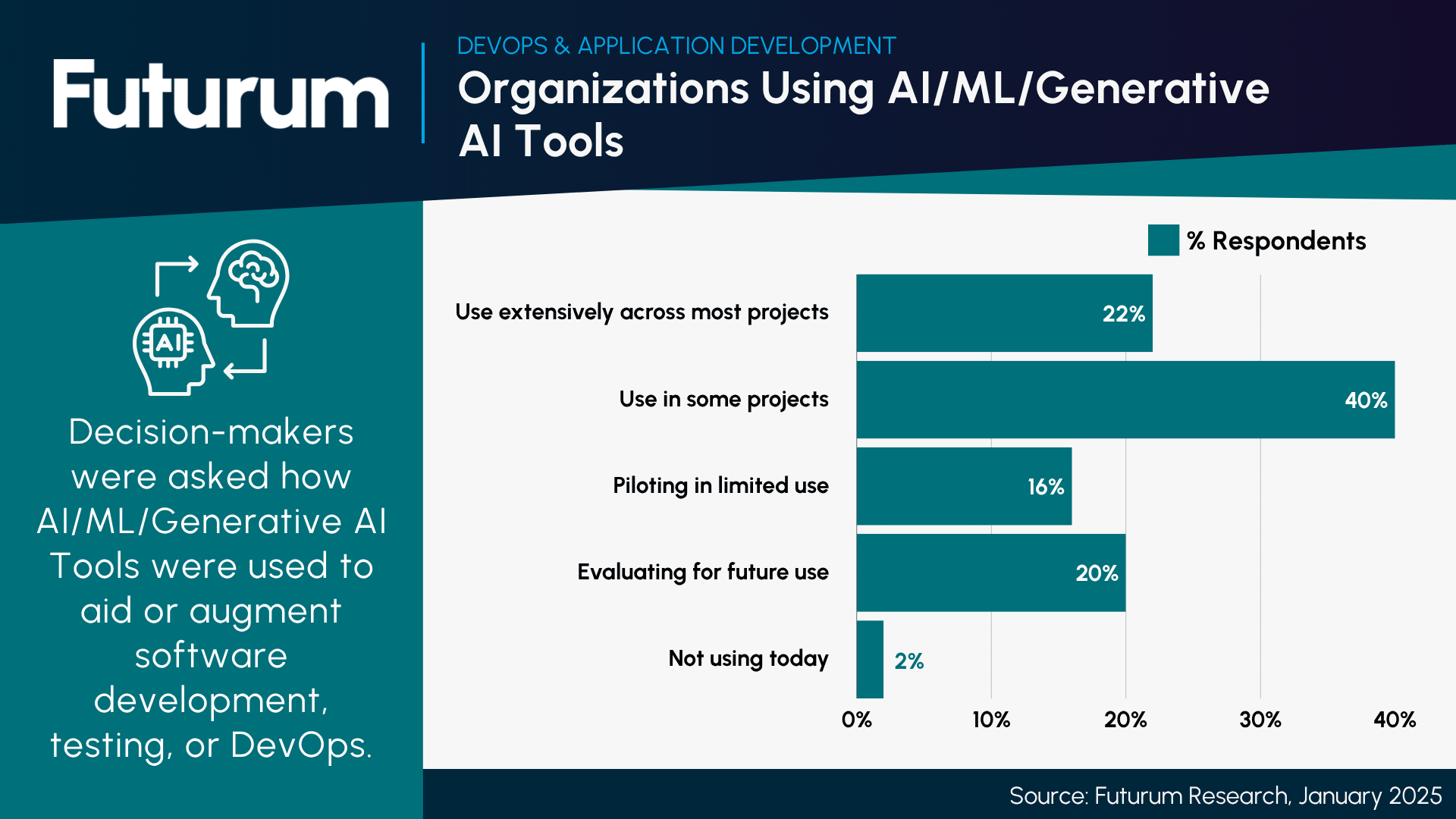
Software teams already use AI, ML, and generative AI in their software development, testing, and DevOps platforms. Futurum’s DevOps and Application Development Decision-Maker survey shows that 62% use AI in their software development processes and 36% are in the evaluation or consideration stages.
“Software development is the proving ground for how AI will change work across the SDLC,” said Mitch Ashley, VP and Practice Lead, DevOps and Application Development at Futurum. “My analyst colleagues and I are working with technology companies as agents, and agentic AI is entering into vendors’ products, roadmaps, delivery, and go-to-market strategies.”
Software development involves analysis, problem-solving, creativity, multi-step processes, and interdependencies between workflows and people. Early adopters lean into, experiment with, and apply AI and agentic capabilities as quickly as vendors race to get the latest innovations into developers’ hands.
“As we move beyond chatbots and natural language queries, agentic agents, AI-native, and concepts like vibe coding introduce disruptive and fundamental change for software developers. Many are increasing their time spent in design, orchestration of work, and determining how best to have agents perform work for them,” according to Ashley.
Conclusion
The accelerating pace of innovation, particularly in creating agentic AI systems that tackle the SDLC, provides valuable foresight for all tech vendors. By studying this “tip of the spear,” companies can anticipate emerging AI paradigms, understand practical applications beyond the hype, and use these insights to drive genuine innovation and value within their own product ecosystems.
The full Analyst Insight Report, Software Development—Proving Grounds for the Agentic AI Revolution, is available via subscription to Futurum Intelligence’s DevOps and Application Development IQ service. Click here for inquiry and access.
Futurum clients can read more about it in the DevOps & Application Development Intelligence Platform, and non-clients can learn more here: DevOps & Application Development Practice.
About the Futurum DevOps & Application Development Practice
The Futurum DevOps & Application Development Practice provides actionable, objective insights for market leaders and their teams so they can respond to emerging opportunities and innovate. Public access to our coverage can be seen here. Follow news and updates from the Futurum Practice on LinkedIn and X. Visit the Futurum Newsroom for more information and insights.
Author Information

Mitch Ashley is VP and Practice Lead for the CIO & Technology Buyers and Software Lifecycle Engineering practices at The Futurum Group. A multi-time CIO and CTO with 30+ years leading technical organizations, Mitch built and operated production systems spanning cybersecurity for the U.S. Department of Defense, PKI services for the broadband and 5G industries, SaaS platforms, large-scale telecom and banking systems, and a national broadband network. His work with AI began early, developing expert systems that diagnosed and repaired complex mainframe environments. That operator foundation grounds his analysis in operational consequence, covering the technology buyer's world of software engineering, cybersecurity, DevOps, cloud, and AI.

