
Austin, Texas, USA, March 31, 2026
Enterprise Procurement Data Confirms the Observability-Native Shift Is Already Underway
Futurum Group’s 1H 2026 Software Lifecycle Engineering Decision-Maker Survey finds enterprise observability spending is migrating decisively toward higher tiers, with organizations committing larger budgets to a category that now must encompass AI and agent behavior visibility alongside traditional infrastructure monitoring.
The data reflects a market moving toward observability-native architecture, the principle that AI behavior must be captured as first-class telemetry throughout the software lifecycle, not inferred from infrastructure side effects after the fact. Organizations are not adding AI observability as a feature request. They are funding it as foundational infrastructure.
Mitch Ashley, VP & Practice Lead of Software Lifecycle Engineering at Futurum, said, “Enterprises will deploy AI agents at scale only to the extent they can observe, explain, and control agent behavior. The survey data confirms this isn’t a forward-looking prediction. It’s already shaping procurement decisions and platform evaluations. Platforms that treat AI decision-making as an opaque internal state will cap customer autonomy at low-risk use cases.”
Observability Budgets Are Structurally Shifting Upward
The capability prioritization shift is accompanied by a decisive migration toward higher observability spending in 2026 vs. 2025:
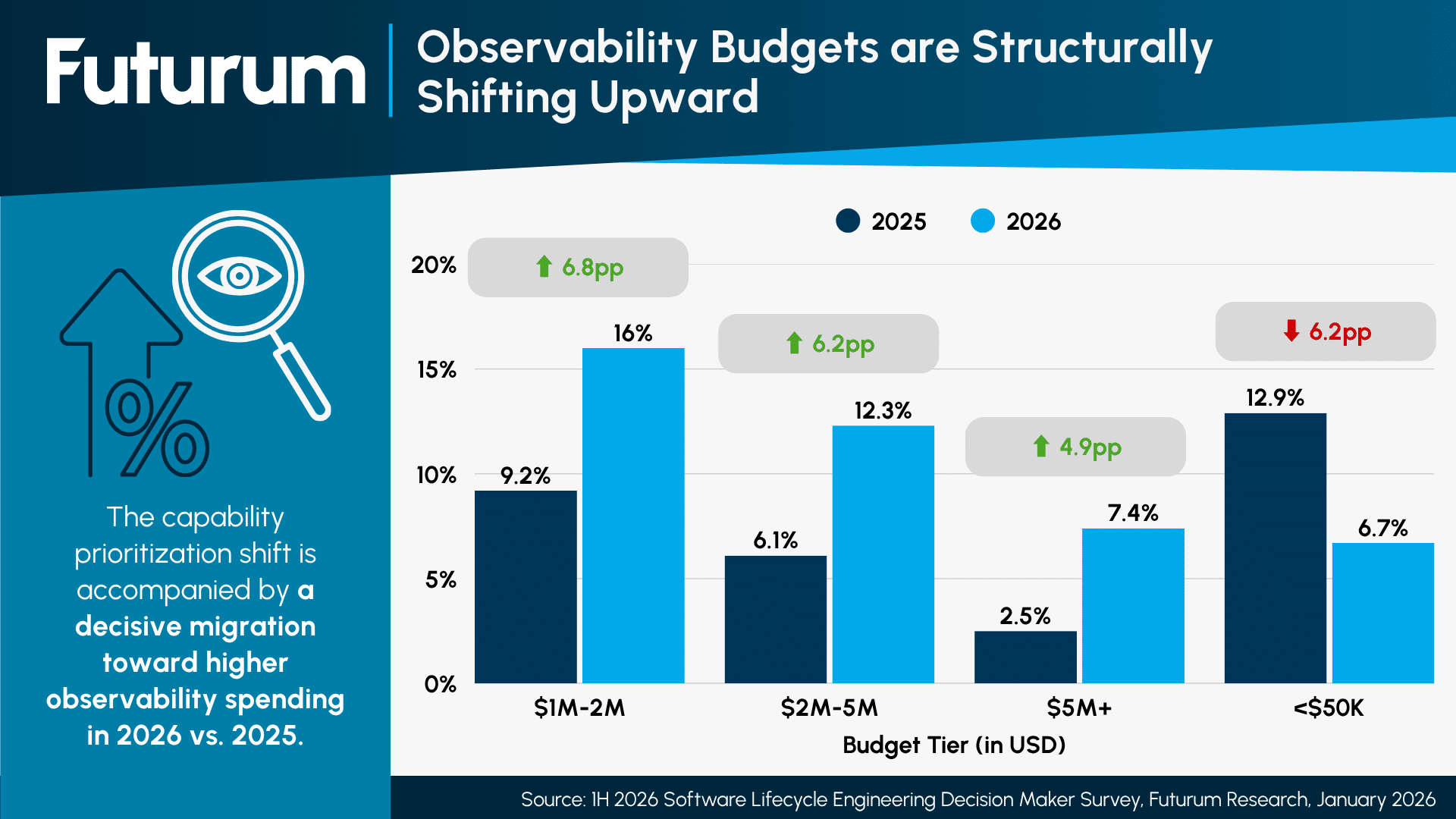
“The budget migration tells a more consequential story than capability rankings alone. When the share of organizations spending under $50K drops by more than six points while the $1M-plus tiers double, that is not incremental expansion. That is a structural reallocation. Observability is moving from operational line item to strategic infrastructure investment, and vendors positioned at the platform layer stand to capture a disproportionate share of that shift.”
The budget data makes the observability-native transition concrete. Enterprises are not exploring AI and agent observability as adjacent capabilities to evaluate later. They are committing larger budgets now, ahead of broad agent deployment, because governance of autonomous agent behavior requires observability infrastructure built for that purpose.
Traditional monitoring stacks were not designed to capture agent intent, reasoning, or decision cycles. The spending shift signals that buyers understand the distinction and are acting on it.
For platform vendors, the window to establish a credible AI observability architecture is closing. Point solutions that address infrastructure monitoring without extending to agent decision cycles will face displacement pressure as enterprise requirements harden around the full observability-native stack.
Subscribers can read the full “1H 2026 Software Lifecycle Engineering Decision Maker Survey Report” on the Futurum Intelligence Platform. Non-subscribers can click here for more information.
About Futurum Intelligence for Market Leaders
Futurum Intelligence’s Software Lifecycle Engineering IQ service provides actionable insight from analysts, reports, and interactive visualization datasets, helping leaders drive their organizations through transformation and business growth. Subscribers can log into the platform at https://app.futurumgroup.com/, and non-subscribers can find additional information at Futurum Intelligence.
Follow news and updates from Futurum on X and LinkedIn using #Futurum. Visit the Futurum Newsroom for more information and insights.
Other Insights from Futurum:
OpenShell Redraws the Agent Control Plane — Open Standard or Product Launch?
Enterprises Prioritize Agent Observability Before They’ve Deployed Agents
The Seven Principles of Observability-Native
IBM vs. Anthropic: A Tale of the COBOL Modernization Tape
Author Information

Mitch Ashley is VP and Practice Lead for the CIO & Technology Buyers and Software Lifecycle Engineering practices at The Futurum Group. A multi-time CIO and CTO with 30+ years leading technical organizations, Mitch built and operated production systems spanning cybersecurity for the U.S. Department of Defense, PKI services for the broadband and 5G industries, SaaS platforms, large-scale telecom and banking systems, and a national broadband network. His work with AI began early, developing expert systems that diagnosed and repaired complex mainframe environments. That operator foundation grounds his analysis in operational consequence, covering the technology buyer's world of software engineering, cybersecurity, DevOps, cloud, and AI.

