
Austin, Texas, USA, March 2, 2026
Futurum Intelligence Research Reveals Security Operations Teams are Driving Platform Adoption to Solve the “Hybrid Mess,” Not Just to Cut Budgets
New research from Futurum debunks the prevailing industry narrative that enterprise leaders are forcing security vendor consolidation purely to cut costs. Instead, findings from the 2H 2025 Cybersecurity Decision Maker study reveal that Security teams are driving the shift toward unified platforms to reduce operational friction and solve the fragmented “hybrid mess” of their current environments.
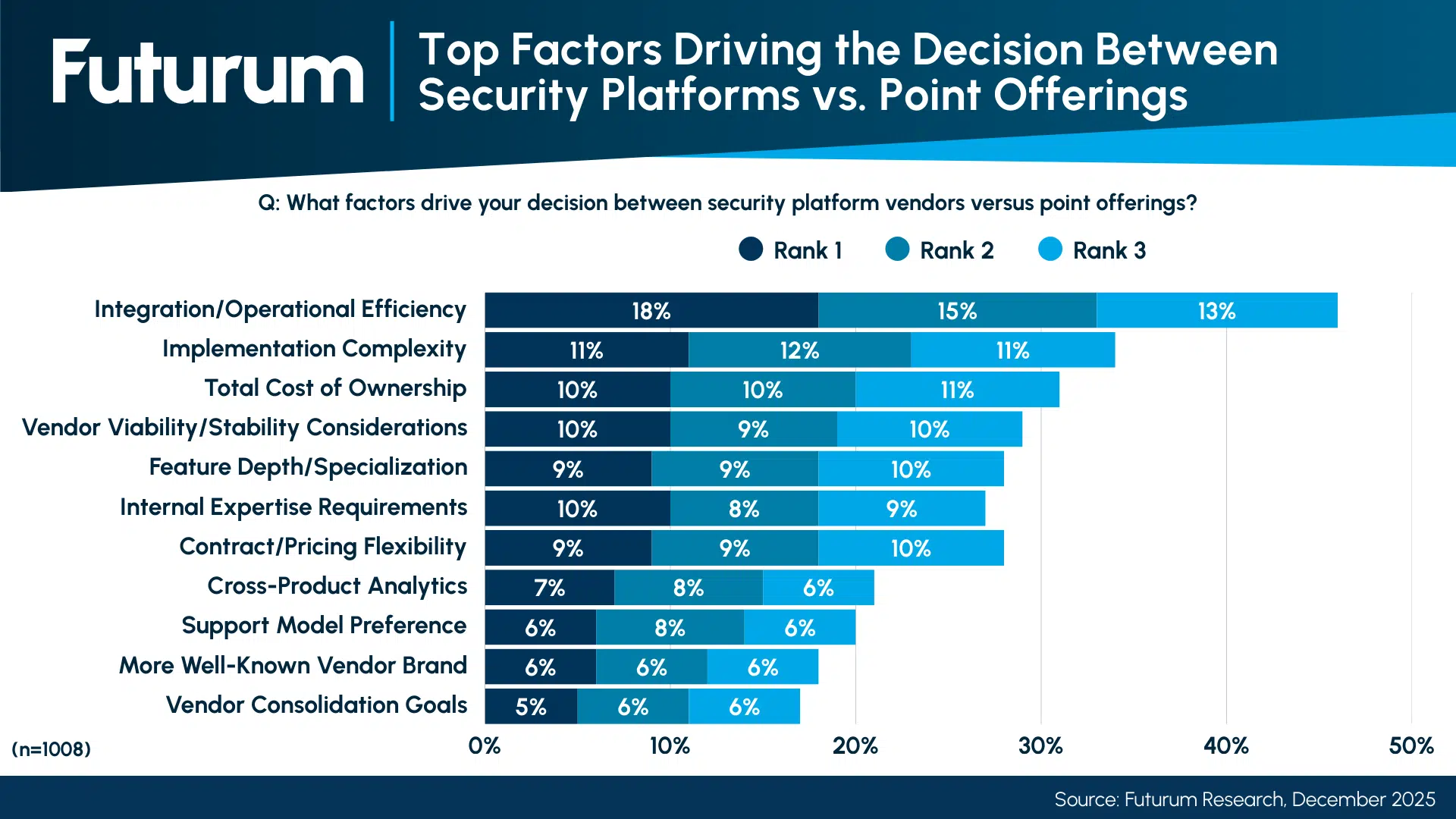
When deciding between security platform vendors versus specialized point offerings, buyers overwhelmingly prioritize “Integration/operational efficiency.” This factor outscored “Total cost of ownership” by a wide margin and completely eclipsed explicit “Vendor consolidation goals”.
Figure 1: Top Factors Driving the Decision Between Security Platforms vs. Point Offerings (n=1008)
Fernando Montenegro, Vice President and Practice Lead, Cybersecurity & Resilience at Futurum, underscores:
“The market narrative has heavily emphasized ‘vendor consolidation’ as a cost-cutting measure, but our data shows the reality is far more nuanced. Buyers aren’t swapping out security tools primarily to shrink their bill; they are drowning in alerts and disconnected dashboards. Organizations are willing to invest in platforms if it means gaining superior integration and reducing the day-to-day friction of the fragmented environments they currently inhabit.”
The Reality: Managing a “Hybrid Mess”
The research highlights that, despite the industry’s push toward platforms, most organizations are currently in a highly complex transition phase. When asked to describe their current toolset, the largest cohort of organizations (420 respondents) described their environment as “Mixed (40-60% platform),” while a significant portion (262 respondents) is still running “Primarily point offerings”.
For security vendors, this signals an important shift in how technology must be positioned: offering a “Best of Breed” detection engine is no longer enough if it adds friction to a buyer’s mixed environment. Superior integration and operational flow are now the primary catalysts for winning enterprise contracts.
Read more in the “2H 2025 Cybersecurity Decision-Maker Survey Report” on the Futurum Intelligence Platform.
About Futurum Intelligence for Market Leaders
Futurum Intelligence’s Cybersecurity and Resilience IQ service provides actionable insight from analysts, reports, and interactive visualization datasets, helping leaders drive their organizations through transformation and business growth. Subscribers can log into the platform at https://app.futurumgroup.com/, and non-subscribers can find additional information at Futurum Intelligence.
Follow news and updates from Futurum on X and LinkedIn using #Futurum. Visit the Futurum Newsroom for more information and insights.
Declaration of Generative AI and AI-assisted Technologies in the Writing Process: While preparing this work, the author used AI capabilities from Google Gemini and Futurum’s Intelligence Platform to summarize source material and assist with general editing. After using these capabilities, the author reviewed and edited the content as needed and takes full responsibility for the publication’s content.
Other Insights from Futurum:
Futurum Research: AI Workloads and Hybrid Work Redefine Network Architecture
Futurum Research: Cybersecurity Sentiment Points to Resilience and Growth
As Cyber Becomes Strategy, How Must Security Management Evolve? – Report Summary
Author Information

Fernando Montenegro serves as the Vice President & Practice Lead for Cybersecurity & Resilience at The Futurum Group. In this role, he leads the development and execution of the Cybersecurity research agenda, working closely with the team to drive the practice's growth. His research focuses on addressing critical topics in modern cybersecurity. These include the multifaceted role of AI in cybersecurity, strategies for managing an ever-expanding attack surface, and the evolution of cybersecurity architectures toward more platform-oriented solutions.
Before joining The Futurum Group, Fernando held senior industry analyst roles at Omdia, S&P Global, and 451 Research. His career also includes diverse roles in customer support, security, IT operations, professional services, and sales engineering. He has worked with pioneering Internet Service Providers, established security vendors, and startups across North and South America.
Fernando holds a Bachelor’s degree in Computer Science from Universidade Federal do Rio Grande do Sul in Brazil and various industry certifications. Although he is originally from Brazil, he has been based in Toronto, Canada, for many years.
