
Austin, Texas, USA, June 3, 2026
Enterprises are building AI infrastructure on autopilot. The architectural layer for AI governance is being decided by default, not design.
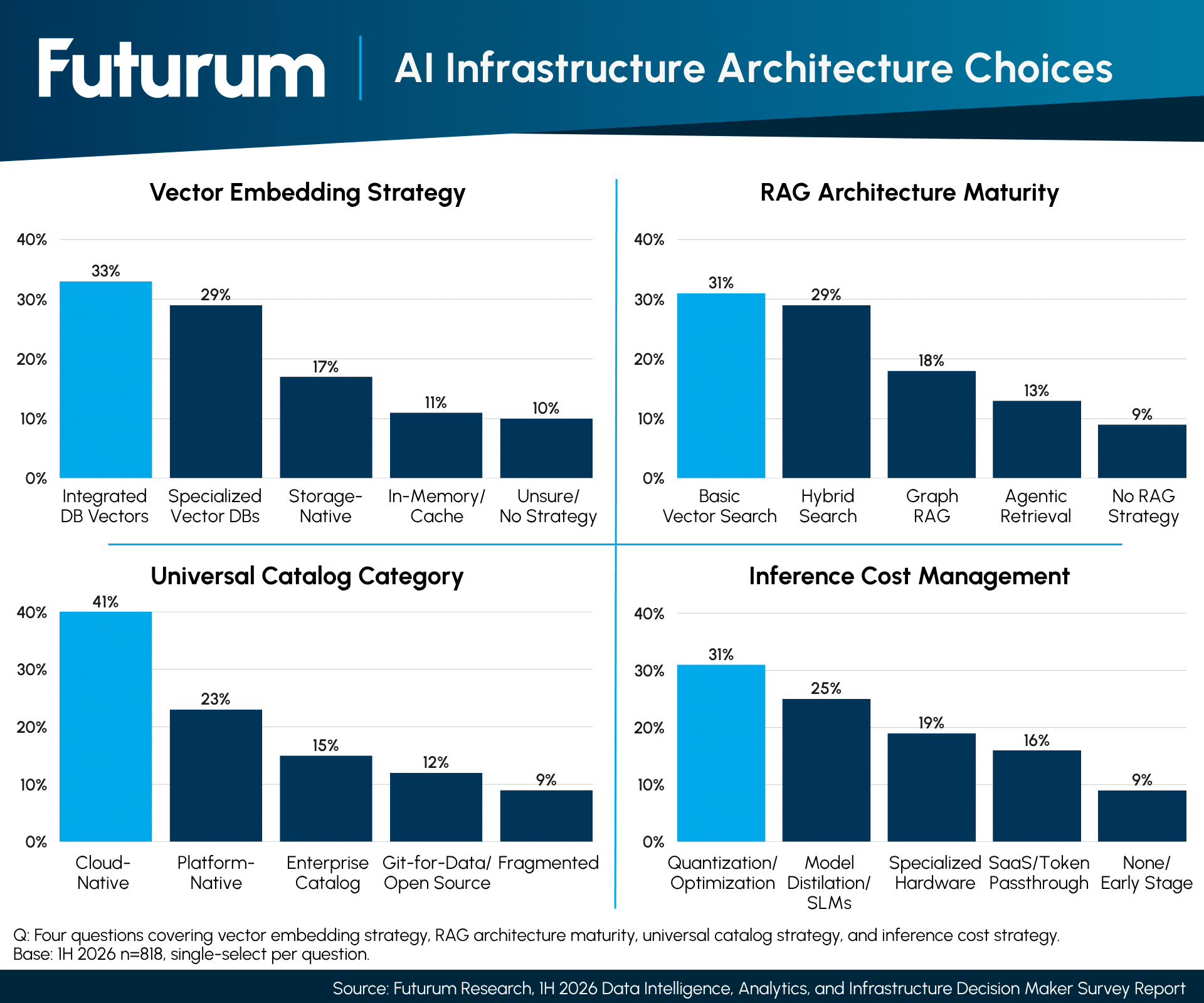
The 1H 2026 Data Intelligence, Analytics, and Infrastructure Decision Makers Survey (1H 2026 n=818) finds that AI infrastructure choices are fragmenting across four distinct architectural layers, with 41.3% of enterprises defaulting to cloud-provider catalogs, 59.4% anchored in basic or hybrid RAG, and vector database strategy split nearly evenly between integrated (33.4%) and specialized (29.3%) approaches.
Figure 1: AI Infrastructure Architecture Choices (1H 2026)
“It is tempting to treat your data catalog like a free prize at the bottom of a cloud subscription, just accepting whatever comes in the box. But the reality is that metadata now anchors your entire infrastructure. We have these wonderfully capable AI agents ready to take on complex tasks, but they are only as smart as the semantic map we give them. Companies must, therefore, treat this trust infrastructure with care. Only by turning off the autopilot and deliberately choosing a universal catalog capable of seeing across the whole, messy data estate, companies give their AI the complete context it needs to do some truly great work.”— Brad Shimmin, VP & Practice Lead, Data Intelligence, Analytics, and Infrastructure, The Futurum Group
Looking at the findings from the 1H 2026 Data Intelligence, Analytics, and Infrastructure Decision Makers Survey, a surprisingly common theme emerges: companies are sleepwalking into their AI governance architecture. We see that over 41% of organizations are simply defaulting to the data catalogs provided by their primary cloud vendors. They are taking the “batteries included” approach, rather than making a conscious, strategic choice about how their information is organized and understood.
This tendency to stay on autopilot is understandable. Setting up foundational data systems is hard work, and using the tool that is already sitting in an existing cloud console feels like a quick win. But when it comes to preparing for agentic AI (systems that do not just answer questions but actively execute tasks on your behalf), relying on a default option often leads to a fragmented, constrained future.
To understand why this matters, we need to look at how technology providers view metadata today. Historically, the gravitational pull in enterprise architecture came from the data warehouse or the data lake. Wherever you stored your massive tables of information, the rest of your tooling naturally followed. Today, that center of gravity is shifting upward and outward. The metadata layer—the data catalog that holds the definitions, lineage, access policies, and semantic meaning of your information—is quickly becoming the new anchor. Cloud providers recognize this shift. If they can manage your metadata, they maintain a strong, subtle hold on your entire analytical and AI workflow.
This makes the choice of a catalog a meaningful decision, not an afterthought.
Read more in the reports “1H 2026 Data Intelligence, Analytics, and Infrastructure Decision Makers Survey”—on the Futurum Intelligence Platform. Non-subscribers click here for more information.
About Futurum Intelligence for Market Leaders
Futurum Intelligence’s Data Intelligence, Analytics, and Infrastructure IQ service provides actionable insight from analysts, reports, and interactive visualization datasets, helping leaders drive their organizations through transformation and business growth. Subscribers can log into the platform at https://app.futurumgroup.com/, and non-subscribers can find additional information at Futurum Intelligence.
Follow news and updates from Futurum on X and LinkedIn using #Futurum. Visit the Futurum Newsroom for more information and insights.
Other Insights from Futurum:
Oracle Positions AI Database 26ai to Lead $1.2 Trillion Market by Bridging the Agentic Reasoning Gap
VAST Data Valuation Triples. Can a Unified Platform Scale AI Globally?
Hybrid Data Platform Strategy: Cloudera’s Stability Bet
Author Information

Brad Shimmin is Vice President and Practice Lead, Data Intelligence, Analytics, & Infrastructure at Futurum. He provides strategic direction and market analysis to help organizations maximize their investments in data and analytics. Currently, Brad is focused on helping companies establish an AI-first data strategy.
With over 30 years of experience in enterprise IT and emerging technologies, Brad is a distinguished thought leader specializing in data, analytics, artificial intelligence, and enterprise software development. Consulting with Fortune 100 vendors, Brad specializes in industry thought leadership, worldwide market analysis, client development, and strategic advisory services.
Brad earned his Bachelor of Arts from Utah State University, where he graduated Magna Cum Laude. Brad lives in Longmeadow, MA, with his beautiful wife and far too many LEGO sets.

