
Analyst(s): Brendan Burke
Publication Date: February 24, 2026
The AI infrastructure market is undergoing a fundamental architectural shift that the semiconductor industry largely missed. While GPUs dominate headlines, a quiet supply crisis has emerged in the CPU market, driven not by traditional server refresh cycles, but by the explosive growth of agentic AI and reinforcement learning workloads that demand massive general-purpose compute for simulation, orchestration, and disaggregated inference.
Key Points:
- CPU Resurgence Driven by Agentic Reasoning: Contrary to expectations of a GPU-dominated future, discrete CPUs are experiencing a surge in demand, driven by the rise of Reinforcement Learning with Verifiable Rewards (RLVR) and agentic workflows. These workloads require massive general-purpose compute for simulation and orchestration, pushing CPU-to-GPU ratios in AI clusters back toward 1:1.
- Supply Crisis and Market Bifurcation: A quiet pivot by hyperscalers has erupted into a public supply shortage, with Intel and AMD confirming high-core-count server processors are effectively sold out. The market is bifurcating into proprietary outer-loop integrated CPUs for GPU stacks and inner-loop discrete CPUs for heterogeneous environments, driving sustained double-digit growth.
- Architectural Shift to Disaggregation: The traditional host processor role is dead. CPUs are evolving into specialized system orchestrators designed to manage massive memory tiers and disaggregated inference phases.
Overview: Strategic Importance of CPUs for Reinforcement Learning
Discrete CPUs are undergoing a massive resurgence, transitioning from head nodes to critical system orchestrators. This shift is fueled by the rise of Reinforcement Learning with Verifiable Rewards (RLVR) and agentic workflows, which require heavy general-purpose compute for simulation and orchestration. As AI labs scale frontier reasoning models, the industry is seeing CPU-to-GPU ratios climb back toward 1:1, effectively ending the era of the GPU-only data center.
AMD’s Performance Leadership and Supply Constraints
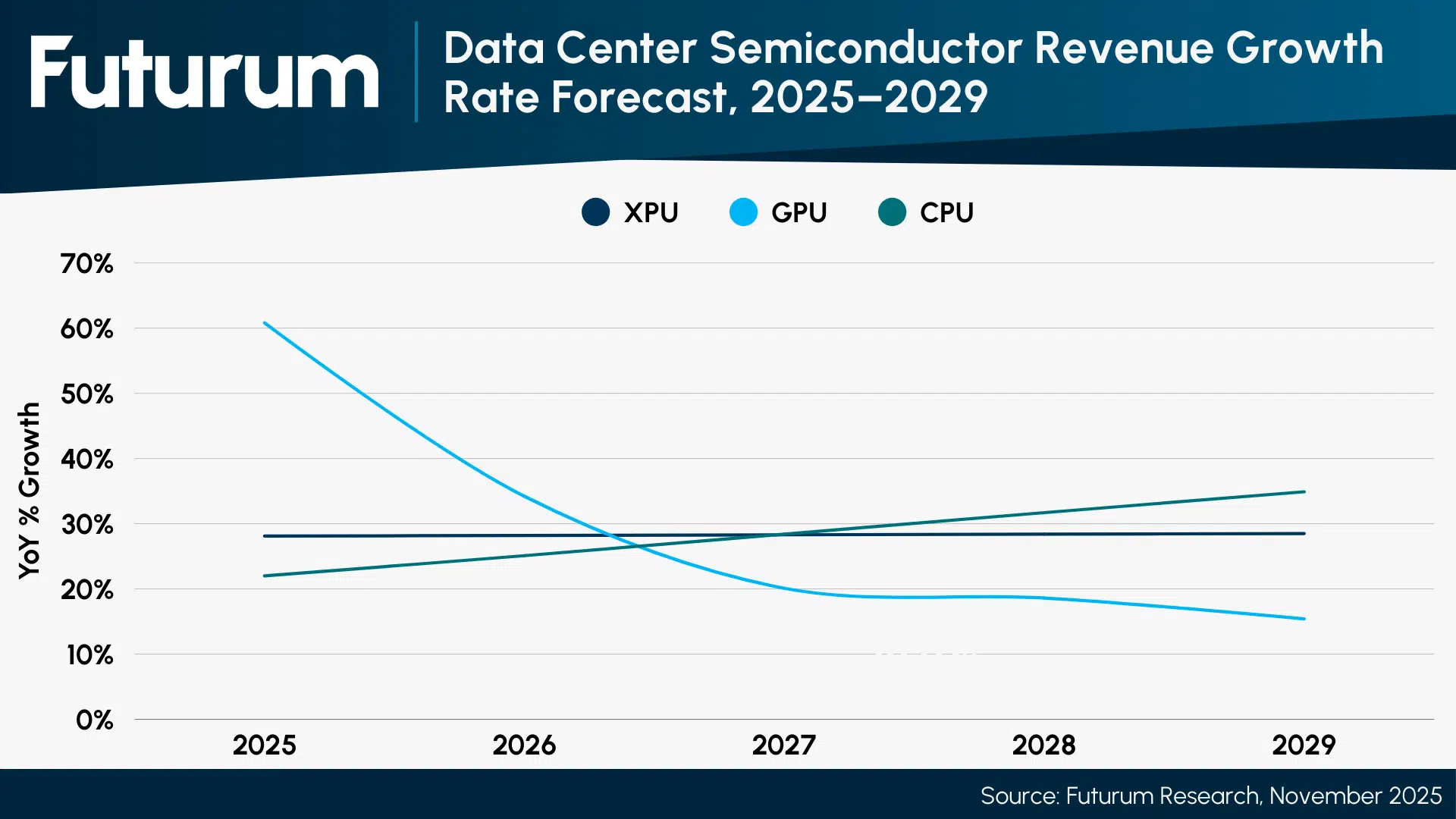
AMD is currently a primary beneficiary of the CPU resurgence, with a growth trajectory expected to help the CPU market exceed GPU and XPU growth by 2028. The upcoming Venice CPU platform and its chiplet-based architecture are driving sustained double-digit growth. However, this success faces headwinds from supply constraints as a non-linear spike in discrete CPU demand from AI hyperscalers emerges.
Figure 1: Data Center Semiconductor Revenue Growth Rate Forecast, 2025–2029 (YoY Growth)
Intel’s x86 Counter-Strike and Roadmap Pivot
Intel is re-architecting its strategy to defend its leading server market share against the Arm surge. The company is collaborating with NVIDIA to build a custom Xeon with integrated NVLink, allowing x86 cores to act as coherent hosts for Blackwell and Rubin clusters. Despite these innovations, Intel faces an immediate supply crunch, leading to delivery delays and encouraging price hikes.
NVIDIA’s Standalone CPU Ambitions
NVIDIA is aggressively moving beyond GPUs with the standalone launch of its Vera CPU in Q1 2026 and unbundling of Grace CPUs from its Blackwell platform. This product line expansion signals NVIDIA’s intent to dominate the system orchestrator market. This strategy was validated by a massive multi-year deal with Meta, which includes the first large-scale deployment of standalone NVIDIA CPUs to support the operation of personal agents.
The Custom Silicon and RISC-V Alternative
Hyperscalers and new ecosystem players are diversifying to mitigate x86/Arm supply risks. Google has already migrated 30% of its internal applications to its custom Axion chips, while Microsoft’s Cobalt 200 is scaling for newer AI workloads. Simultaneously, RISC-V is becoming a viable high-performance contender through a strategic partnership between SiFive and NVIDIA, integrating NVLink Fusion to create specialized engines for memory-bound AI decode phases.
Conclusion
The CPU market is entering a supercycle defined by the shift to reinforcement learning simulation and agentic reasoning. As memory supply tightens and providers pivot toward specialized system orchestrators, buyers face increases in CPU pricing and persistent hardware backlogs. The winners in this new era will be those who can move beyond the general-purpose mindset to embrace a workload-optimized silicon landscape.
Futurum clients can read more about it in the Futurum Intelligence Platform, and non-clients can learn more here: Semiconductors, Supply Chain, & Emerging Technology Practice.
About the Futurum Semiconductors, Supply Chain, & Emerging Technology Practice
The Futurum Semiconductors, Supply Chain, & Emerging Technology Practice provides actionable, objective insights for market leaders and their teams so they can respond to emerging opportunities and innovate. Public access to our coverage can be seen here. Follow news and updates from the Futurum Practice on LinkedIn and X. Visit the Futurum Newsroom for more information and insights.
Author Information

Brendan is Research Director, Semiconductors, Supply Chain, and Emerging Tech. He advises clients on strategic initiatives and leads the Futurum Semiconductors Practice. He is an experienced tech industry analyst who has guided tech leaders in identifying market opportunities spanning edge processors, generative AI applications, and hyperscale data centers.
Before joining Futurum, Brendan consulted with global AI leaders and served as a Senior Analyst in Emerging Technology Research at PitchBook. At PitchBook, he developed market intelligence tools for AI, highlighted by one of the industry’s most comprehensive AI semiconductor market landscapes encompassing both public and private companies. He has advised Fortune 100 tech giants, growth-stage innovators, global investors, and leading market research firms. Before PitchBook, he led research teams in tech investment banking and market research.
Brendan is based in Seattle, Washington. He has a Bachelor of Arts Degree from Amherst College.
