
Austin, Texas, USA, April 10, 2026
Enterprise buyers have developed a split personality when it comes to software pricing, creating both opportunities and risks for vendors.
New findings from The Futurum Group’s “1H 2026 Enterprise Software Decision Maker Survey Report,” a study of 830 global IT decision-makers, reveal a striking bifurcation in enterprise pricing preferences. For core software platforms, preference for consumption-based pricing dropped 5.8 percentage points to 30.1% as buyers retreat toward predictability. For Generative AI features, the opposite is true: consumption-based pricing surged 5.3 percentage points to 42.9%, the dominant preferred model by a widening margin. The same buyers demanding pricing stability for their ERP and CRM platforms are simultaneously rejecting flat-fee “AI taxes” in favor of usage-based metering for AI capabilities.
Figure 1: Outcome-Based Pricing Preferences, Core Software vs. GenAI Features, 1H 2026 vs. 2H 2025
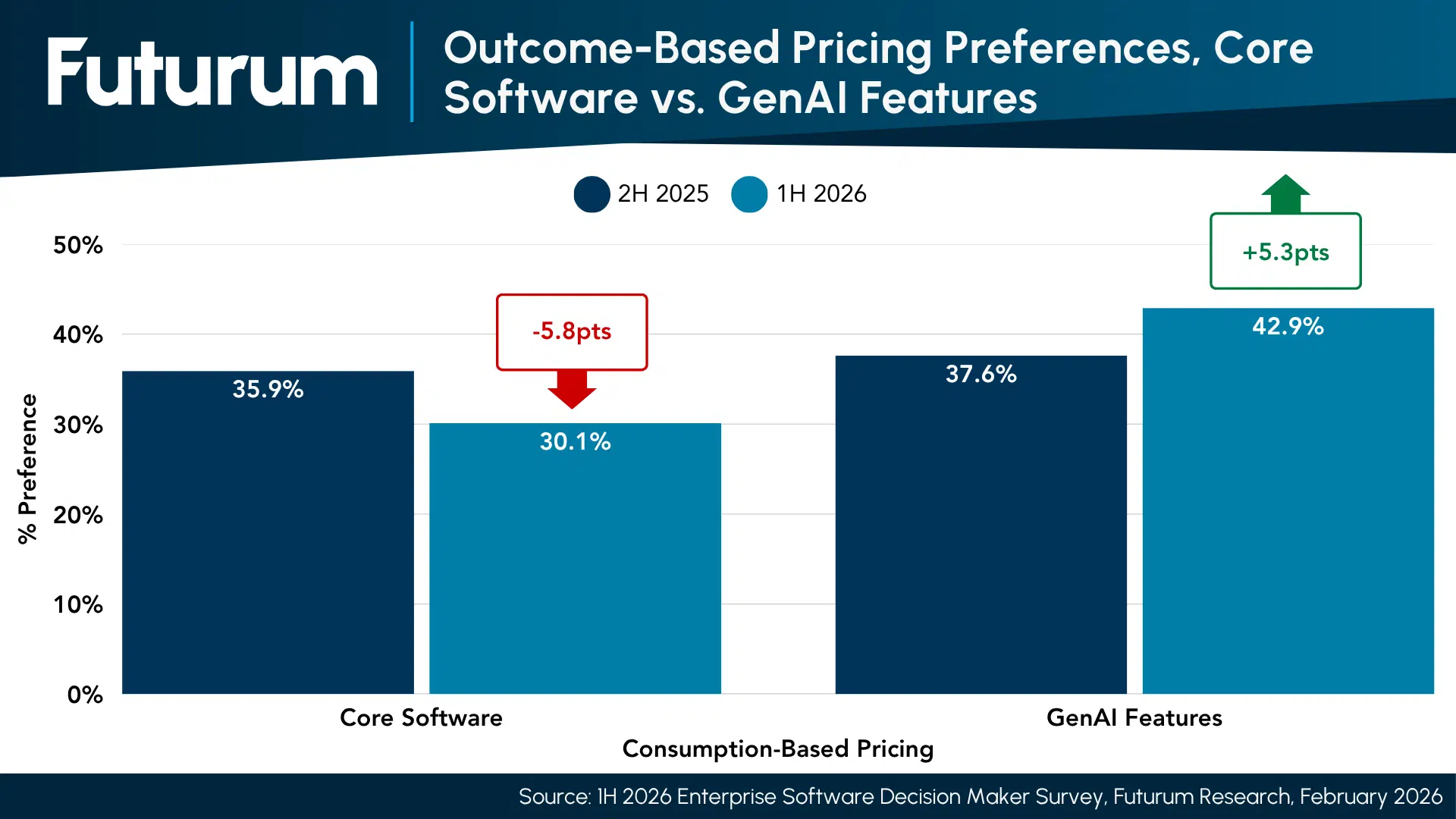
As we enter the second quarter of 2026, vendors are increasingly adjusting their pricing and packaging strategies, choosing to introduce more flexible pricing approaches, with the goal of meeting customers where they are, based on use case, risk, and ROI goals.
“Enterprise buyers have become remarkably sophisticated about pricing architecture. They understand that mission-critical platforms require cost predictability, while AI workloads scale unpredictably across functions and use cases. Vendors offering a single pricing model across their entire portfolio will frustrate buyers in one dimension or the other. The winning architecture is a hybrid: stable subscriptions for the platform core, layered with transparent consumption-based metering for AI.”
— Keith Kirkpatrick, Vice President and Research Director, The Futurum Group
The research reveals several additional pricing developments shaping enterprise software procurement:
- Fixed-price and outcome-based models are gaining ground for core software: Perpetual and fixed-price preferences rose from 18.7% to 22.5%, while outcome-based pricing climbed from 18.4% to 21.7%, as buyers seek models that tie costs to established, measurable workflows.
- Outcome-based pricing is losing favor for GenAI: Despite its rise for core software, outcome-based pricing declined 4.1 percentage points for GenAI features (30.9% to 26.8%), reflecting buyer uncertainty about how to define and measure AI-specific business outcomes.
- Per-user pricing is softening across both categories: Per-user, per-month models declined as a preferred method for capturing AI value, confirming that buyers reject bundling AI costs into seat licenses.
Subscribers can read more in the full report — “1H 2026 Enterprise Software Decision Maker Survey Report” — on the Futurum Intelligence Platform. Non-subscribers click here for more information.
About Futurum Intelligence for Market Leaders
Futurum Intelligence’s Enterprise Software & Digital Workflows IQ service provides actionable insight from analysts, reports, and interactive visualization datasets, helping leaders drive their organizations through transformation and business growth. Subscribers can log into the platform at https://app.futurumgroup.com/, and non-subscribers can find additional information at Futurum Intelligence.
Follow news and updates from Futurum on X and LinkedIn using #Futurum. Visit the Futurum Newsroom for more information and insights.
Other Insights from Futurum:
Agentic AI Surges 31.5% to Become the Fastest-Growing Enterprise Tech Priority
Will the AWU Metric Drive Outcome Pricing Use by Enterprises Above 18.7%?
Systems of Agency: Agentic AI to Drive $762B Enterprise Software Super-Cycle by 2031
Author Information

Keith Kirkpatrick is VP & Research Director, Enterprise Software & Digital Workflows for The Futurum Group. Keith has over 25 years of experience in research, marketing, and consulting-based fields.
He has authored in-depth reports and market forecast studies covering artificial intelligence, biometrics, data analytics, robotics, high performance computing, and quantum computing, with a specific focus on the use of these technologies within large enterprise organizations and SMBs. He has also established strong working relationships with the international technology vendor community and is a frequent speaker at industry conferences and events.
In his career as a financial and technology journalist he has written for national and trade publications, including BusinessWeek, CNBC.com, Investment Dealers’ Digest, The Red Herring, The Communications of the ACM, and Mobile Computing & Communications, among others.
He is a member of the Association of Independent Information Professionals (AIIP).
Keith holds dual Bachelor of Arts degrees in Magazine Journalism and Sociology from Syracuse University.
